Home Sauna Electrical Requirements: What Each Heater Actually Needs
By Evan Reid, with research from the HPG Research Team · Updated Oct. 4, 2026
An electrician's visit is all that stands between you and sauna evenings at home. Traditional electric heaters almost always need a dedicated 240V circuit with permanent wiring. The smaller plug-in infrared cabins, such as Sun Home's 1- to 3-person Solstice, run on a dedicated 120V, 20 amp circuit.
Saunas with the same number of seats can need different wiring, because home sauna electrical requirements are set in each model's installation manual. You've picked the spot, so settle what your electrician will have to install there before the order goes in.
The makers' own documents don't always agree. Sun Home now calls for GFCI protection on the Solstice circuit, though its earlier guidance said GFCI and AFCI breakers "trip during normal operation." Harvia's current KIP manual prints no breaker size at all. Each pick below comes with the one question to send its maker in writing before you pay.
- A traditional sauna room on a dedicated 240V circuit: the Harvia KIP60B, sold by SaunaKits, if Harvia's calculator puts your room at 6 kW, or the 8 kW KIP80B for a larger or glassier room. See the Harvia KIP60B at SaunaKits
- A finished indoor cabin on a dedicated 120V, 20 amp circuit: Sun Home's 1- to 3-person Solstice. See Sun Home's saunas
- A backyard sauna: Sun Home's outdoor Luminar takes a dedicated GFCI-protected 240V circuit, 20A for the 2-person and 30A for the 5-person. Compare seven barrels and cabins in our outdoor sauna comparison. If you can't add 240V, our outdoor infrared sauna picks include SunRay's Burlington and Grandby, which run on a dedicated 120V circuit.
- A room no standard cabin fits: a SaunaCloud custom build. It has no off-the-shelf spec sheet, so get the electrical requirement for your design in writing. See how SaunaCloud builds
On an older 100-amp service that already carries an air conditioner, an electric range and a dryer, get a load calculation before you order any of them.
Home sauna electrical requirements: which circuit does your model need?
The one its installation manual names, checked against your local code. Seating capacity does not reliably predict anything electrical, so skip the charts that sort saunas by it.
Sun Home's own lineup shows why. Several of its smaller indoor infrared models run on a dedicated 120V/20A circuit, and its 4-person Solstice runs on 240V with a dedicated 20-amp circuit. Its outdoor Luminar line runs on 240V, at 20A for the 2-person and 30A for the 5-person. That's four different electrical setups inside one brand and one category.
For a traditional heater, the breaker size, the conductor size, whether GFCI protection is required or prohibited, and how the unit connects all depend on the specific heater.
So choose the sauna and the circuit together, starting from the exact model's installation manual.
Checkpoint: the circuit you can add. If your electrician can add a dedicated 240V circuit, the amps decide the rest. The 4-person Solstice takes a dedicated 20-amp circuit, and the Luminar a dedicated GFCI-protected one at 20A (2-person) or 30A (5-person). A traditional heater from SaunaKits draws 25 amps at 6 kW or 33.3 at 8 kW.
If a dedicated 120V, 20 amp circuit is the most your panel can take, your list here is the Sun Home indoor infrared cabins that run on it, such as the 1- to 3-person Solstice. A SaunaCloud build needs whatever its design calls for, so ask.
Step one: which heater does your room call for?
The one sized to its volume and its construction, and that heater then sets the circuit.
Manufacturers publish a recommended room volume range for each heater. Harvia's KIP manual lists the 6 kW KIP60B for 170–300 ft³ and the 8 kW KIP80B for 250–425 ft³, both with a minimum room height of 75 inches in the USA.
Say your sauna is a common 6 × 6 × 7 ft. That's 252 cubic feet, inside both ranges.
That overlap is where construction decides. Insulation, exterior wall exposure, and especially glass all change the answer.
Harvia's own sizing guidance treats glass, brick, concrete and other uninsulated surfaces as increasing the effective heating requirement. That's why its calculator has a glass door checkbox and asks for the area of non-insulated walls alongside the dimensions.
For your order, the heater choice is a circuit choice too. Glass that tips your room into 8 kW also changes the breaker and the wire; Step two shows how.
Use the manufacturer's sizing tool for the heater family you're considering, and enter your actual glass area. Don't use a "one kilowatt per X cubic feet" rule from a blog, and don't add a kilowatt for safety.
Still choosing? Our guide to what size sauna heater you actually need walks through it, because getting the heater wrong means redoing the electrical.
Step two: what does that exact heater's manual ask for?
Its breaker, wire and GFCI lines. Wattage gives you only an approximate operating current:
6,000 W ÷ 240 V = 25 amps
8,000 W ÷ 240 V = 33.3 amps
That's an operating current and nothing more. The breaker and conductor size, the conductor's temperature rating, the wiring method, the disconnect and GFCI protection all come from the heater's installation instructions and the electrical code your local authority actually enforces.
Find your heater's output in the second column, then read the third to see whether its maker prints a breaker size at all.
On a phone, swipe the table to see all three columns.
| Heater | Output | What the manufacturer publishes |
|---|---|---|
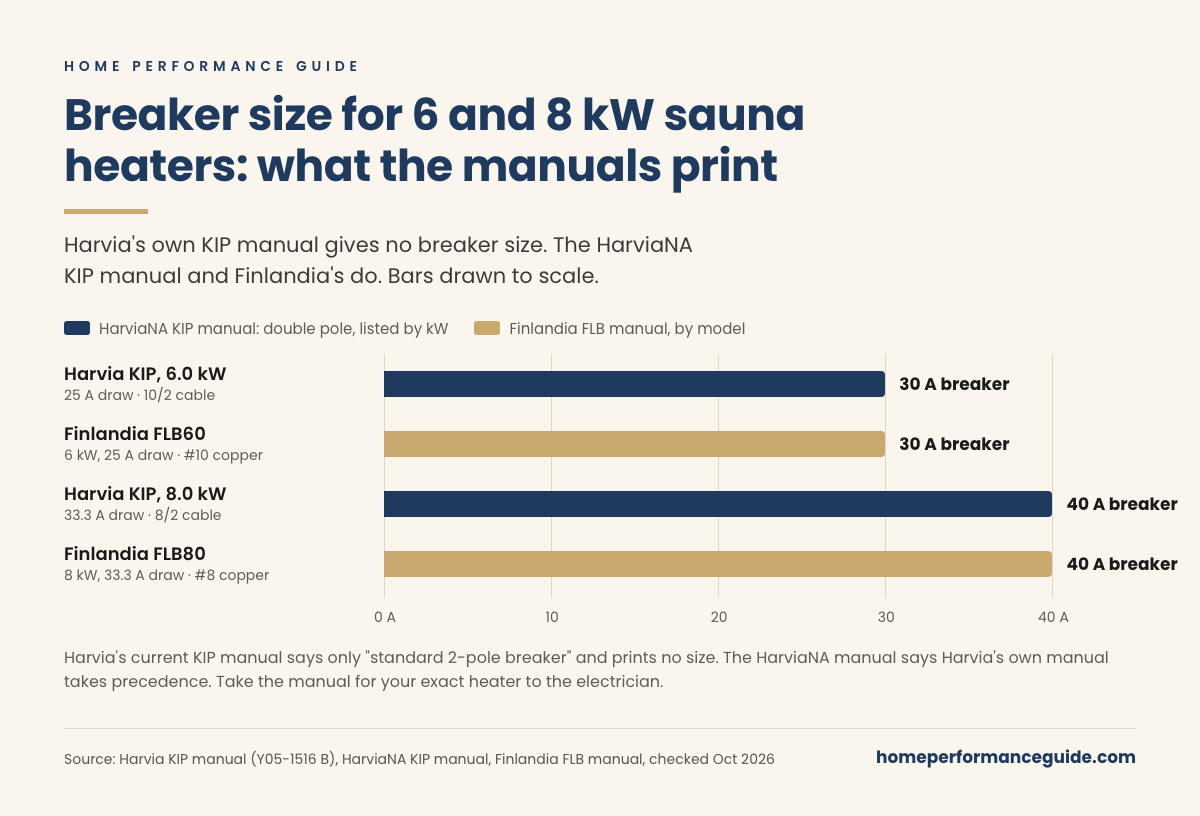
| Harvia KIP60B | 6 kW | 240 VAC, 1 phase, 25.0 A. "Standard 2-pole breaker," no size printed. 10/2 cable |
| Harvia KIP80B | 8 kW | 240 VAC, 1 phase, 33.3 A. "Standard 2-pole breaker," no size printed. 8/2 cable |
| Finlandia FLB60 | 6 kW | 25 A draw. 30 A breaker. #10 copper |
| Finlandia FLB80 | 8 kW | 33.3 A draw. 40 A breaker. #8 copper |
Finlandia publishes a breaker size. Harvia's current KIP manual does not. The current manual (Y05-1516 B) says the heater "must be connected to a standard 2-pole breaker" and stops there.
A separate HarviaNA KIP manual, hosted on Almost Heaven's site, lists a 30-amp double pole breaker for 6.0 kW KIP heaters and a 40-amp one for 8.0 kW. It goes by kW rather than by model, and says the manufacturer's manual takes precedence.
Harvia's own US product pages disagree with each other here. Its older pages for the steel KIP60B and the KIP80B still print a minimum fuse figure ("min. 25A" and "min. 33,4A"), while its current pages for the same heaters print no fuse or breaker size.
Sizing a breaker from a current figure is a job for the electrician. Many online wiring charts quietly do it anyway, which is why you will find three different "required" breaker sizes for the same heater on three different websites.
What this means for you: two independent manufacturers land in the same neighborhood, so the table works as a sanity check on a quote, not as a wiring plan. If you want a breaker size in print before the electrician arrives, Finlandia prints one, and your electrician still checks it against your local code; with a Harvia KIP, the electrician sizes it.
Take the actual manual for your actual model to the electrician, with this list:
- The model, its kW, and its volts, phase and amps, such as the KIP60B's 240 VAC, 1 phase, 25.0 A.
- The breaker the manual names, or a note that it names none.
- The manual's GFCI line, word for word (the GFCI section shows why).
- Permanent wiring or a plug.
- The distance from the panel along the real wire path.
Should you add 125% to the heater's amps?
Not on your own. You will run into sauna guides that multiply the heater's amperage by 125%, call the result the required breaker, and arrive at 40 amps for a 6 kW heater.
The reasoning comes from the National Electrical Code's continuous-load rule: a load whose maximum current is expected to continue for three hours or more carries additional sizing requirements.
The problem is the assumption that every sauna heater qualifies. Harvia states that the KIP-B automatically shuts off after 60 minutes of operation, and Finlandia's FLB documentation describes a 60-minute operating timer as well.
Whether a given heater counts as a continuous load depends on its controls, its duty cycle, its listing, and how your jurisdiction reads the code. Notice also that neither manufacturer publishes a derated number of its own.
For your quote, that means a 40 amp breaker on a 6 kW heater needs a model's document behind it. Finlandia prints a 30 A breaker for its 6 kW FLB60. Leave the breaker size to the manual and your electrician, and set aside any chart, or send back any quote, that gives a number without naming the model.
Does your sauna need a GFCI breaker?
It depends on the exact model and on your local code, which is where blanket internet advice becomes genuinely unsafe. Three real examples from two brands show why.
Finlandia FLB series. The manual specifies a double-pole non-GFCI breaker, and separately warns that a GFI should not be installed because it may trip.
Sun Home Luminar, outdoor. The documentation requires a dedicated GFCI-protected 240V circuit: 20A for the 2-person, 30A for the 5-person.
Sun Home Solstice, indoor. As of September 2026, the product page says the 1- to 3-person models each take a dedicated 120V, 20A circuit and the 4-person requires 240V. It tells buyers to "Include a GFCI or dual-function (AFCI/GFCI) breaker on that circuit and check local code." Sun Home's earlier guidance for this cabin said the opposite: use a standard breaker, because GFCI and AFCI breakers "trip during normal operation."
Three units, and they still do not agree: Finlandia says no GFI, and both Sun Home cabins now call for GFCI protection. Sun Home also reversed its own Solstice instruction, which is the best argument for reading the current manual for your exact model instead of a saved chart.
If the sauna is going in a garage, the garage adds GFCI rules of its own, covered in our guide to putting a sauna in a garage.
For every model we have checked, our sauna heater breaker size and GFCI table quotes each maker's breaker and GFCI wording for 34 heaters and saunas.
Now layer local code on top of that. Rules may require GFCI protection depending on where the sauna sits, how it's wired, and which code edition your jurisdiction has adopted, outdoors in particular. So the equipment instruction and the code requirement can genuinely conflict.
Leave that conflict to your electrician, who reconciles the instructions with the code your jurisdiction enforces. Your inspector has the final word, and a manufacturer's statement doesn't waive code. Raise it early, before the wire is in the wall, because it is not cheap to redo.
What this means for you: the GFCI line can split your shortlist, since Finlandia's FLB manual and Sun Home's current pages point opposite ways. Ask your electrician which one your spot and your local code allow before you order either. If your electrician says the spot needs GFCI protection, the Solstice and Luminar already call for it, while a Finlandia FLB would put its manual and your code at odds.
Is a bigger breaker safer?
No, even though it sounds prudent. If the instructions call for a 30-amp circuit, a 40-amp breaker does not give you margin.
A breaker protects the conductor and the equipment. Put a 40-amp breaker on a circuit wired with 10-gauge conductor and the wire is no longer protected. It can carry more current than it is rated for before the breaker ever trips. Listed equipment also specifies a maximum overcurrent protection rating that cannot simply be exceeded.
Breaker and conductor are sized together, from the manual and the code.
Swap the question "can I put a bigger breaker on it" for "what breaker and conductor combination does this listed equipment require under the code that applies here." That's an electrician's question, and it has one right answer for your installation.
Heavier wire is sometimes correct on a long run to manage voltage drop. That by itself does not justify a bigger breaker.
When you compare quotes, compare the breaker and the wire as a pair. A quote that puts a 40-amp breaker on 10-gauge wire for a heater whose manual calls for 30 amps is the one to send back with questions.
Does a long run from the panel change the breaker?
Usually it changes the wire and leaves the breaker alone, and distance explains why a quote can come back higher than you expected.
Be careful with the rule you'll see on a lot of sauna retailer sites: under 30 feet use 10/2, over 30 feet use 8/2. It circulates widely. We couldn't find it in current manufacturer technical documentation, so treat it as a rule of thumb someone wrote down, not as a specification.
The underlying principle is real: longer runs can require larger conductors to control voltage drop. Code guidance points at roughly 3% on a branch circuit and about 5% combined with the feeder.
That comes from a calculation based on the actual conductor path, load, conductor material and size, and installation method. No universal sauna-specific distance threshold replaces it. Upsizing conductors for voltage drop normally does not require upsizing the breaker, though the full installation governs.
Measure the route the wire would actually take, following joists, around walls, up and over, from the panel to the spot. Not the straight line across your basement. On a long run through finished walls, labor will cost more than the wire.
So when a quote upsizes the wire for a long run, that's voltage drop at work. A bigger breaker on the same quote is the line to ask about.
Can your house take a sauna? Three questions to settle first
Your panel, the run and your local rules decide it, and each one can change the quote.
1. Does the house have the capacity?
Empty breaker spaces don't answer it. A panel can have four open slots and no available service capacity, and you cannot determine what's left by adding up the ratings printed on the existing breakers.
What matters is your service rating against everything already on it. A 100-amp service in an older house may not absorb a large new circuit on top of an air conditioner, an electric range and a dryer. The answer comes from a load calculation. The code has provisions specifically for determining whether an existing service can take an additional load.
A subpanel does not create service capacity. It adds circuit spaces and improves distribution. If the service itself is short on capacity, the remedies are different: load management, changing or removing an existing load, or a service upgrade. Which one applies depends on the calculation.
Those remedies cost very different amounts, which is why you want the calculation before you shop rather than after.
What this means for you: if the calculation comes back short, ask the electrician whether the 1- to 3-person Solstice's dedicated 120V, 20 amp circuit fits what's left, or price the remedy before you order.
2. How hard is the run?
A short route from an unfinished basement panel and a sixty-foot run through finished walls, an attic, a crawlspace or a trench are different projects. Wire is a small part of the cost. Access and labor dominate.
Have a rough idea of the real route before you ask for quotes. It's the first thing they'll ask.
3. What does your jurisdiction require?
Ask whether the installation needs a permit and inspection, and whether there are local requirements around disconnects or GFCI protection. Enforcement varies. The code's own framing recognizes that the authority having jurisdiction might be a building official, an electrical inspector, or a fire marshal.
It's a phone call to your building department, and worth making. Permitted work also leaves you with documentation of the job. Whether the sauna itself needs a building permit is a separate question, covered in our guide to home sauna permits.
Don't assume another homeowner's installation in another state, or even another county, tells you anything about yours.
What will the electrical work cost?
It depends more on your house than on your sauna.
A short run to an accessible panel with capacity to spare is the cheap case. Long concealed runs, trenching to an outdoor unit, a subpanel, or a service upgrade move it up by multiples. A service upgrade in particular is a four-figure line item that has nothing to do with the sauna itself.
None of that appears on the product page, which makes wiring one of the easiest costs to overlook on a home sauna.
Get site-specific quotes before you order equipment. National averages are close to useless here, because the variance is driven by your panel and your floor plan rather than by the market.
Even one maker's own numbers disagree. As of October 12, 2026, SaunaCloud's pages give three different figures for the electrician, the lowest $200 to $800 and the highest $500 to $1,500. Our guide to custom infrared sauna cost lines all three up.
Ask each electrician to quote from the same things: your model's manual, the measured route and a photo of your panel.
Which sauna to get once the electrical side is settled
The one whose manual matches the circuit your electrician says your house can take.
Picture an April morning before sunrise, with the rest of the house still asleep. The steel KIP60B is in place in the room you measured, and the new 2-pole breaker has its label in the panel. You hang your towel by the door and settle onto the bench.
Each card below is one route. The picks after them match each route to a circuit.
SaunaKits.com
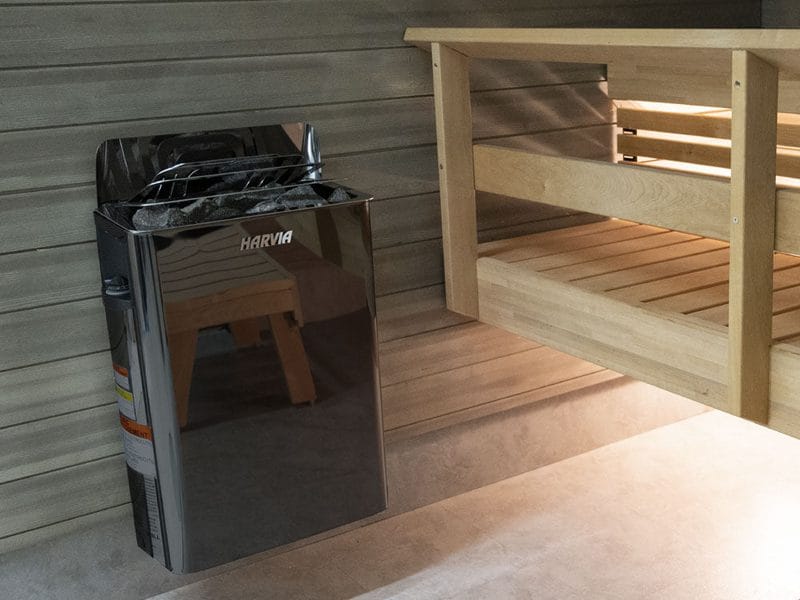
Carries traditional sauna kits and electric heaters, including the Harvia and Finlandia equipment cited above. Good starting point if you want a cut-to-fit kit rather than a prebuilt cabin. Download the installation manual for the exact heater before you call an electrician.
Browse heaters and kits at SaunaKitsFinancing through Shop Pay Installments (Affirm's lenders), 0–36% APR if approved. HSA/FSA through Truemed, which needs a Letter of Medical Necessity.
Sun Home Saunas
Builds prebuilt infrared and traditional cabins if you'd rather buy finished than assemble. Read the electrical specification for the specific model closely. As the examples above show, Sun Home's own lineup spans 120V/20A, 240V/20A and 240V/30A, and its Nova 6 traditional cabin adds a "Dedicated 240V / 40A circuit," per its spec sheet. Its models also disagree with each other about GFCI. That isn't a criticism of the brand. It's the clearest illustration in this article of why the model manual beats any generic wiring chart.
See Sun Home's saunasAffirm at checkout; Sun Home doesn't publish Affirm's rates or terms. HSA/FSA through TrueMed after a short health survey.
SaunaCloud
Builds custom infrared saunas to your room's dimensions. A custom design has no off-the-shelf spec sheet, so get the electrical requirement for the exact design in writing before your electrician quotes the job.
See how SaunaCloud buildsFinancing on approved credit, per SaunaCloud; the lender isn't named.
Harvia KIP60B at SaunaKits: a traditional room on a dedicated 240V circuit
Get the KIP60B if Harvia's calculator, with your glass entered, puts your room at 6 kW. Harvia lists it at 240 VAC, 1 phase, 25.0 A on 10/2 cable, for 170–300 ft³. For a larger or glassier room, the 8 kW KIP80B draws 33.3 A on 8/2 cable.
- Best for: a traditional room on a dedicated 240V circuit with permanent wiring.
- Skip it if: the most your panel can take is a 120V circuit.
- Main compromise: Harvia's current KIP manual names no breaker size, so the size comes from your electrician.
Confirm before you order: Harvia's older page for the steel KIP60B prints a minimum fuse figure ("min. 25A"), and the HarviaNA KIP manual lists a 30-amp double pole breaker for 6.0 kW. The current manual names no size. Use the 30-amp figure, which Finlandia also prints for its 6 kW FLB60, as the sanity check on your electrician's quote, and ask Harvia in writing which breaker it requires.
If it won't say, Finlandia's FLB60, which SaunaKits also carries, prints a 30 A breaker and #10 copper; its manual calls for a non-GFCI breaker, so check that against your local code.
With Harvia's answer, your load calculation and the permit question settled, the KIP60B is ready to order.
See the Harvia KIP60B at SaunaKits
Sun Home Solstice: a finished indoor cabin on a dedicated 120V, 20 amp circuit
Start with the 1- to 3-person Solstice if you'd rather buy a finished cabin than build a room. Its product page puts each of those sizes on a dedicated 120V, 20A circuit, the smallest circuit in this guide: a finished cabin with seats for up to three, and no 240V line to run.
- Best for: one to three people who want a finished indoor cabin without a 240V line.
- Skip it if: you want four seats on 120V; the 4-person Solstice runs on 240V.
- Main compromise: Sun Home reversed its own Solstice GFCI instruction, so check which breaker the current manual names.
Confirm before you order: the current Solstice page calls for a GFCI or dual-function (AFCI/GFCI) breaker, while Sun Home's earlier guidance said those breakers "trip during normal operation." Plan on the current page's GFCI line and ask Sun Home in writing which breaker the current manual for your size names. If it won't answer in writing, hold the order until your electrician has that manual.
With that answer, your load calculation and the permit question settled, order the Solstice.
SaunaCloud: a custom infrared sauna for a room no cabin fits
Choose SaunaCloud when no standard cabin fits the room. It builds custom infrared saunas to your room's dimensions, so the room you have sets the shape of the sauna.
- Best for: a room whose dimensions no standard cabin matches.
- Skip it if: a standard cabin fits and a dedicated 120V, 20 amp circuit is what you have; the 1- to 3-person Solstice is built for that.
- Main compromise: there's no off-the-shelf electrical spec, so the quote waits on SaunaCloud's written requirement for your design.
Once that written requirement fits the circuit your load calculation allows, the design is ready to go ahead.
Shopping for a backyard sauna instead? Our outdoor sauna comparison lines up seven barrels and cabins with the power each maker lists, so you can match a model to the circuit you have.
Before you pay: one question for your pick's maker
Send it in writing, and keep the answer with your electrician's quote:
- Harvia: What breaker size do you require for the KIP60B, or the KIP80B, on a 240V, single-phase circuit?
- Sun Home: Which breaker does the current manual for each Solstice size call for: GFCI, dual-function (AFCI/GFCI), or standard?
- SaunaCloud: What circuit does this exact design need, in volts, amps, breaker size and GFCI protection?
Before you order
Do these in order:
- Measure the space. Length, width, ceiling height, and the distance from the panel along the real wire path.
- Identify the glass and any other uninsulated surfaces that affect heater sizing.
- Use the manufacturer's sizing tool or published volume range to narrow the heater family.
- Choose the specific model. The picks above match each route to a circuit. For a traditional room, browse heaters and kits at SaunaKits.
- Download the actual installation manual, not the product page, and ask the seller for it if it isn't posted. Send the maker its question from the list above, too.
- Have an electrician walk the room with that manual in hand, plus the hand-over list from the heater-manual section.
- Confirm permit and inspection requirements with your building department.
- Then buy the model that passed, with the manual, the quote and the written answer in hand. For a finished 120V, 20 amp cabin, see Sun Home's saunas.
Step six is the cheapest hour you'll spend on this project. In one visit, an electrician can tell you whether your panel supports what you want and whether the run is straightforward, and can flag a GFCI conflict before it's in the wall.
Planning a cold plunge, a hyperbaric chamber or a red light panel for the same room? Our guides to cold plunge electrical requirements and hyperbaric chamber electrical requirements run the same maker-by-maker check, and home hyperbaric chamber cost lists what the makers charge. For the panel's own draw, our guide to full body red light panels sets out what each maker publishes, with the amps at 120 volts. Mounting is the harder part of adding the light, covered in what it takes to actually hang a red light panel.
Your next step
Tonight, open the panel door (leave the cover on) and photograph the breakers and the label, then run a tape along the path the wire would take.
Wiring answers one of about a dozen questions about whether a room can take a sauna at all. The rest cover ceiling height, floor construction, ventilation, drainage, access clearances and whether the crate can physically get down your stairs.
Our free planner turns that list into thirteen numbers to measure before you shop, each with the manufacturer specs and code references behind it.
Get the free Home Performance Room Planner →
We read Harvia's KIP manual and US product pages, the HarviaNA KIP manual, Finlandia's FLB manual and Sun Home's Luminar, Solstice and Nova 6 specifications in September and October 2026, and did not test these saunas. This is general information, not electrical, code or medical advice. Follow your model's installation manual, and have a licensed electrician do the work to your local code. Home Performance Guide earns a commission on some links here if you buy (SaunaKits, Sun Home, SaunaCloud), at no extra cost to you (affiliate disclosure, editorial standards).
Get the Room Planner.
Thirteen measurements to take before you buy sauna or recovery equipment, with the manufacturer specs and code references behind each one. Free. Planning a golf simulator instead? There is a twelve-measurement golf planner too.
ABOUT
Verified buyer guides for home sauna, cold plunge and recovery equipment. Specs from the manufacturers, not from other blogs.