What Size Sauna Heater Do You Actually Need?
By Evan Reid, with research from the HPG Research Team · Updated Oct. 4, 2026
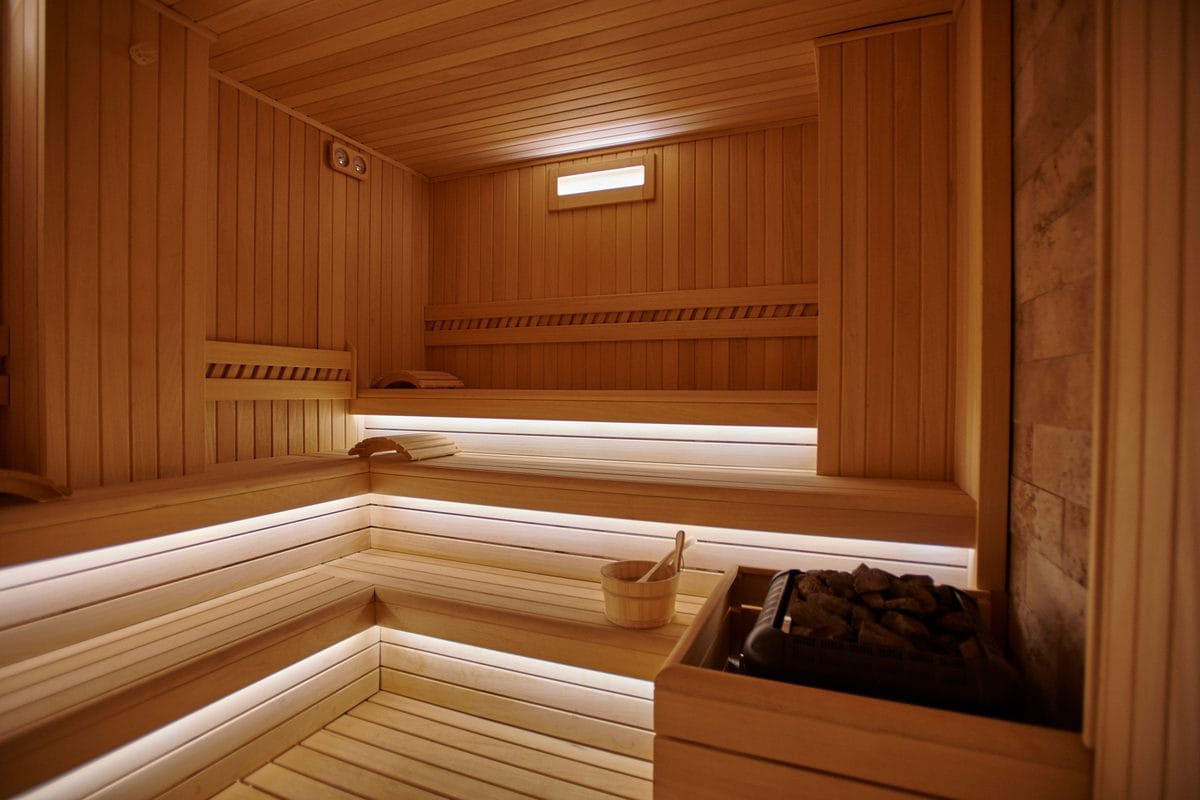
Water ladled over hot stones in your own sauna is what all this measuring is for. Heater makers answer what size sauna heater a room needs with one number: its volume in cubic feet.
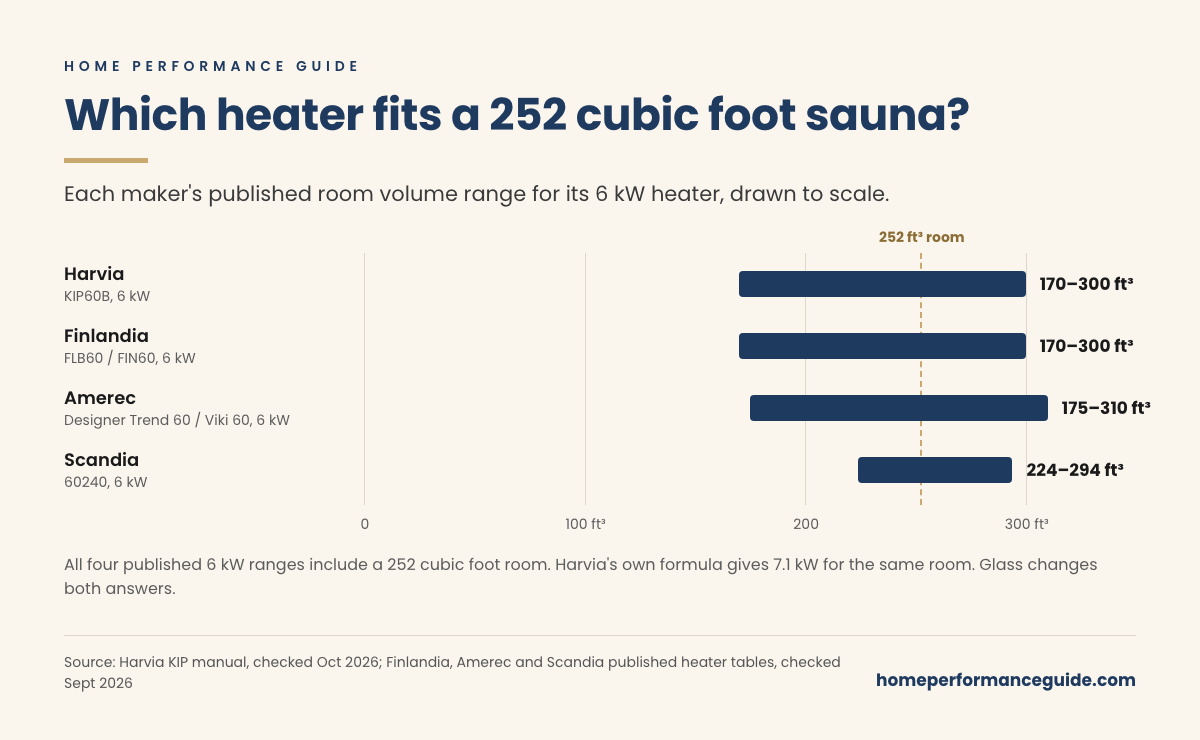
Take a common home size, six feet wide, six feet deep and seven feet high: 252 cubic feet. Four makers' own tables put that room on a 6 kW heater. Start with the Harvia KIP60B, whose manual gives it a range of 170 to 300 cubic feet.
Harvia's own formula sizes the same room at 7.1 kW, which means buying an 8 kW heater. Add one ordinary glass door and every glass correction Harvia and HUUM publish points at 9 kW, so measure the glass before you choose a model.
In September 2026, we read what six heater makers publish, from product pages and catalogs to sizing guidance and installation manuals, and we re-checked Harvia's KIP manuals in October.
- Your room is well built, with a solid door, no glass and no stone, tile or log walls: a 6 kW heater whose range puts your room near its middle. Around 252 cubic feet, get the Harvia KIP60B once Harvia confirms its breaker size (its current manual names none), or Finlandia's FLB60, whose documents print a 30 A breaker, for the same 170 to 300 cubic foot range.
- Your room has a glass door or window: size it with the heater maker's own calculator and your glass area. Compare heaters at SaunaKits
- You'd rather not size a heater at all: a prebuilt infrared cabin from Sun Home, matched to its heater at the factory, though infrared cabins bring their own electrical considerations. See Sun Home's saunas
Below: the room's volume and glass first, then the circuit, then which heater to get.
What size sauna heater does a 252 cubic foot room need?
For a well-built room with no glass, a 6 kW heater, on four makers' independently published ranges, though Harvia's own formula points to 8 kW.
Most heater makers publish a room volume range for each model. Find the model whose range contains your room and you have a defensible answer, one the manufacturer stands behind and one a warranty claim would be judged against.
Read down the third column: every maker's 6 kW range holds 252 cubic feet.
| Manufacturer | Model | Published volume range | Output |
|---|---|---|---|
| Finlandia | FLB60 / FIN60 | 170–300 ft³ | 6 kW |
| Amerec | Designer Trend 60 / Viki 60 | 175–310 ft³ | 6 kW |
| Scandia | 60240 | 224–294 ft³ | 6 kW |
| Harvia | KIP60B | 170–300 ft³ | 6 kW |
Now hold that against the formulas. Harvia's support site publishes one kilowatt per cubic meter, which works out to 35.3 cubic feet per kilowatt. Run this room through it and you get 7.1 kW. HUUM publishes the same ratio, roughly 35 cubic feet per kilowatt, and lands in the same place.
Harvia's range and Harvia's formula disagree about the same room by a full model size.
Checkpoint: the room's volume and its uninsulated surfaces. Multiply width, depth and height, and count every glass door and window plus any stone, concrete, tile or log surface. A well-built room with a solid door, none of those and a volume near the middle of a 6 kW range keeps the KIP60B and the FLB60 on your list. With any of them, run the glass sections below first; for a log sauna, Harvia's KIP manual says to multiply the volume by 1.5.
Why do the ranges and the formulas disagree?
A published range is wide on purpose. It has to cover a well-insulated room with a solid door and a poorly insulated one with a wall of glass, because the manufacturer can't see your room.
Work out the cubic feet per kilowatt at the top of Finlandia's ranges and the number drifts: 43.3 for the FLB30, 46.7 for the FLB45, 50.0 for the FLB60, 53.1 for the FLB80. The ratio changes from model to model, so it can't be a sizing constant. Each figure marks the upper edge of what that model can do under favorable conditions.
Harvia addresses this directly in its own sizing guidance. It tells you to choose a heater near the midpoint of its stated range rather than at the extremes, and warns that an undersized heater has to run longer and harder, which shortens its life.
What this means for you: buy the model whose range puts your room near its middle. That's also the answer, on Harvia's guidance, if you're tempted to size up to 8 kW to be safe. The 252 cubic foot room sits a little above the KIP60B's midpoint, a reasonable place for a well-built room with an ordinary door. Near the top of a range, compare the next model's range too, since that's the extreme Harvia warns against.
Does the 1 kW per 50 cubic feet rule hold up?
Only with its second half, the instruction to round up. Search for heater sizing and you'll be told, again and again, that you need 1 kW for every 50 cubic feet.
The popular claim that no manufacturer publishes it is wrong. Saunacore publishes it. Its own product catalog, on its own domain, gives the instruction outright:
Divide the CUBIC FOOTAGE BY 50 = Kilowatts Required
And its entire sizing table is exactly that arithmetic at every row: 2 kW for 100 cubic feet, 3 for 150, 4 for 200, 5 for 250, 6 for 300. The rows go on from there in a straight line.
So one manufacturer does stand behind the rule, and Saunacore is the outlier. Harvia and HUUM both publish roughly 35 cubic feet per kilowatt. The 50 figure is about 42 percent more generous than that, and it matches only the very top of the other manufacturers' ranges, which is precisely where Harvia tells you not to buy.
Saunacore's instruction also has a second half that the blogs quoting the rule almost universally drop:
Select the next size of Saunacore model stove which exceeds the calculated room cubic feet
In other words, round up. Run our room through the full Saunacore method and you get 252 ÷ 50 = 5.04, then round up to the 6 kW model, the same answer the other makers' ranges give.
Trouble starts when the rounding instruction is dropped, which is the version that gets passed around. If a chart quotes 50 cubic feet per kilowatt, round up to the next model and check it against your heater's own range.
Do Harvia and Finlandia really use 1 kW per 45 to 50 cubic feet?
No, and you can check it yourself in about ninety seconds. One guide that ranks high for this question states that the standard formula is 1 kW per 45 to 50 cubic feet of well-insulated sauna space. It then says Harvia and Finlandia follow that standard.
Harvia's own support page publishes 1 kW per cubic meter, which is 35.3 cubic feet. That's roughly 27 to 42 percent more conservative than the figure being credited to it.
Finlandia publishes no ratio at all on any page we could read, only model-by-model volume ranges.
Neither company publishes the standard attributed to them. So when a sizing guide names a manufacturer, check what that manufacturer published, and size from the documents of the heater you're buying.
How much does glass change the answer?
Enough to need a bigger heater: a glass door or window behaves thermally like a much larger room. Both manufacturers who publish a correction handle it the same way, by adding equivalent volume rather than by telling you to add wattage.
Harvia:
One square meter of stone, glass or similar non-insulated surface increases the heater power requirement as much as if the sauna room volume were increased by 1.2 cubic meters.
For a log sauna, Harvia's KIP manual says to multiply the room's cubic volume by 1.5.
HUUM publishes 1.0 cubic meter per square meter in its sizing article and in its European DROP manual, stated in imperial as 3.3 cubic feet per square foot.
So the two manufacturers who publish a number don't agree with each other. On a sauna with a full glass door and a window, roughly 3 square meters, Harvia adds 3.6 cubic meters and HUUM adds 3.0. At a kilowatt per cubic meter that's most of a kilowatt of disagreement, enough to change the model you buy.
HUUM also doesn't agree with itself. Its US DROP manual, the document a US DROP buyer reads, says this instead:
an additional calculated volume of 53 ft³ (1.5 m³) should be added to the sauna room for each such square meter of the wall
That's 1.5 cubic meters per square meter, 50 percent higher than the figure the same company publishes in its sizing article and in the European version of the same manual. Only the US document is the outlier.
Confirm before you order: use the coefficient published by the manufacturer of the heater you're buying, from the most recent document you can get directly from them. Don't average them, and don't take a glass adder from a blog. For a HUUM DROP in the US, plan on the US manual's 1.5, the stricter figure, until HUUM answers in writing which applies.
In a 252 cubic foot room with one ordinary glass door, the answer won't change your heater: all three coefficients land on 9 kW (next section).
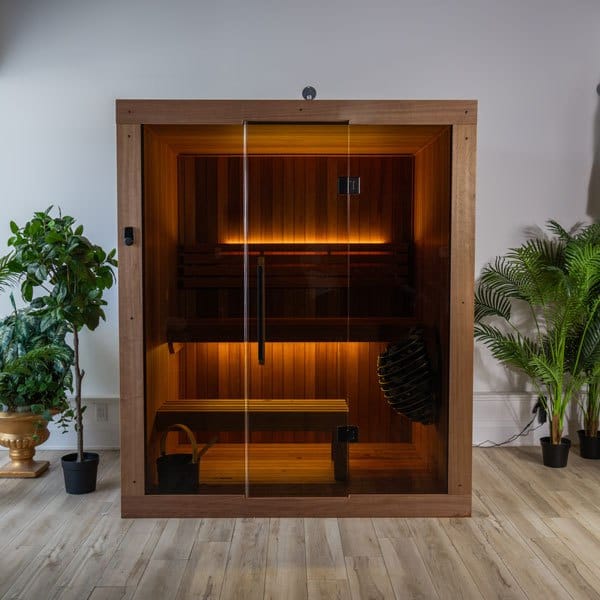
For a cabin with a full glass front, like the Dundalk CT Element Studio pictured below, get the total glass area from the seller in writing.
What size sauna heater do you need with a glass door?
For the 252 cubic foot room with one glass door, a 9 kW heater, on all three of Harvia's and HUUM's published glass methods. A standard sauna glass door is roughly 14 square feet, about 1.3 square meters.
Read the last column for the heater each method buys.
| Method | Arithmetic | Result | What you buy |
|---|---|---|---|
| Harvia's formula and coefficient | 7.14 + 1.56 | 8.7 kW | 9 kW |
| HUUM's sizing article coefficient | 7.14 + 1.30 | 8.4 kW | 9 kW |
| HUUM's US DROP manual coefficient | 7.14 + 1.95 | 9.1 kW | 9 kW |
Without glass, the published model ranges pointed at 6 kW and the formulas pointed at 8. Add one ordinary glass door and the same formulas point at 9.
That's a real and expensive fork, and it's the strongest argument for using the manufacturer's own calculator with your actual glass area rather than any shortcut. Harvia and HUUM both publish one, and both ask specifically for uninsulated surface area. That field exists because of exactly this problem.
What this means for you: at around 252 cubic feet with one glass door, shop 9 kW models and confirm the size in the maker's calculator. The circuit rows in the next section are for 6 kW heaters, so your electrician works from the 9 kW model's own manual. SaunaKits carries both Harvia and Finlandia heaters.
What circuit will your sauna heater need?
The circuit follows the heater, and your electrician sizes the breaker from the manual for your exact model, which takes careful reading because makers don't label protection the same way. At 240 volts, the 6 kW heaters below draw 25.0 amps.
Find your heater's maker, then read across to the protection and conductor columns.
| Manufacturer | 6 kW model | Voltage | Draw | Published protection | Conductor |
|---|---|---|---|---|---|
| Finlandia | FLB60 | 240 V | 25.0 A | 30 A breaker | (2) #10 + ground, 90 °C copper |
| Harvia | KIP60B | 240 V | 25.0 A | Manual: "standard 2-pole breaker," no size. Older product page: "Fuse … min. 25A" | 10/2 |
| HUUM | DROP 6 | 240 V | 25.0 A | 30 A circuit breaker | 10 AWG |
| Scandia | 60 series | 208 V | 28.9 A | 40 A circuit breaker | 3 × #8 |
Read the Scandia row carefully: it's the 208 volt configuration. Scandia's sizing table lists model 60240 at 240 volts and 25 amps, but the only Series 60 wiring row in its installation document is the 208 volt one. At 28.9 amps, a 40 amp breaker with 8-gauge conductor is the ordinary result, so the row agrees with the others once the voltage is accounted for. If you're running 240 volts, Scandia's published wiring row doesn't cover you, so ask Scandia in writing which row does.
Two Harvia details matter if a KIP heater is your pick.
Harvia's current KIP manual (Y05-1516 B) prints no breaker size. It says the heater "must be connected to a standard 2-pole breaker" and gives the current, 25.0 amps for the KIP60B. A separate HarviaNA KIP manual on Almost Heaven's site lists a 30-amp double pole breaker for 6.0 kW KIP heaters, by kW rather than by model, and says the manufacturer's manual takes precedence.
Harvia's own product pages disagree. Its older US page for the 8 kW KIP80B still reads "Fuse … min. 33,4A." That's the 33.3 amp draw (8,000 watts divided by 240 volts) under a protection heading, and 33.4 amps isn't a breaker you can buy.
Harvia's current KIP80B page prints no fuse or breaker figure, and its KIP manual prints none either. Turning a current figure into a breaker size is a job for the electrician, working from the manual for your exact heater.
Confirm before you order: if the KIP60B is your heater, ask Harvia in writing which breaker it calls for, and hand your electrician both KIP manuals with the 25.0 amp draw. If Harvia won't put a size in writing, consider a heater whose own documents print one, such as Finlandia's FLB60 (30 A), rather than applying another maker's figure to the KIP60B. Once Harvia answers and your electrician has signed off on the circuit, the KIP60B is ready to order.
Does a sauna heater need a GFCI breaker?
Three makers advise against one in writing, though your local code may require it. Finlandia states it plainly:
Breaker must be double pole non-GFCI.
It also specifies 90 °C copper wire.
HUUM's US DROP manual takes the same position in different words, recommending that the unit be connected without an earth-leakage circuit breaker.
Harvia's KIP manual is just as direct: "Do not use a ground fault circuit interrupter (GFCI)."
Our sauna heater breaker size and GFCI table lists each heater's breaker size and GFCI wording, model by model, from the makers' own manuals.
Scandia, Saunacore and Amerec say nothing about ground-fault protection in either direction.
That silence isn't permission. Your local code may require what these manufacturers discourage, and that conflict gets resolved by your electrician and your inspector, working from the manual for the model you bought. Raise it before the wire is in the wall, and if your inspector requires ground-fault protection, ask the heater maker in writing how it wants the circuit protected.
What to confirm with the maker before you order
Not every manufacturer publishes enough to plan from, and where a figure can't be traced to a maker's document, this guide says so.
Saunacore publishes a single cubic foot figure per model rather than a range, and no breaker rating, no wire temperature rating, no GFCI statement and no timer specification anywhere in its catalog.
If a Saunacore heater is on your list, get those answers from Saunacore in writing before you order (question 5 below).
Amerec publishes volume ranges and amperage but no breaker rating, no wire size and no GFCI statement in the material still reachable. Amerec's site now states that Amerec Sauna is Helo Sauna and that its products are available through that sister brand, and its download library carries steam documentation only. If you're considering Amerec, get documentation in writing from the seller before you order.
Harvia's US catalog lists both US and European models. Some Vega pages, such as the one for the Vega BC60, sit on the en-US site but publish 400 volt three-phase specifications, millimeter-squared cable sizes and fuse ratings. Other Harvia models on the same site, including the older KIP 240 volt pages, publish AWG figures (10AWG for the KIP60B, 8AWG for the KIP80B), and Harvia's KIP manual gives 10/2 and 8/2. The practical test is simple: if the page is showing you millimeters, that page wasn't written for your installation.
Send these to the maker of the heater you're buying, and keep the answers with its manual.
- Harvia, for a KIP60B: Which breaker size does the KIP60B need? The current KIP manual says only "standard 2-pole breaker."
- HUUM, for a DROP in the US: Which glass coefficient applies, the 1.0 cubic meter per square meter in your sizing article and European manual, or the US manual's 1.5?
- Finlandia, for an FLB60 in a room with glass: How should the glass area be counted when sizing this heater?
- Scandia, for a Series 60 on 240 volts: Which wiring row and breaker cover 240 volt operation?
- Saunacore, Amerec or Helo: What breaker rating, wire size and GFCI statement apply to this model?
- Any maker, if your inspector requires GFCI: How should this heater's circuit be protected where local code requires ground-fault protection?
- The seller of a glass-front cabin: What is the cabin's total glass area in square feet?
Which sauna heater to get once you know your kW
Get the heater whose maker's range holds your room near its middle, glass counted in.
The sauna is finished, and the first week of December brings the early dark. The 6 kW heater hangs on the wall of the room you measured at 252 cubic feet, wired to the 240 volt circuit its manual calls for. You pull the solid door shut behind you and ladle the first water over the stones.
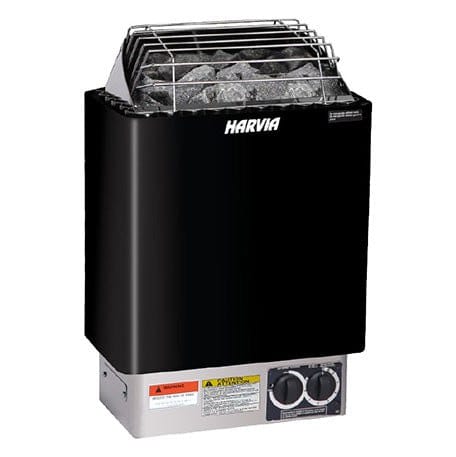
Harvia KIP60B: a 6 kW heater for a solid-door room around 252 cubic feet
For a well-built, solid-door room around 252 cubic feet, one of the most common home sauna sizes there is, the KIP60B is our pick. Harvia's KIP manual gives it a range of 170 to 300 cubic feet, which puts that room a little above the midpoint, near where Harvia's guidance says to aim. It runs on 240 volts at 25.0 amps with 10/2 wire, and the manual says not to use a GFCI. Harvia's sizing calculator lets you check your exact room in the maker's own tool.
- Best for: a well-built room near the middle of the KIP60B's 170 to 300 cubic foot range, with an ordinary door, no glass and no stone, tile or log walls.
- Skip it if: your room has a glass door; in the 252 cubic foot example, one glass door takes it to 9 kW.
- Main compromise: Harvia's own formula puts the 252 cubic foot room at 7.1 kW, an 8 kW heater, so you're buying on Harvia's range rather than its formula.
Its current manual names no breaker size, while the HarviaNA KIP manual lists a 30-amp double pole breaker for 6.0 kW KIP heaters. Once Harvia answers in writing (question 1 above) and your electrician signs off on the circuit, it's the one to order.
Check today's KIP60B price at SaunaKits
Finlandia FLB60: the same 6 kW range, with the breaker in print
Finlandia lists the FLB60 at 170 to 300 cubic feet, the same range as the KIP60B, so a 252 cubic foot room sits at the same spot in it. Its own documents print the breaker size Harvia's current manual leaves out, 30 A, along with (2) #10 + ground in 90 °C copper and a breaker that "must be double pole non-GFCI."
- Best for: a solid-door room near the middle of its 170 to 300 cubic foot range, when you want the breaker size in the maker's own document before the electrician quotes.
- Skip it if: your room has glass and Finlandia won't say in writing how to size for it; it publishes no glass correction on the pages we read.
- Main compromise: Finlandia publishes no sizing ratio on any page we read, only model-by-model ranges.
To order it, ask SaunaKits, which carries Finlandia heaters (its card is below), whether it stocks the FLB60, and get the installation manual with the quote.
Where to order: SaunaKits for the heater, Sun Home for a ready-made cabin
SaunaKits carries the Harvia and Finlandia families compared above, so it's where to price the KIP60B against Finlandia's line, or to compare both families for a glass-door room. If you'd rather not size a heater at all, Sun Home's prebuilt infrared cabins come matched to their heaters at the factory. Each card below notes the financing its seller offers.
SaunaKits.com
Carries Harvia and Finlandia heaters along with cut-to-fit kits, which makes it a reasonable place to compare the two families cited above side by side. Download the installation manual for the exact model before you call an electrician.
Compare heaters at SaunaKitsFinancing through Shop Pay Installments (Affirm's lenders), 0–36% APR if approved. HSA/FSA through Truemed, which needs a Letter of Medical Necessity.
Sun Home Saunas
Builds prebuilt infrared and traditional cabins if you would rather not size a heater at all. Infrared cabins skip this question entirely, since the heater and the cabin are matched at the factory, though they bring their own electrical considerations.
See Sun Home's saunasAffirm at checkout; Sun Home doesn't publish Affirm's rates or terms. HSA/FSA through TrueMed after a short health survey.
For a backyard sauna
If the sauna will sit outdoors, our outdoor sauna comparison covers seven backyard barrels and cabins and the power each maker lists, from wood-burning options to the 6 kW Harvia included with the SunRay Cayman.
If the sauna will be its own backyard building, the building permit is a separate question, covered in our guide to home sauna permits.
Before you order
- Measure the room. Width, depth, height. Multiply for cubic feet.
- Measure the glass and any stone, concrete, tile or uninsulated log surface, in square feet.
- Pick the heater family, then use that manufacturer's own calculator or published range. Harvia and HUUM both have one.
- Aim for the middle of the range, not the top. Harvia says so in its own guidance, and the top of the range is where the loose version of the rule of thumb lands you.
- Download the installation manual for the exact model, not the product page.
- Give that manual to an electrician before you order anything. Our guide to what electrical work a home sauna actually requires covers breaker size, wire gauge, GFCI and the permit questions to settle first.
- Send the questions above to your heater's maker, and get the answers in writing.
- Then buy. For a well-built, solid-door room around 252 cubic feet with no glass, stone or log walls, get the KIP60B once Harvia answers on the breaker: See the Harvia KIP60B at SaunaKits. With a glass door, shop 9 kW models instead, sized with the glass counted in.
The whole difference between a project that goes smoothly and one that stalls is whether step six happens before or after the heater is sitting in your garage.
Your next step
Tonight, take the room's width, depth and height, and measure every glass door and window, and any stone, tile or log wall, in square feet. Photograph your electrical panel for the electrician.
The heater is one decision among about a dozen that settle whether this room will work as a sauna. Panel capacity, drainage, ventilation, access clearances, floor construction and ceiling height make up the rest.
All of them fit on one free planner: thirteen measurements to make before you shop, and for each, the manufacturer specs and code references it rests on.
Get the free Home Performance Room Planner →
We read the makers' own documents cited above, checked September and October 2026, and did not test these heaters or saunas. This is general information, not electrical, code or medical advice. Confirm your model's details with the maker, and have a licensed electrician do the wiring to the installation instructions and local code. Home Performance Guide earns a commission on some links here, at no extra cost to you (affiliate disclosure, editorial standards).
Get the Room Planner.
Thirteen measurements to take before you buy sauna or recovery equipment, with the manufacturer specs and code references behind each one. Free. Planning a golf simulator instead? There is a twelve-measurement golf planner too.
ABOUT
Verified buyer guides for home sauna, cold plunge and recovery equipment. Specs from the manufacturers, not from other blogs.