Can You Put a Sauna in a Garage? What the Manufacturers and the Code Actually Say
By Evan Reid, with research from the HPG Research Team · Updated Oct. 4, 2026
Your garage already gives a sauna a roof overhead and a slab underfoot. Finlandia and Scandia list garages among "ideal places for Saunas," so several makers say yes to a sauna in a garage.
For a garage you heat, start with a plug-in cabin whose documents call for GFCI, the ground-fault protection the code requires on garage outlets. Sunlighten's Signature and Clearlight's Sanctuary do, as do Sun Home's current Equinox and Solstice pages. Sun Home's earlier guidance said GFCI and AFCI breakers "trip during normal operation," so go by the current page and get its answer in writing. See Sun Home's saunas
For an unheated garage, Golden Designs recommends against using its Dynamic DYN-6996-01 cabin below 60°F, while Sunlighten allows one with more warm-up time.
In September 2026, we read nine makers' manuals, product pages and FAQs, plus the code sections and four local permit pages for a garage build.
Quick picks for your garage:
- Your garage stays heated through winter: Sun Home's Equinox or Solstice once Sun Home confirms its breaker in writing, or Clearlight's Sanctuary.
- Your garage stays unheated through winter: a Sunlighten cabin such as the Signature. Sunlighten allows an unheated garage with more warm-up time, and the Signature's documents call for GFCI.
- You want a traditional sauna with a hardwired heater: a Harvia or Finlandia heater from SaunaKits, once your inspector confirms NEC 210.8(F) doesn't reach the heater circuit, since both manuals say no GFCI. Browse heaters and kits at SaunaKits
- No standard cabin fits your bay: a custom infrared sauna from SaunaCloud. Start a free 3D design at SaunaCloud
- Skip for a GFCI-protected garage receptacle: the Almost Heaven Harmony, whose manual says GFCI "is not recommended."
Which sauna makers say a garage is fine?
All six makers below accept a garage, several with conditions you'll find in the second column.
| Manufacturer | What its own documents say about garages |
|---|---|
| Finlandia | Lists "garages" among "ideal places for Saunas." Needs "an easy to clean waterproof floor" and a 220/240V hookup for the heater. |
| Scandia | The same sentence as Finlandia, word for word. |
| Clearlight | "Garage, basement, attic, playroom, bedroom, or garden house are just a few of the possible locations for your sauna." |
| Sunlighten | "If your sauna is outside in an unheated garage... you may require additional time to warm the sauna up." |
| Almost Heaven | Its flooring guide calls a garage slab "almost as easy as it gets" for an indoor sauna. Its barrel manual warns that "many garage, basement or deck floors are sloped for drainage." |
| Sun Home | "A garage can provide useful space for a home sauna, but it is not automatically installation-ready." |
That last line is the most useful one we found in any maker's material. Sun Home's garage guide goes on to name the checks: climate control, moisture, slab condition, ceiling height, electrical service and permits.
One retailer's guide says the opposite: garages "can handle fluctuating air and temperature, so you don't have to worry about air exchange and humidity control." The makers' own manuals and the residential code don't support the "don't worry" part.
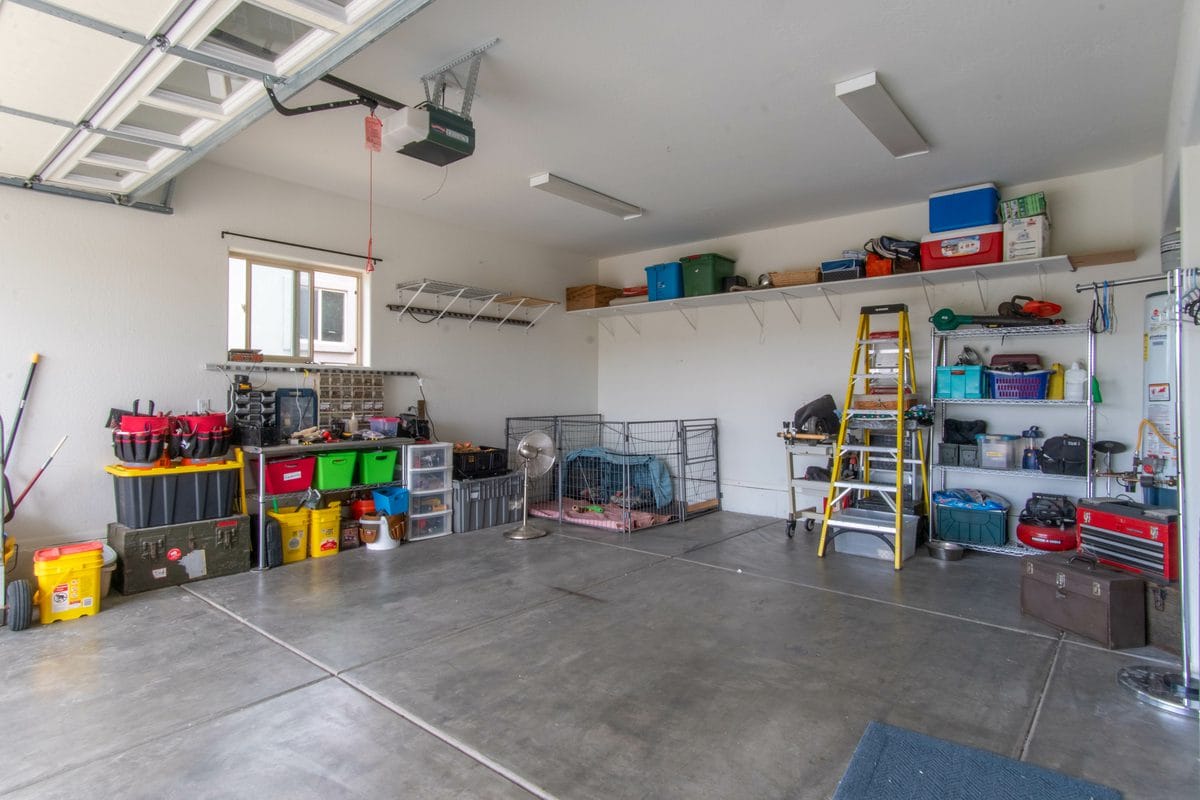
How cold is too cold for a sauna in a garage?
For at least one cabin, anything below 60°F, and for Sun Home's Eclipse, any room that isn't temperature-controlled. Every maker that mentions cold says a colder room means a longer heat-up.
- Golden Designs, in the manual for its Dynamic DYN-6996-01 infrared cabin: "If the ambient temperature is below 68°F/20°C, the sauna will take longer to pre-heat. It is not recommended to use the sauna in an environment with an ambient temperature below 60°F/16°C."
- Scandia sizes its electric heaters on the assumption that the room starts at 60°F: "The maximum room sized is based on the heater bringing the room temperature from 60 to 180 in 60 minutes."
- Sun Home's Eclipse indoor manual says "Installation in a temperature-controlled room with sufficient ventilation is necessary for proper functioning and user safety."
- Sunlighten allows an unheated garage, with more warm-up time.
- Harvia's KIP manual says to let the sauna heat for 30 to 60 minutes. The HarviaNA KIP manual on Almost Heaven's site gives 45 to 60 minutes to reach 170°F, "although this timeframe can be longer depending on the ambient temperature outdoors."
An unheated garage below 60°F falls outside the first three: it passes as a location, and its winter cold is the problem.
Sun Home's insulation guide says that when a garage drops to 30°F, "the 'load' on the sauna is doubled." The arithmetic is smaller than that. Heat loss through the walls rises with the temperature difference. Assuming a 160°F cabin, that difference is 90°F in a heated 70°F room and 130°F in a 30°F garage, about 1.4 times as much, by our arithmetic.
Sun Home's fix still holds: insulate a garage sauna on all six sides, as if it were outdoors, and plan that into the build. Only the "doubled" figure overstates what the cold costs you.
Checkpoint: your garage in January. If you heat it through winter, Sun Home's cabins, Clearlight's Sanctuary and Sunlighten's Signature stay on your list, and GFCI decides next. If it goes unheated below 60°F, Sunlighten stays on, since it allows an unheated garage. Golden Designs' Dynamic DYN-6996-01 and Sun Home's Eclipse fall outside their manuals, and any other Sun Home model needs its manual checked first.
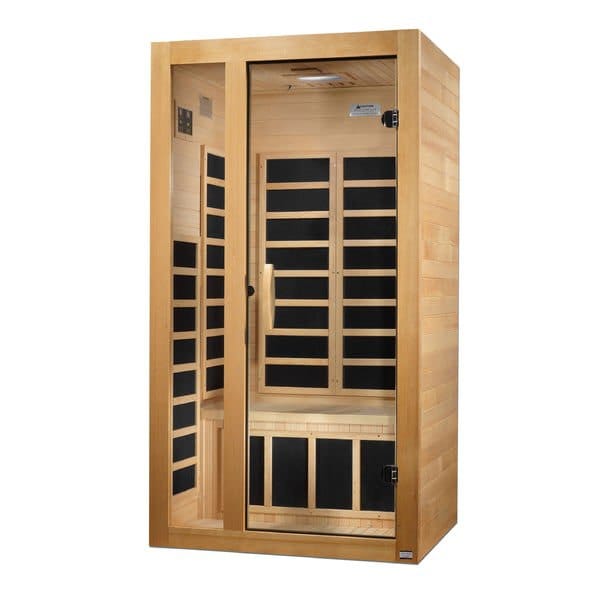
Can your sauna run on the GFCI protection a garage requires?
A plug-in cabin has to, where the codes below apply. Garage receptacles are one of the places the electrical code requires ground-fault protection. The 2021 International Residential Code, section E3902.2:
"125-volt through 250-volt receptacles installed in garages and grade-level portions of unfinished accessory buildings used for storage or work areas and supplied by single-phase branch circuits rated 150 volts or less to ground shall have ground-fault circuit-interrupter protection for personnel."
The 2020 National Electrical Code says the same in section 210.8(A)(2). Note the range: 125 through 250 volts. That covers the 240V twist-lock receptacle some larger plug-in cabins use, as well as ordinary 120V outlets.
For a plug-in infrared cabin, that makes the manual's GFCI position decide the purchase, so find yours in the first column.
| Plug-in cabin | GFCI position in its own documents |
|---|---|
| Sunlighten Signature | "For US: Install GFCI (Ground Fault Circuit Interrupter) or a DF (Dual Function) breaker in breaker panel." |
| Clearlight Sanctuary | "We strongly recommend the use of a GROUND FAULT CIRCUIT INTERRUPTER (GFCI) device in any potentially wet locations." |
| Sun Home Equinox, Solstice | "Include a GFCI or dual-function (AFCI/GFCI) breaker" and check local code |
| Almost Heaven Harmony | "GFCI protected outlet/circuit breaker is not recommended." The listed fix: "Replace the outlet/circuit breaker with non-GFCI ones." |
What this means for you: skip the Almost Heaven Harmony for a garage where these codes apply, since its manual has you remove the very protection they require there. The cabins that call for GFCI anyway have no conflict: Sunlighten's Signature, Clearlight's Sanctuary, and Sun Home's Equinox and Solstice on their current pages.
Sun Home's position has changed, as its pick below spells out, so go by the current page for your model. Our sauna electrical guide, which quoted the earlier line, has been updated.
For a hardwired heater in a traditional sauna, the question is open. Finlandia's manual says "A ground fault interrupter (GFI) should not be installed in and does not belong in a Sauna." Harvia's KIP manual says "Do not use a ground fault circuit interrupter (GFCI)." The HarviaNA KIP manual on Almost Heaven's site adds "Using GFI will cause damage to the heater."
Our sauna heater breaker size and GFCI table puts each heater manual's GFCI line next to the infrared makers' wording, for 34 models.
Section 210.8(F) of the 2023 NEC covers outdoor outlets on circuits of 50 amps or less, "including outlets installed in the following locations," the first of which is "Garages that have floors located at or below grade level." Code commentators word it differently.
Leviton's analysis, which reprints the code text with NFPA permission, describes it as covering "outlets installed in garages that have floors located at or below grade level." Mike Holt's 2023 change summary restates the rule as covering outlets "located outside" garages, accessory buildings and boathouses, though its note on the change describes garage receptacles.
What this means for you: if the rule reaches outlets inside the garage, it takes in a hardwired 240V heater circuit of 30 or 40 amps, because both are under its 50 amp limit. The difference decides whether a Finlandia or Harvia heater in your garage runs straight into a code requirement its manufacturer forbids. Only your inspector can say which reading your jurisdiction applies. Ask before you buy the heater, not after the wire is run.
Two smaller electrical points:
- The 2023 NEC (section 210.11(C)(4)) requires at least one 120V, 20 amp circuit for the garage's receptacles, and that circuit can't serve other kinds of outlets, with exceptions. A cabin whose manual calls for a dedicated 20 amp circuit still needs its own new circuit, not a share of that one.
- A plug-in cabin needs its own outlet close enough to reach. Almost Heaven, Golden Designs and Sunlighten all prohibit extension cords. Sun Home's garage guide says not to use them "unless the manufacturer expressly authorizes them," and its own manual and product page split on it, as its pick below shows.

What does the wall to the house change in an attached garage?
It decides how the sauna can vent and what has to be protected where it passes through that wall. An attached garage has a required fire separation from the house. The 2021 IRC's Table R302.6 calls for at least 1/2-inch gypsum board on the garage side of the wall to the house, and 5/8-inch Type X gypsum under any habitable rooms above the garage.
Three related rules matter for a sauna build:
- Openings (R302.5.1): no openings from the garage directly into a room used for sleeping. Doors between garage and house must be solid wood or steel at least 1 3/8 inches thick, or 20-minute fire rated, and must be self-latching with a self-closing or automatic-closing device.
- Ducts (R302.5.2): ducts that pass through the separation "shall not have openings into the garage."
- Other penetrations (R302.5.3): anything that passes through the separation has to be protected as the code specifies.
That last one is where venting advice gets complicated. Almost Heaven's Custom Cut manual says the sauna's air outlet must be "on an interior wall to vent the sauna room (never vent to the outdoors)." Finlandia's FAQ says "We recommend venting from the Sauna to an area inside the house."
In a detached garage, venting into the garage itself is the natural reading of that advice. In an attached garage, venting into the house means a hole through the fire separation.
So settle the vent with your inspector before you order, along with anything that would fasten to or pass through that wall.
Will your garage slab work under a sauna?
Usually, yes. All four makers below accept concrete.
- Almost Heaven: "Your indoor sauna can go on almost any surface," including concrete, tile and laminate. A duckboard on top is optional, for comfort.
- Finlandia: "You must provide a waterproof floor (concrete, tile, or vinyl)" for its prefab rooms, and "pressure treated plates (against concrete)" for framed builds.
- Redwood Outdoors: "Level concrete" is among its recommended foundations.
- Sunlighten: concrete is fine, but "If placed near or on cool surfaces (like concrete and basement walls), warm-up can be impacted."
The catch is the slope. IRC section R309.1 requires the parking area of a garage floor to slope toward a drain or the main door. Almost Heaven's barrel manual is the only maker document we found that addresses it directly: "A slight slope will not be an issue, but a more pronounced slope will require shimming to make the sauna level."
Floor drains are a straight disagreement. Finlandia says a floor drain "is recommended for new construction." Scandia says "a drain is actually not recommended as hosing down the sauna for cleaning will damage the interior wood."
Add shims or a level base to your order, and on a drain, follow your brand's manual.
Do you need a permit for a sauna in a garage?
For a framed room, plan on one. Framing a sauna room inside a garage is building new walls, and several local governments list that as work that needs a permit.
Fairfax County, VA includes "building new wall(s)" under interior alterations. Montgomery County, MD requires a permit for "reconstruction or renovation to an existing structure other than a repair." Denver requires one for "alterations to the existing floor plan" and "new or relocated electrical or plumbing fixtures." Austin has a separate web form for garage conversions.
One retailer's guide says that "In many areas, small indoor saunas do not require a special building permit, especially if they are pre-fabricated kits." None of the official pages we checked says that. None of them addresses a freestanding plug-in cabin set down in a garage with no new walls, either way, so that is a question for your building department.
Our guide to home sauna permits shows what 12 local governments publish. Every one of those pages that addresses electrical work requires a separate permit for it.
For your budget, plan on an electrical permit for any new circuit.
Which sauna to get for your garage
The one whose manual agrees with your garage on the cold and on GFCI.
January, after dark: frost on the driveway and the garage door down. The cabin stands level under the shop light at the back of the bay, on the shims you set for the slope. By now it has warmed up, and you take a seat inside.
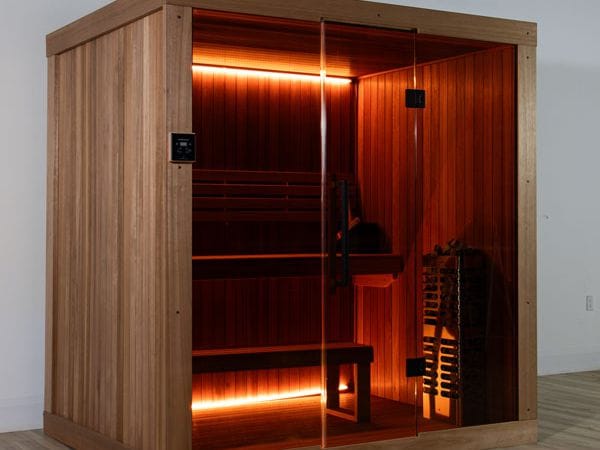
SaunaKits.com
Carries indoor cabins, DIY kits and Harvia and Finlandia heaters. Its own garage guide says you don't have to worry about air exchange in a garage, which the manuals above do not support, so ask for the installation manual for the exact model and check its temperature and GFCI requirements before you order.
Browse cabins at SaunaKitsFinancing through Shop Pay Installments (Affirm's lenders), 0–36% APR if approved. HSA/FSA through Truemed, which needs a Letter of Medical Necessity.
Sun Home Saunas
Publishes one of the few manufacturer guides written specifically about garages, and its current product pages call for GFCI protection, which fits a garage receptacle. Its Eclipse manual requires a temperature-controlled room, so check the manual for the model you want against your garage in winter.
See Sun Home's saunasAffirm at checkout; Sun Home doesn't publish Affirm's rates or terms. HSA/FSA through TrueMed after a short health survey.

SaunaCloud
Builds custom infrared saunas and says every one is "custom-built for its setting," starting from your dimensions. That can suit a garage bay no standard cabin fits. Ask for the electrical requirement and any minimum room temperature for the design it proposes before you commit.
Start a free 3D design at SaunaCloudFinancing on approved credit, per SaunaCloud; the lender isn't named.
Sun Home Equinox or Solstice: a plug-in cabin for a garage you heat
Get the Equinox or Solstice if your garage stays heated through winter. Both current pages say to "Include a GFCI or dual-function (AFCI/GFCI) breaker" and check local code, so the cabin asks for the same protection a garage receptacle needs. It plugs in, with no heater to hardwire.
- Best for: a garage you heat through winter, with a GFCI-protected receptacle the cord reaches.
- Skip it if: the garage goes unheated and your model's manual asks for a "temperature-controlled room," as the Eclipse manual does.
- Main compromise: Sun Home's own documents disagree on GFCI and on extension cords, so the current manual for your model has to settle both.
Confirm before you order: Sun Home's earlier guidance said to use a standard breaker because GFCI and AFCI breakers "trip during normal operation." Its current Equinox and Solstice pages say to include one. Plan on the current page's line, and ask Sun Home in writing which breaker the current manual for your model names.
Its documents also split on extension cords: the Equinox page says "No power strips, no extension cords," while the Eclipse manual allows "an AC socket or extension cable that is suitable for use." Plan a new outlet within the cord's reach.
If Sun Home won't confirm in writing, Clearlight's Sanctuary avoids the question: its manual strongly recommends GFCI in potentially wet locations and names the garage first among possible locations. When Sun Home has answered, the Equinox or Solstice is clear to order.
Sunlighten Signature: a plug-in cabin for a garage that stays unheated
Sunlighten allows an unheated garage, with more warm-up time, and its Signature documents say "For US: Install GFCI (Ground Fault Circuit Interrupter) or a DF (Dual Function) breaker in breaker panel." That puts it on the right side of both garage lines, the cold and the receptacle.
- Best for: a garage that stays unheated through winter.
- Skip it if: the nearest outlet is out of the cord's reach, since Sunlighten prohibits extension cords.
- Main compromise: a longer warm-up in the cold, and Sunlighten says cool surfaces like concrete can slow it further.
Ask Sunlighten for the manual for the model you want, and check its GFCI and extension-cord lines against your garage. With a GFCI-protected receptacle in reach of the spot, the Signature suits a cold garage on Sunlighten's own terms.
A Harvia or Finlandia heater from SaunaKits: a traditional room your inspector has cleared
This is the route to a traditional sauna: a framed room or kit with a Harvia or Finlandia heater.
- Best for: a framed room or kit in a garage, on a 240V circuit your inspector has signed off on.
- Skip it if: your inspector reads NEC 210.8(F) as reaching the heater circuit, since both makers' manuals say no GFCI.
- Main compromise: a framed room is building work: several local governments list new walls as needing a permit, and the heater needs a 220/240V hookup.
Confirm before you order: plan around the heater's own installation manual rather than SaunaKits' garage guide, the gap the card above flags. Ask SaunaKits for that manual and check its minimum room temperature and GFCI lines.
If your inspector reads the rule as reaching the heater circuit, a plug-in cabin whose documents call for GFCI avoids the conflict. Sunlighten's Signature and Clearlight's Sanctuary qualify, and so does Sun Home's Equinox once Sun Home confirms its breaker in writing. Once the inspector's reading is clear, a Harvia or Finlandia heater from SaunaKits is ready to order.
Browse heaters and kits at SaunaKits
SaunaCloud: a custom build for a bay no cabin fits
When the bay sets the size, look to SaunaCloud: it says each sauna starts from your dimensions, and the 3D design is free to start. SaunaCloud's own pages put the price at $5,000 to $17,000 or more as of October 12, 2026; our custom infrared sauna cost guide sorts out which figure covers what.
- Best for: a garage bay no standard cabin fits.
- Skip it if: you need a circuit figure before you start; ask SaunaCloud for it with the design.
- Main compromise: any minimum room temperature depends on the design too, so a cold garage stays an open question until you have it.
Once the design's circuit and minimum room temperature fit your garage, go ahead with it.
Start a free 3D design at SaunaCloud
The questions to send before you order
Send your pick's maker its question in writing, and keep the answer with your electrician's quote.
- Sun Home: Which breaker does the current manual for this Equinox or Solstice call for, GFCI, dual-function (AFCI/GFCI) or standard, and does it allow an extension cord?
- Sunlighten: What do the manual's GFCI and extension-cord lines say for this model, and how much longer is the warm-up in an unheated garage?
- SaunaKits: Can you send the installation manual for this exact heater, with its minimum room temperature and its GFCI requirement?
- SaunaCloud: What electrical requirement and what minimum room temperature does the proposed design have?
- Your inspector: How do you read NEC 210.8(F) for an outlet inside this garage, and does it reach a hardwired 240V heater circuit?
If the garage doesn't work out, our outdoor sauna comparison lines up seven backyard barrels and cabins on their makers' own specs. For an infrared cabin in the yard, our guide to the best outdoor infrared sauna sorts its picks by circuit, yard and coldest month. If the bay is for a golf simulator instead, how much room a golf simulator needs gives width, depth and ceiling by launch monitor.
Before you order: six checks for a garage sauna
- Find the model's minimum room temperature, or its "temperature-controlled room" requirement, in the manual. Compare it with how cold your garage gets in January. If it goes unheated below 60°F, put Sunlighten first.
- Plug-in cabin: read the manual's GFCI position and measure to the outlet. It has to work on a GFCI-protected garage receptacle within reach of its cord, with no extension cord unless the manual for your model allows one. Sunlighten's Signature, Clearlight's Sanctuary and Sun Home's current Equinox and Solstice pages call for GFCI (confirm Sun Home's in writing): see Sun Home's saunas.
- Hardwired heater: ask your inspector how they read NEC 210.8(F) for your garage, and measure the run from the panel, before you buy the heater. Once the answer clears it, browse heaters and kits at SaunaKits.
- If the garage is attached, decide with your inspector where the sauna vents and whether anything touches the wall to the house.
- Check the slab slope where the sauna will sit, and plan shims or a level base.
- Call the building department about the walls and the circuit, and send your pick's maker its question from the list above.
Common questions
Can you put a sauna in a garage?
Yes, for many models. Finlandia and Scandia list garages among ideal places for saunas, and Clearlight's Sanctuary manual names the garage as a possible location. Check four things first: the model's minimum room temperature, GFCI requirements for garage receptacles, the fire separation wall in an attached garage, and the slope of the garage slab.
Is a garage too cold for a sauna?
It can be for some models. Golden Designs says it is not recommended to use its Dynamic DYN-6996-01 cabin below 60°F, Scandia sizes its electric heaters from a 60°F starting temperature, and Sun Home's Eclipse manual requires a temperature-controlled room. Sunlighten allows an unheated garage with extra warm-up time.
Does a sauna in a garage need GFCI?
Garage receptacles rated 125 through 250 volts need GFCI protection under the 2021 International Residential Code and the 2020 National Electrical Code, so a plug-in cabin in a garage will usually be on a GFCI-protected receptacle. Finlandia and Harvia say not to use GFI on their hardwired heaters, and how the 2023 NEC applies to hardwired garage circuits is a question for your inspector.
Your next step
Tonight, set a level on the slab where the sauna would go, and find the outlet or panel that would power it. On the next freezing night, note how cold the garage gets; if all three check out against your pick's manual, it's ready to order.
The free Home Performance Room Planner adds the rest: thirteen measurements to take before you order, panel capacity, wire run and clearances included, and cites a maker's spec or the code for each.
Get the free Home Performance Room Planner
Sources are the documents named above; we did not test these saunas. This is general information, not electrical, code or medical advice. Codes vary by the edition and amendments adopted where you live; follow your manual, hire a licensed electrician, and your inspector decides. Home Performance Guide earns a commission on some links here, at no extra cost to you (affiliate disclosure, editorial standards).
Get the Room Planner.
Thirteen measurements to take before you buy sauna or recovery equipment, with the manufacturer specs and code references behind each one. Free. Planning a golf simulator instead? There is a twelve-measurement golf planner too.
ABOUT
Verified buyer guides for home sauna, cold plunge and recovery equipment. Specs from the manufacturers, not from other blogs.