Best Launch Monitor for Small Space (2026): Room Figures by Maker
By Evan Reid, with research from the HPG Research Team · Updated Oct. 19, 2026
The best launch monitor for a small space sits beside the ball when your garage or spare room is short on depth.
By our reading of Bushnell's manual, the Bushnell Launch Pro is the one to choose for a small room when depth runs out first. The manual sets it upright "approximately 2 feet away from the hitting area," with the ball in front of it, so nothing goes behind the ball. As of October 7, 2026, the price is $2,999.99.
Bushnell's buyer's guide still recommends "18ft x 12ft x 9ft" for a simulator room. Under 18 feet deep, get Bushnell's depth answer in writing, or plan on the SkyTrak ST MAX, whose Studio 8' package lists 15 feet. And Bushnell's "FREE 30-DAY RETURNS" banner leaves out the Launch Pro's 20% restocking fee, so measure first.
On October 7, 2026, we read the manuals, product pages, support articles and store policies of nine launch monitor makers, plus Carl's Place.
Quick picks
In a small room, where the unit sits matters more than how big it is.
- Best when depth is the tight dimension: Bushnell Launch Pro. Why: Bushnell's manual places it upright "approximately 2 feet away from the hitting area," with the ball in front of it, so nothing goes behind the ball (our reading). As of October 7, 2026, the price is $2,999.99. Compromise: club data and Premier course play need a paid plan, and Bushnell's own figure for a full simulator room is still 18 feet deep.
- Best on a low budget, and for both hands: Garmin Approach R10. Why: Garmin asks for "at least 15 feet long by 8 feet wide by 8 feet high" and says "you can use the same alignment regardless of your handedness." As of October 7, 2026, the price is $499.99. Compromise: the unit sits 6 to 8 feet behind the ball, and course play needs a Garmin Golf membership; as of October 7, 2026, the price is $99.99 a year.
- Best for the smallest published simulator room: SkyTrak ST MAX. Why: SkyTrak says the unit "sits next to the ball," and its Studio 8' package lists "Minimum Room Size: 8.5' W / 15' D / 8' H." As of October 7, 2026, the regular price is $2,995, and a sale was running. Compromise: the 15 foot room figure is for the Studio 8' package, and $2,995 buys the unit alone. SkyTrak's same block says a driver needs a 9 foot ceiling and 10 feet of width, and the warranty is 6 months or 25,000 shots.
- Best Bushnell package for an 8 foot garage ceiling: Bushnell Launch Pro Simulator Bundle, 8'. Why: Bushnell's Sim Fit Check lists "Ceiling, needs 8'" with 10 feet of width and 18 feet of depth. As of October 7, 2026, the price is $6,499.99. Compromise: 18 feet of depth, and the net, mat, frame, screen and projector can't be returned.
- Best with no yearly software fee: FlightScope Mevo Gen2. Why: FlightScope promises "full feature access and 8 home golf simulator courses by E6 Connect out of the box with $0 recurring fees." As of October 7, 2026, the price is $1,299. Compromise: it sits 8 feet behind the ball and wants 8 feet of ball flight, 16 feet by our arithmetic.
- Best for building your own bay: a Carl's Place DIY enclosure kit with any floor unit above. Why: the DIY kit is an enclosure with no launch monitor, so it pairs with whichever unit fits your room. As of October 7, 2026, the price is $999.95 to $1,874.95 depending on size. Compromise: Carl's recommends standing 10 to 12 feet from the screen, more than the 8 feet most launch monitor makers ask for.
Skip these in a small room: the Trackman iO (Trackman recommends a room "at least 15 ft wide, 10 ft high, and 18 ft deep") and, until they are back in stock, the Bushnell Launch Pro Indoor and Square Golf OE (both sold out on October 7, 2026). Measure first with the free Golf Simulator Room Planner.
See the Launch Pro price at Bushnell Golf
See the 8' bundle price at Bushnell Golf
See DIY enclosure prices at Carl's Place
Based on the makers' own documents. Prices as of October 7, 2026. SkyTrak had a sale running.
Below: the depth each unit needs first, then the picks, then what to confirm with each maker before you pay.
How much space do you need for a launch monitor?
It depends on where the maker tells you to put the unit. A unit behind the ball adds its own distance to the roughly 8 feet most makers want between the ball and the screen or net. A unit beside the ball adds little to depth, by our reading, though its makers still publish rooms 15 to 18 feet deep for a full simulator.
Garmin, for one, places the Approach R10 "between 6 and 8 feet behind the ball" and wants the ball "at least 8 feet away from the impact screen or net." That adds up to 14 to 16 feet of depth, by our arithmetic. The one overhead unit, the Trackman iO, mounts 8 feet 10 inches to 10 feet 6 inches above the hitting surface, depending on unit type.
Four of the eleven units here publish no room size at all: the Bushnell LPi, Foresight GC3, Uneekor EYE MINI LITE and Square Golf OE. The Bushnell Launch Pro and SkyTrak ST MAX are the two beside-the-ball units whose makers publish placement, width, depth and ceiling figures. If you want to plan a small room on a maker's own numbers, those two give you all four.
In the table, prices are as of October 7, 2026. "Sale running" means a sale was running when we checked, and the price shown is the regular price. Year one is our arithmetic from each maker's published plan prices.
Read where each unit sits before its price, since a unit behind the ball needs its own 6 to 9 feet on top of about 8 feet to the net.
On a phone, swipe the table to see all five columns.
| Launch monitor | Where the unit sits | Room figure the maker publishes | Software, year one | Price as of Oct. 7, 2026 |
|---|---|---|---|---|
| Bushnell Launch Pro | About 2 ft from the hitting area, ball in front of it | "Recommended: 18ft x 12ft x 9ft" for a simulator (buyer's guide); 8' bundle needs 8' ceiling, 10' width, 18' depth | $0 on Free (ball data); $494 Silver plus Course Pass; $849 Gold plus GSPro | $2,999.99 |
| Bushnell Launch Pro Indoor (LPi) | 16 to 24 in from the hitting zone | None published for the LPi | Subscription needed for ball and club data; Silver from $199 | $1,999.99, sold out |
| SkyTrak ST MAX | "sits next to the ball" | 10 x 10 ft unobstructed area (ST MAX guide); Studio 8' minimum 8.5' W, 15' D, 8' H | $0 while a promotion runs; $99.99 Essential; $299.99 Core | $2,995, sale running |
| Garmin Approach R10 | 6 to 8 ft behind the ball | At least 15 ft long, 8 ft wide, 8 ft high | Garmin Golf $99.99 for course play | $499.99 |
| Garmin Approach R50 | 1 to 2 ft from the ball, on the far side | Recommended: 9 ft ceiling, 10 ft width (13 for both hands), 8 ft to the net; no depth | Course play needs a subscription | $4,999.99 |
| Rapsodo MLM2PRO | 6.5 to 8.5 ft behind the ball | "A little more than 14 total feet" deep | $0 basic; $199.99 Premium; $599.99 lifetime offer | $699.99, sale running |
| FlightScope Mevo Gen2 | 8 ft behind the ball (FAQ: 7 to 9 ft) | 8 ft unit to tee plus 8 ft of ball flight; SwingBay bundle 12 ft W, 9 ft H, 15 ft L minimum | $0 recurring | $1,299 |
| Foresight GC3 | About 2 ft from the hitting area | None published | 30 days of Foresight+ Gold included; after that, unclear | $6,999, tax and freight extra |
| Uneekor EYE MINI LITE | Ground unit, parallel to the target line | None for the unit; "enough space to swing a driver safely" | $0 Player; $199 Pro; $449 Pro plus GSPro | $2,750, sale running |
| Square Golf OE (Omni Edition) | Ball zone 2 in to the side, 14 in in front | None published | Square Golf's help center gives two answers | $1,599, sold out |
| Trackman iO | Ceiling, 8'10" to 10'6" above the hitting surface by unit type | Recommended: 15 ft wide, 10 ft high, 18 ft deep | Home software free the first year, then $700 a year | From USD 13,995 |
Say your room gives you 15 feet from the back wall to where the net will hang. On Garmin's figures, the R10 fits with the unit about 7 feet or closer behind the ball, and SkyTrak's Studio 8' lists exactly that 15 feet of depth. Bushnell's simulator bundles, at 18 feet, don't fit that room.
Checkpoint: your depth, from the back wall to where the net will hang. At 18 feet or more, every pick below stays in play, Bushnell's simulator bundles included. At 15 to 17 feet, your list is the SkyTrak ST MAX, the Garmin R10 and, from 16 feet, the Mevo Gen2. Bushnell's buyer's guide recommends an 18 foot deep simulator room for the Launch Pro, so it joins them only if Bushnell's written answer on depth fits your room; the question is in its pick block.
Our golf simulator room size guide covers width, depth and ceiling for a full simulator room in more detail.
Best launch monitor for small space: which one fits your room
Each pick below suits a different small room, and your depth and your software budget decide which one is yours.
Picture the garage on a cold Sunday morning, with one light on over the mat. The Launch Pro stands upright beside the hitting area, raised to the level of the mat, and the net hangs where you taped it, about 8 feet out. You set a ball in front of the unit and hit your opening drive.
Bushnell Launch Pro: beside the ball, for a room short on depth
The Launch Pro is our pick for tight depth because of where Bushnell puts it. The manual says "place upright approximately 2 feet away from the hitting area" and tells you to set the ball in front of the unit; grouping it with the beside-the-ball units is our reading of those lines. As of October 7, 2026, the price is $2,999.99, with no sale running.
- Best for: a room where depth runs out before width.
- Skip it if: the unit can't get online at least once every 45 days, or you want club data without paying for a plan.
- Main compromise: Bushnell's own simulator room is still 18 feet deep, and a return costs a 20% restocking fee, about $600 by our arithmetic at the October 7, 2026 price.
Bushnell's own room figures are bigger than the placement suggests. Its Launch Pro buyer's guide recommends "18ft x 12ft x 9ft" for a simulator room. For distance to the screen, the Foresight SIM IN A BOX Play 10 manual linked from Bushnell's support page says "Place the Front of the Hitting Mat Approximately 8 Feet from the Screen." Our Launch Pro and GC3 space requirements guide goes through Bushnell's room advice in more detail.
What this means for you: the unit saves the space behind the ball, but not the 18 feet Bushnell plans for a full simulator. If your room is shorter, ask Bushnell in writing what depth it recommends with a screen. If it won't give one, SkyTrak's Studio 8' lists 15 feet, by our comparison the smallest published screen room here, so the ST MAX below, in that studio, avoids the question.
On a mat, the manual adds, "If you are using a hitting mat, make sure the Launch Pro is raised to the same level as the hitting surface," so plan how you'll raise it to mat height. The unit is 5 by 6 by 12 inches and weighs 5 pounds, and Bushnell gives a 7 by 10 inch hitting zone, so set each ball inside it, in front of the unit.
One club-marker troubleshooting answer says to "raise it 1–1.5 inches above the ball," while the manual and the next answer say the same level as the ball. Set it level, as the manual says, and ask Bushnell when the lift applies.
Bushnell lists it for "Indoor + Outdoor" use, so the same unit can go to the range. The box holds the Launch Pro, a USB-C cable, an Ethernet cable, an alignment stick, a power cord and a club marker pack. A gaming PC and a software membership are not included.
Software sets the year-one cost. Bushnell's Free tier covers ball data, but club data needs a paid plan and Premier course play isn't on Free. As of October 7, 2026, Silver costs $199 a year and Gold $599; Course Pass adds $295 a year, Course Pass PRO $595, and GSPro $250 with an active Gold membership.
New devices get a 30-day trial, and memberships are billed annually. By our arithmetic, year one costs $0 on Free, $494 for Silver plus Course Pass, or $849 for Gold plus GSPro, at October 7, 2026 prices. If ball data covers what you want, Free keeps year one at the price of the unit.
The Launch Pro "requires internet connection within the United States at least once every 45 days." After that it stops connecting to apps and software, though Bushnell's manual says it "will continue to work as a stand-alone device." The warranty is one year from purchase.
Confirm before you order: the return terms. Bushnell's banner says "FREE 30-DAY RETURNS," but its returns page says the Launch Pro is "Returnable within 30 days of shipment with a 20% restocking fee," and software sales are final. Plan on the fee and on paying return shipping yourself, and ask Bushnell in writing who pays return shipping on a launch monitor.
If Bushnell's depth answer fits your room and the 20% fee works for you, the Launch Pro is the one to get for a room short on depth.
Bushnell Launch Pro
The unit sits upright about 2 feet from the hitting area, with the ball in front of it. Bushnell recommends an 18 by 12 by 9 foot simulator room. Ball data is free; club data and course play need a plan. As of October 7, 2026, the price is $2,999.99.
Check the Launch Pro at Bushnell GolfGarmin Approach R10: the lowest price, and the same setup for either hand
The R10 is the budget pick, and Garmin backs it with a full room minimum: "Your space must be at least 15 feet long by 8 feet wide by 8 feet high." As of October 7, 2026, the price is $499.99, with no sale running.
- Best for: paying the least of any pick here, and rooms where both left- and right-handed golfers play.
- Skip it if: the room is shorter than Garmin's 15 foot minimum (16 feet with the unit a full 8 feet back, by our arithmetic), or the floor is a shiny finished garage floor (see the garage section).
- Main compromise: the 6 to 8 feet behind the ball that a beside-the-ball unit doesn't use.
The mat "needs to be at least 2 feet long by 2 feet wide," and the ball should be "at least 8 feet away from the impact screen or net." The R10 itself goes "on the ground between 6 and 8 feet behind the ball," near the height of the ball. On a mat, Garmin's manual says the bottom edge of the unit should sit above the mat.
That's 14 to 16 feet by our arithmetic, so Garmin's 15 feet works only with the unit about 7 feet back or closer. Plan on 16 feet, or ask Garmin in writing whether its 15 foot minimum assumes the unit nearer 6 feet back.
Garmin asks you to use the tripod in the box, since "Using other mounts, or attempting to attach it to a wall, could result in inaccurate readings or error messages." For a household with left- and right-handed golfers, Garmin says "you can use the same alignment regardless of your handedness and no settings need to be changed." So golfers who swing from opposite sides can share one setup without moving the unit.
The R10 ships with a tripod stand, a phone mount, a carry case, a microUSB cable and documentation. Course play on Home Tee Hero needs a Garmin Golf membership; as of October 7, 2026, the price is $99.99 a year or $9.99 a month, after a 30-day trial. So a year of Garmin Golf adds $99.99 to the R10's $499.99, at October 7, 2026 prices.
Garmin gives a one-year warranty, and garmin.com takes returns within 30 days; opened software is nonrefundable. If your room has 16 feet of depth and the floor isn't a shiny finished garage floor, the R10 is the lowest-priced launch monitor here for a small room.
Garmin Approach R10
Garmin asks for at least 15 feet long by 8 feet wide by 8 feet high, with the unit 6 to 8 feet behind the ball. The same alignment works for either hand. As of October 7, 2026, the price is $499.99.
See the R10 at GarminSkyTrak ST MAX: next to the ball, with the smallest studio room
The ST MAX is our pick for a small simulator room because SkyTrak says its unit "sits next to the ball vs other launch monitors that require up to 8' behind the hitting area." Its Studio 8' package lists "Minimum Room Size: 8.5' W / 15' D / 8' H," by our comparison the smallest minimum room for a screen package on this page. As of October 7, 2026, the regular price is $2,995, and a sale was running; that price buys the unit alone.
- Best for: a simulator room about 15 feet deep, with the unit beside the ball.
- Skip it if: you want a long warranty, or you might return the unit after registering it.
- Main compromise: the warranty runs 6 months or 25,000 shots, and once the unit is registered, the return fee may reach 40%.
The ST MAX user guide says "Make sure STMAX is raised level with the hitting surface" and "Place ST MAX parallel to your intended line of play." It lists a 10 by 10 foot "Minimum Unobstructed Area," and adds that "Safe ceiling height varies and depends on your physical height and the length of your club." The studio's own footprint is 8 feet wide, 4 feet deep and 7 feet 6 inches tall.
In its Studio 8' listing, SkyTrak adds that "a standard golfer requires at least a 9-foot ceiling and 10 feet of width to safely swing a driver." The Studio 10' needs 11 feet of width, 16 of depth and 9 of height. With the Studio 8', allow 9 feet up and 10 across for a driver; the Studio 10' already lists 9 up and 11 across.
SkyTrak's general advice is a 12 foot width and 17 feet of depth for "a comfortable and spacious setting." On ceilings, it says "a ceiling height of 10' typically offers ample clearance for most golfers, however many golfers say that 9' is enough." So 15 feet gets a Studio 8' in, and 17 is the depth SkyTrak calls comfortable.
When we checked on October 7, 2026, a "This Week Only" promotion added a free year of Core (FS) membership, and SkyTrak says "You will activate your membership once you receive & register your device." Without it, plans cost $99.99 a year for Essential, $299.99 for Core: Foresight, $349.99 for Core: Trackman and $599.99 for Elite, as of October 7, 2026, after a 14-day trial.
SkyTrak's brand-wide answer, on its ST+ page, says the system "includes basic features for free," while Course Play and game-improvement features "require a paid SKYTRAK Membership." By our arithmetic, year one is $0 while the promotion runs, or $99.99 for Essential and $299.99 for Core with courses, at October 7, 2026 prices.
You'll need a PC or an Apple device with an M1 chip or later; SkyTrak notes that "Currently no iPhone will work with course play." SkyTrak backs the unit with a "6-month warranty or 25,000 shots, whichever comes first," and returns run 30 days.
SkyTrak's own pages give a 20% and a 40% restocking fee, and its FAQ, which allows up to 40%, names a registered unit among the cases. At 20%, that's $599 on the $2,995 regular price as of October 7, 2026, by our arithmetic, and twice that at 40%. Ask SkyTrak in writing which applies if you register for the free year and then return the unit, and budget for the 40% until it answers.
If SkyTrak won't say, the Garmin R10 fits the same 15 to 16 foot room on Garmin's figures, and garmin.com takes returns within 30 days. With SkyTrak's answer and the Studio 8' package price in hand, the ST MAX is ready to order for a room about 15 feet deep.
SkyTrak ST MAX
SkyTrak's unit sits next to the ball. Its Studio 8' package lists a minimum room of 8.5 feet wide, 15 deep and 8 high, with a 9 foot ceiling for a driver. As of October 7, 2026, the regular price is $2,995, and a sale was running.
See the ST MAX at SkyTrakBushnell Launch Pro Simulator Bundle, 8': for a garage with an 8 foot ceiling
The 8' bundle carries the lowest ceiling figure among the bundles Bushnell's store lists: its Sim Fit Check says "Ceiling, needs 8'," with 10 feet of width and 18 feet of depth. Its enclosure frame "runs 8'W × 7'6"H × 17'L." As of October 7, 2026, the price is $6,499.99 for either the 8' or the 10' bundle, with no sale running.
- Best for: a garage or basement with an 8 or 9 foot ceiling, 10 to 12 feet of width and 18 feet of depth.
- Skip it if: the room is under 18 feet deep.
- Main compromise: the package parts can't be returned, and the room is deeper than the unit's placement alone suggests.
The bundle puts the net, mat, frame, screen and projector in one order with the launch monitor. That cuts both ways: Bushnell's returns page says "Simulator package components (net, mat, frame, screen, projector) are not returnable." The Launch Pro's software, internet and warranty terms above apply, and our golf simulator packages guide covers what Bushnell's bundles leave out.
The 10' bundle needs a 9 foot ceiling, 12 feet of width and 18 feet of depth, around a frame 10 feet wide, 8 feet 6 inches tall and 17 feet long. With 10 to 12 feet of width, the 8' is the one that fits, and our 9 foot ceiling guide compares every maker's ceiling figures.
SkyTrak says a standard golfer needs a 9 foot ceiling to swing a driver in a studio of this same width and height. So take a full driver swing where the ball will sit, and send Bushnell the ceiling question below. If Bushnell confirms its 8 foot figure covers a full driver swing and your own swing clears, the 8' bundle fits.
Bushnell Launch Pro Simulator Bundle, 8'
Bushnell lists an 8 foot ceiling, 10 feet of width and 18 feet of depth for the 8' bundle, whose frame is 7'6" tall. Package parts are not returnable. As of October 7, 2026, the price is $6,499.99.
Check the 8' bundle at Bushnell GolfFlightScope Mevo Gen2: no yearly fee, 8 feet behind the ball
Get the Mevo Gen2 if a yearly software bill is the deal-breaker. FlightScope's page, read October 7, 2026, says "You get full feature access and 8 home golf simulator courses by E6 Connect out of the box with $0 recurring fees." As of the same date, the price is $1,299, with no sale running.
- Best for: a room at least 16 feet deep (8 feet behind the ball plus 8 feet of ball flight, by our arithmetic) where a yearly software bill is the deal-breaker.
- Skip it if: depth is your tightest dimension.
- Main compromise: 8 feet behind the ball, and no published width or ceiling for the unit.
The Mevo Gen2 sits behind the ball: "place your Mevo Gen2 unit 8 feet directly behind the golf ball and in-line with the radar's camera on the ground." Its indoor spec reads "8 feet from unit to tee with 8 feet ball flight," which is 16 feet by our arithmetic. Spin readings indoors need aluminum dots or Titleist RCT balls.
The FAQ on the same page gives "7-9 feet sensor to tee distance with 8 feet of ball flight minimum." Its SwingBay bundle recommends at least 12 feet wide, 9 feet high and 15 feet long, and prefers 12 by 10 by 16 feet. Plan on 16 feet, or 17 if the unit ends up 9 feet back, by our arithmetic, and ask FlightScope which distance its indoor spec assumes.
FlightScope publishes no width, ceiling or handedness figure for the unit. Its Pro Package is sold separately as a one-time purchase; as of October 7, 2026, its regular price is $1,000, and a sale was running.
The warranty is 12 months. FlightScope accepts returns up to 30 days after delivery; the unit should come back unused in its original packaging, or FlightScope may charge a 15% restocking fee, and the buyer pays return shipping. With 16 to 17 feet of depth, order the Mevo Gen2; FlightScope promises no recurring software fee.
FlightScope Mevo Gen2
No recurring software fee, per FlightScope. The unit sits 8 feet behind the ball with 8 feet of ball flight, 16 feet by our arithmetic. As of October 7, 2026, the price is $1,299.
See the Mevo Gen2 at FlightScopeCarl's Place DIY enclosure kit: the enclosure for any floor unit
Carl's Place's DIY kit is an enclosure with no launch monitor, so it pairs with any floor unit above, in a size you choose for your room. As of October 7, 2026, the price is $999.95 to $1,874.95 depending on size, with no sale running.
- Best for: building a bay around a Launch Pro, ST MAX, R10 or Mevo Gen2.
- Skip it if: you want an enclosure that comes with a launch monitor; this kit has none.
- Main compromise: Carl's 10 to 12 foot stand-off takes more depth than the launch monitor makers' 8 feet.
Its product page says "we recommend standing a minimum distance of 10 to 12 feet away from the screen," which is more than the 8 feet Garmin, Rapsodo and FlightScope ask for between ball and net. Plan the depth of a Carl's bay on those 10 to 12 feet, and with the R10 or Mevo Gen2, add the unit's own 6 to 9 feet behind the ball.
As of October 7, 2026, the price of the Carl's Place Pro kit is $3,409.95 to $5,609.95 depending on size, with no sale running. Which sizes fit under an 8 or 9 foot ceiling is in our 9 foot ceiling guide. If you're building your own bay, start with the DIY kit.
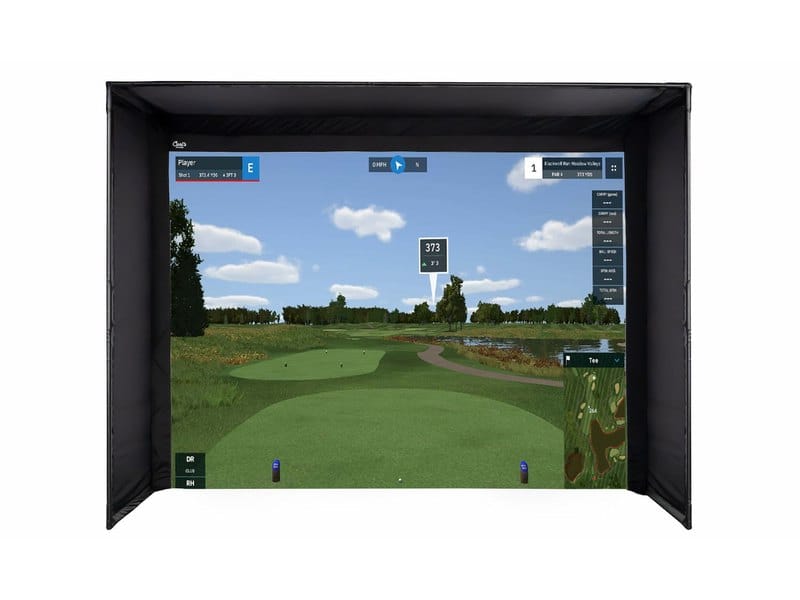
Carl's Place DIY Golf Simulator Enclosure Kit
An enclosure to pair with any floor launch monitor. Carl's recommends standing 10 to 12 feet from the screen. As of October 7, 2026, the price is $999.95 to $1,874.95 depending on size.
Check the DIY kit at Carl's PlaceNew launch monitors for October 2026: Foresight GC2 and Rapsodo MLM2XPRO, and why neither is a pick yet
Both units appeared on their makers' pages on October 1, 2026. Neither is a pick here, because neither maker publishes a placement distance or a room size yet.
- Foresight GC2: an all-new two-camera unit. As of October 7, 2026, the price is $1,699, with orders open and "Shipping Begins October 9." Foresight lists ball data only, indoor and outdoor use, 4.5 pounds, a one-year warranty and 30 days of Foresight+ Gold with Course Pass Pro for US orders. It costs less than the Launch Pro, and both start on a Foresight+ trial, but Foresight hasn't said where the GC2 sits or how much room it needs.
- Rapsodo MLM2XPRO: as of October 7, 2026, the price is $899.99, but the page shows "Notify Me," so it can't be ordered yet. It comes with a 21-day Core trial that renews at $199.99 a year, as of the same date, and a one-year limited warranty.
Foresight also lists a SIM IN A BOX Net package with the GC2; as of October 7, 2026, the price is $2,899, shipping from October 12, with no iPad or PC included. Its frame is 14 feet deep, 8 feet wide and 9 feet high, with a 5 by 5 foot mat. Foresight publishes no room minimum, so your room needs at least those 14 feet, and Foresight doesn't say how much more.
If either is on your list, ask its maker in writing where the unit sits and how much room it needs before you pay. As of October 7, 2026, a GC2 order carries the GC3's terms: after 24 hours, canceling costs a $250 fee, and the balance becomes store credit. Until Foresight answers, the Launch Pro is the Foresight+ unit here whose maker publishes both a placement and a room figure. The MLM2PRO below is the Rapsodo you can order now, with a published depth.
Launch monitors that sit beside the ball: the other five, and what each one leaves out
Bushnell, SkyTrak, Foresight, Uneekor, Square Golf and Garmin's R50 all place the unit near the ball rather than behind it. The Launch Pro and ST MAX are covered above, and for Bushnell, Foresight and Uneekor, calling it "beside the ball" is our reading of their placement lines. None of the five below is a pick; the short version at the end of this section says why.
Bushnell Launch Pro Indoor vs Launch Pro: 16 to 24 inches, and sold out
The Launch Pro Indoor, or LPi, is the same 5 by 6 by 12 inch, 5 pound box with the same 7 by 10 inch hitting zone and no display. Bushnell lists it as "Indoor only," and the LPi manual places it closer to the ball: "To use your Launch Pro i place it 16" to 24" away from the hitting zone." The manual also says "4-dot data is not offered on Launch Pro i." Bushnell publishes no room size for the LPi on its own.
Software is where the two part ways. The LPi page says "BALL & CLUB DATA REQUIRE A SOFTWARE SUBSCRIPTION," and the lowest plan on that page is Silver at $199 a year as of October 7, 2026, so the LPi has no $0 year. The 45-day internet rule, the one-year warranty and the 30-day return window with a 20% restocking fee match the Launch Pro.
As of October 7, 2026, the price is $1,999.99, and Bushnell's LPi page showed it "SOLD OUT" with no restock date. Until it's back, the Launch Pro is the Bushnell to get, since it works on the Free tier and goes indoors or out. Our Launch Pro and GC3 space requirements guide covers both Bushnell units' setup.
Garmin Approach R50: 1 to 2 feet away, on the far side of the ball
Garmin places the R50 "on the ground 1-2 feet in front of the ball so that the ball is between you and the Approach R50." The owner's manual puts it "approximately 1.5 ft. (0.5 m) to the side of the tee location," at a similar height to the tee, and says "leveling is not required." Which side it goes on follows the handedness set in your Garmin account.
Garmin gives its R50 room figures as a recommendation "for most users," and calls none of them a minimum: "Ceiling height of 9 feet or more. Distance to the net of 8 feet or more. Space width of 10 feet or more. For dual-handed setups use a space of 13 feet or more." Garmin publishes no room depth for the R50 in its support article or its owner's manual.
As of October 7, 2026, the price of the Garmin Approach R50 is $4,999.99, with no sale running. Home Tee Hero course play needs an active subscription. Garmin packs the R50 with a carrying case, an AC adapter and power cord, 250 club tracking stickers and documentation. Garmin's page also shows R10 and R50 "Complete Studio Package" options sold through PlayBetter rather than garmin.com.
With no published depth, the R50 is hard to plan into a short room. If it's on your list, ask Garmin in writing for a depth figure, and plan on 13 feet of width if both hands will use it.
Foresight GC3: about 2 feet away, and no room size
Foresight's GC3 manual uses the same wording as Bushnell's Launch Pro manual: "place upright approximately 2 feet away from the hitting area," raised to the level of the hitting surface on a mat. Both publish the same 5 pound weight; the GC3's 7 by 10 inch hitting zone appears only on Foresight's older compare page. Foresight publishes no room size for the GC3, and the device has left- and right-handed modes.
Foresight's blog gives general room advice: a 10 foot ceiling ("9 feet works for many; 8.5 feet for irons only"), 12 to 15 feet of width, and 15 to 18 feet of depth, which it says "Depends on launch monitor and tracking technology." We treat those as Foresight's general advice rather than GC3 figures.
As of October 7, 2026, the price of the Foresight GC3 is $6,999, with tax and freight extra. Foresight includes 30 days of Foresight+ Gold with Course Pass Pro. What year one costs after that is unclear: the product page's description says "No subscription required," while Foresight's blog lists both a subscription GC3 and a subscription-free "GC3 Ball Enabled," and the listing doesn't say which this is.
The GC3 must go online at least once every 45 days for full function. Foresight gives a 2-year warranty. As of October 7, 2026, you can cancel within 24 hours at no charge; after that, Foresight charges a $250 fee and keeps the balance as store credit, with no refund.
Those terms make the GC3 a purchase to settle in writing first. Ask Foresight which version the listing is and how much room the unit needs before you order, since the free cancel window is only 24 hours.
If you want Foresight+ software on a unit beside the ball, the Launch Pro uses the same placement wording, and Bushnell publishes a room figure for it. As of October 7, 2026, it costs $2,999.99 against the GC3's $6,999. The GC3's product page gives a 2-year warranty, against the Launch Pro's one year.
See the Launch Pro at Bushnell Golf
Uneekor EYE MINI LITE: indoor only, and the room size is left to you
Uneekor's product page says: "This device can only be used indoors. Ensure you have enough space to swing a driver safely." That's the only room guidance for this unit. The manual says to align it "parallel to your target line" and to keep it "level with the hitting surface." It measures 13.9 by 4.7 by 8.6 inches, weighs 8.4 pounds, isn't portable, needs a PC and gives a 12 by 8 inch hitting area. Uneekor doesn't say how left-handed golfers set it up.
Uneekor's general setup article recommends "a space of at least 13 ft × 15 ft × 10 ft," at least 13 feet of width (15 for golfers 6 feet or taller) and 12 feet from tee to screen, with 10 feet as a minimum. That article illustrates an overhead EYE XO install, so we don't treat its figures as MINI LITE figures.
As of October 7, 2026, the regular price of the Uneekor EYE MINI LITE is $2,750, and a sale was running. Every Uneekor product includes a free Player membership, and three months of Ultimate come with the unit. As of the same date, Pro is $199 a year, Champion $399 and Ultimate $599, and GSPro needs its own $250-a-year license plus a paid tier.
By our arithmetic, year one is $0 on Player, $199 on Pro, or $449 for Pro plus GSPro, at October 7, 2026 prices. The warranty is one year. The return window is short: "Earlier of 15 days after license activation or 60 days after receipt," with a 15% restocking fee, and paid software isn't refundable.
Measure the room before you activate the license, since activation can start a 15 day clock. Ask Uneekor in writing for a MINI LITE room figure first.
Square Golf OE (Omni Edition): a 10 inch ball zone beside the unit
OE is Square Golf's Omni Edition, model SQGOE300A. Its manual starts the ball zone about 2 inches to the side of the unit, on the other side for left-handed players, and 14 inches in front of it. The zone is 10 by 10 inches, and Square Golf recommends the front of it for club capture.
Keep the ball and the unit at the same level where you can, since the zone gets smaller when the ball sits higher or lower. Handedness switches with a long press on the device or in the app. Square Golf's Home Edition uses different placement figures, so match the manual to your model.
Square Golf publishes no room size; the manual asks only for "sufficient clearance for a full golf swing." The OE manual says "The device may be used indoors or outdoors; however, it is not waterproof," and the product page says "INDOOR AND OUTDOOR READY."
As of October 7, 2026, the price of the Square Golf OE is $1,599, and squaregolf.com showed it sold out. Square Golf's FAQ gives a one-year warranty without naming a model, and returns run 14 days from purchase. Its help center gives two different answers on software fees, so we don't state a year-one cost.
Sold out on October 7, 2026, the OE isn't a pick today. When it's back, ask Square Golf in writing whether the OE needs a membership and whether it's rated for outdoor use, since its own pages answer both questions two ways.
The short version: the LPi and OE were sold out, and the other three publish no room depth for the unit. For a small room, plan on the picks above.
Launch monitors that sit behind the ball, and the one on the ceiling: how much depth they take
Units that sit behind the ball add their own distance to the space between ball and net. The Garmin R10 (6 to 8 feet behind) and FlightScope Mevo Gen2 (8 feet, or 7 to 9 in its FAQ) are covered in the picks. SkyTrak's planning page describes other launch monitors as needing "up to 8' behind the hitting area," while Rapsodo's and FlightScope's own ranges reach 8.5 and 9 feet.
Rapsodo MLM2PRO: "a little more than 14 total feet"
Rapsodo says the MLM2PRO "is designed to sit 6.5-8.5 feet directly behind the ball aimed down the target line." Its FAQ adds up the room: "A little more than 14 total feet is needed. First, 8 feet is needed from ball to the net. Then, the MLM2PRO requires another 6.5-8.5 feet behind the ball. Taller players may need to place the device further back to capture their entire swing video." Those parts come to 14.5 to 16.5 feet, by our arithmetic.
Rapsodo publishes no width or handedness figure for the MLM2PRO. Its blog, writing about simulators in general, says "most indoor golf simulators require a clearance space of 9 feet tall minimum," that taller golfers "may need 10 or even 11 feet," and that a room may need to be "something like 10' H, 14' W, 17-18' D." Those are blog lines, and Rapsodo doesn't give them as MLM2PRO specs.
As of October 7, 2026, the regular price of the Rapsodo MLM2PRO is $699.99, and a sale was running. The box holds the MLM2PRO, a tripod, a carrying case, a charging cable and 3 balls with RPT.
To the question "Can I use my MLM2PRO without a Premium Membership?" Rapsodo answers yes, and adds that "Advanced features like speed training, club data and full-course access require premium membership." Premium starts with a 45-day trial that auto-renews.
As of October 7, 2026, it then costs $199.99 for one year or $329.99 for two, and Rapsodo lists "a limited time offer of a lifetime subscription for a $599.99 one-time payment." By our arithmetic, year one is $0 on basic features, $199.99 with Premium, or $599.99 for lifetime if Rapsodo still lists that offer when you order, at October 7, 2026 prices.
Rapsodo gives a one-year warranty, though its pages disagree on when it starts, and a 30-day money-back guarantee on hardware bought from rapsodo.com; memberships aren't refunded.
On Rapsodo's figures, the MLM2PRO fits a room 16.5 feet deep with the unit anywhere in its range, by our arithmetic. If yours is that deep and basic features cover what you want, it's the Rapsodo to order. Take a full swing where the ball will sit first, since Rapsodo publishes no width or ceiling figure for the unit.
Trackman iO: overhead, and the largest room here
The iO is "a sleek ceiling-mounted unit." As of October 7, 2026, the price is from USD 13,995, Trackman's "Starting at" figure for its home solutions. Trackman recommends "a room that's at least 15 ft wide, 10 ft high, and 18 ft deep," and says most users need 9 to 10 feet of ceiling for a driver.
Trackman's setup article mounts the iO 8 feet 10 inches to 10 feet 6 inches above the hitting surface, depending on unit type. The Low type runs from 8'10" (9'2" recommended, 9'6" maximum), the Mid from 9'4" (9'8", 10'), and the High from 9'10" (10'2", 10'6"). The same table puts the tee 3'0" to 3'7" from the unit horizontally.
The tee needs at least 8 feet 2 inches to the screen, with 10 feet recommended, and a tee area at least 6 feet deep by 5 feet wide. Under a recessed ceiling, "at least one-third of the hitting screen" must be visible to the iO's front-facing camera.
For two-handed play, Trackman's iO DUO allows "both right- and left-handed players to comfortably use bays as narrow as 10 feet in width," but Trackman labels it "for narrow commercial bays" and publishes no price.
Trackman's smallest enclosure, the DIY Flex Cage X-Small, is 9 feet high, 11 wide and 6 deep. As of October 7, 2026, the price is from USD 29,715, and Trackman recommends a room 15 feet or more wide, 10 or more high and 18 or more deep for it.
As of October 7, 2026, home software is free the first year, then $700 a year. Trackman's warranty ends 12 months after delivery, and hardware defects must be reported within 14 days of receipt. Buyers can withdraw within 30 days of delivery if the product is complete and unused, and they pay return shipping. More is on Trackman's iO page.
In a small room, the iO is the unit to skip. Trackman's own recommendation, 15 by 10 by 18 feet, is the largest room here, and the unit goes on the ceiling.
Best launch monitor for garage: four things a garage changes
Start with the ceiling at its lowest point. Bushnell's Sim Fit Check says "Measure your lowest ceiling point (joists, ducts, lights) and the clear floor area, not wall-to-wall." Bushnell's 8' bundle and SkyTrak's Studio 8' both list an 8 foot ceiling, SkyTrak with its own note that a driver needs 9, and Garmin's R10 minimum is also 8 feet high.
Below 8 feet, none of the launch monitor picks here lists a ceiling that low. At 8 feet, the ones whose makers list that height are the 8' bundle, the Studio 8' and the R10.
The floor matters for the R10. Garmin warns that "Metallic, shiny surfaces, and structures may impact performance. This includes finished garage floors and light poles." So on a shiny finished floor, the R10 is the pick to skip.
Internet matters for Bushnell and Foresight. The Launch Pro, LPi and GC3 must go online at least once every 45 days, so plan how the unit will reach your network if the garage has weak Wi-Fi. The Launch Pro box includes an Ethernet cable.
Some units can also go to the range. Bushnell lists the Launch Pro for "Indoor + Outdoor" use, and Square Golf says the OE works "indoors or outdoors" but is "not waterproof." Foresight lists indoor and outdoor use for the new GC2. Bushnell's LPi and Uneekor's EYE MINI LITE are indoor only. If you want one unit for the garage and the range, the Launch Pro is listed for both.
See the Launch Pro at Bushnell Golf
For outlets and power at the hitting bay and the projector, see our golf simulator electrical guide.
Best launch monitor for indoor golf simulator: distance to the screen
Most makers want about 8 feet between the ball and the screen or net, and a few want more:
- Garmin R10: the ball "at least 8 feet away from the impact screen or net."
- Garmin R50: "We recommend around 8 feet or more."
- Rapsodo MLM2PRO: "8 feet is needed from ball to the net."
- FlightScope Mevo Gen2: "8 feet ball flight" in the spec.
- Bushnell's bundles: the Foresight SIM IN A BOX Play 10 manual linked from Bushnell's support page says "Place the Front of the Hitting Mat Approximately 8 Feet from the Screen."
- Trackman iO: at least 8 feet 2 inches from tee to screen, with 10 feet recommended.
- Uneekor (general advice): 12 feet from tee to screen recommended, 10 feet as a minimum.
- Carl's Place: stand 10 to 12 feet from the screen.
Then add what sits behind the ball. For the R10, MLM2PRO and Mevo Gen2, the unit's own 6 to 9 feet goes on top, which is how they reach 14 to 17 feet by our arithmetic. For a beside-the-ball unit, plan around the makers' room figures: 15 feet for SkyTrak's Studio 8', 16 for its Studio 10' and 18 for Bushnell's bundles. The SIM IN A BOX Play 10 manual also puts the screen about 17 feet from the back of the PC cart.
So at 15 feet of depth, SkyTrak's Studio 8' is the screen setup whose maker lists a room that size. At 18, Bushnell's bundles open up.
Launch monitor for left and right handed golfers: who needs more width
A shared room needs either more width or a unit that doesn't care which side the golfer stands on. The makers' answers vary:
- Garmin R10: "you can use the same alignment regardless of your handedness and no settings need to be changed."
- Garmin R50: the unit's position follows the handedness in your Garmin account, with the ball always between golfer and unit; Garmin recommends 13 feet of width for dual-handed setups.
- SkyTrak: allow "an additional 1' to 2' of width"; the Studio 12' (minimum 13 feet wide) suits both hands from a center hitting spot. In the software, handedness "can not be changed mid round."
- Square Golf OE: the ball zone moves to the other side of the unit when you switch.
- Bushnell Launch Pro, LPi and Foresight GC3: a left- or right-handed mode on the device. Neither Bushnell nor Foresight says whether the unit moves to the other side of the ball.
- Trackman iO DUO: both hands in bays "as narrow as 10 feet," labeled for commercial bays, no published price.
- Foresight's blog: 12 to 15 feet of width, since "More width supports both right and left handed players."
- Rapsodo, FlightScope and Uneekor: no handedness guidance in the documents we read.
If left- and right-handed golfers will share a narrow room, the R10 is the pick: Garmin says the same alignment works for either hand, so the unit doesn't move. Garmin's general minimum width is 8 feet; make sure each golfer can swing freely from their own side. If you'd rather keep the unit beside the ball, plan on 13 feet of width, the figure Garmin gives for the R50 and SkyTrak for its Studio 12'.
Best launch monitor without subscription: year-one software cost
FlightScope is the only maker here that promises full feature access with "$0 recurring fees," on its page as of October 7, 2026. Several others run on a free tier with fewer features, and Square Golf's help center gives two answers on fees. Year one below is our arithmetic from each maker's published plan prices, as of the same date.
Find the features you'd pay for in the middle column, then read across to what year one costs.
| Launch monitor | What works without a paid plan | Year one, by our arithmetic |
|---|---|---|
| FlightScope Mevo Gen2 | "full feature access and 8 home golf simulator courses" with "$0 recurring fees"; Pro Package $1,000 one-time (regular price; a sale was running) | $0 |
| Trackman iO | Home software included the first year | $0, then $700 a year |
| Uneekor EYE MINI LITE | Free Player tier; 3 months of Ultimate included | $0, $199 (Pro) or $449 (Pro plus GSPro) |
| Rapsodo MLM2PRO | Basic features; speed training, club data and full courses need Premium | $0, $199.99 (Premium) or $599.99 (lifetime offer) |
| Bushnell Launch Pro | Ball data on the Free tier; club data and Premier course play need a plan | $0, $494 (Silver plus Course Pass) or $849 (Gold plus GSPro) |
| SkyTrak ST MAX | Basic features (SkyTrak brand answer); course play needs a plan | $0 during the promotion, otherwise $99.99 (Essential) or $299.99 (Core) |
| Garmin Approach R10 | Garmin doesn't say what works without Garmin Golf; Home Tee Hero needs it | $99.99 for course play |
| Garmin Approach R50 | Home Tee Hero needs an active subscription | Not priced in the documents we read |
| Bushnell LPi | Ball and club data need a subscription | $199 (Silver) |
| Foresight GC3 | 30 days of Gold with Course Pass Pro, then unclear | Unclear |
| Square Golf OE | Square Golf's help center gives two answers | Not stated |
Bushnell's software sales are final, and Rapsodo and Uneekor don't refund paid memberships or software.
What this means for you: pick the plan after the room is set up and the trial has run, since a paid plan is hard to undo. If you never want a software bill, the Mevo Gen2 is the unit sold that way. If basic data is enough, the free tiers on the Launch Pro, Rapsodo MLM2PRO and Uneekor EYE MINI LITE also keep year one at $0, as of October 7, 2026.
See the Mevo Gen2 at FlightScope
What to confirm with the makers before you order
Several makers here give more than one answer for the same thing, Bushnell included. Where a maker's pages disagree, both figures are below, with the one to plan around and the question to ask. Write to the maker about each one before you pay, so your room is measured against the right figure.
Trackman: three answers that don't match
Trackman's home simulator FAQ says "The absolute minimum space required is around 8 ft 2 in (2.5m) from screen to ball" and, a few lines later, "there are no minimum distance requirements in front of or behind the ball." The iO product page repeats the second line. The support article says "Ensure a minimum distance of 8 feet 2 inches (2.5 meters) from the tee to the screen."
The same support article says "The minimum room height should be 9 feet 4 inches," then "Depending on which unit type you have, the height will differ," and its own table starts the Low type at 8 feet 10 inches.
The X-Small cage's own page says "From USD 29,715," while structured data on the iO page says "From USD 29,490."
Plan on at least 8 feet 2 inches from tee to screen, and Trackman's recommended 10 feet if your room allows it, with your unit type's own height from Trackman's table. Ask Trackman in writing which iO type a quote covers and what ceiling it needs from the hitting surface. A floor unit from the picks sidesteps that question in a small room.
Bushnell and SkyTrak on the same size enclosure
Bushnell's 8' bundle frame is 8 feet wide and 7'6" tall, and Bushnell's Fit Check says "Ceiling, needs 8'." SkyTrak's Studio 8' footprint is "8' W x 4' D x 7'6" H." SkyTrak writes: "Even though this enclosure is only 7'6" tall and 8' wide, a standard golfer requires at least a 9-foot ceiling and 10 feet of width to safely swing a driver." SkyTrak's own minimum for that studio is still 8 feet.
Foresight, whose Foresight+ software the Launch Pro runs, says on its blog that 8.5 feet is "for irons only" and that "For most golfers, 10 feet of ceiling height is the practical minimum for a comfortable full driver swing."
At 8 feet, no pick here sidesteps the driver question, since Garmin's R10 lists the same 8 foot height. Ask Bushnell in writing whether its 8 foot figure assumes a full driver swing. If Bushnell can't confirm it, plan on 9 feet, as SkyTrak advises, before you order either 8 foot setup.
See the 8' bundle at Bushnell Golf
Bushnell LPi: is ball data free or not?
The LPi page says "BALL & CLUB DATA REQUIRE A SOFTWARE SUBSCRIPTION." The same page's Free plan card says "Ball data on every device," and its table marks ball data as included on Free. It also calls the setup "a pay-as-you-go software model" while saying "Memberships billed annually." We use the subscription line for the LPi's year-one cost, since it is the stricter of the two.
Ask Bushnell in writing whether the LPi's Free plan includes ball data. Buying now, the Launch Pro settles it: its Free tier covers ball data, and the LPi was sold out.
Bushnell's older buyer's guide: a Net Bundle and a year of Gold
Bushnell's Launch Pro buyer's guide is an older page. It still recommends a Net Bundle that Bushnell's store no longer lists, and says its recommended bundles include "1-year of Gold." The guide's own footnote says "Every new device includes a 30-day trial of Silver or Gold," and the current bundle page says "Includes a 30-day trial of Foresight+ Silver or Gold ... you choose your plan when the trial ends." As of October 7, 2026, Gold is $599 a year on Bushnell's current plan cards.
The guide's smallest room also sits in that Net Bundle section: 13 feet of depth, 6 feet of width and "Recommended: 14ft x 6ft x 7ft." Because Bushnell's store no longer lists the bundle it describes, we don't build a pick on it.
Plan on the 30-day trial, and ask Bushnell which software a new device includes.
Restocking fees: "FREE 30-DAY RETURNS" and two SkyTrak numbers
Bushnell's site banner read "FREE SHIPPING ON ORDERS OVER $99 + FREE 30-DAY RETURNS" when we checked on October 7, 2026. Its returns page says the Launch Pro is "Returnable within 30 days of shipment with a 20% restocking fee," about $600 on $2,999.99 as of that date, by our arithmetic, and an asterisk limits free return shipping to "GPS and laser rangefinders in like-new condition."
SkyTrak's refund policy says "a 20% restocking fee will apply," its Return & Warranty Policy says "subject to a 40% restocking fee," and its FAQ says "a restocking fee of up to 40%," naming a registered unit among the cases. SkyTrak's software promotion activates when you register the device. By our reading, claiming it may put a return in the 40% bracket, so ask SkyTrak before you register.
Plan on the stricter terms in both cases: Bushnell's 20% fee plus your own return shipping, and SkyTrak's 40% until it answers in writing. Measure before you order, so the room isn't the reason a unit goes back.
Smaller conflicts worth knowing
The question list below covers every one of these contradictions. Where two depth figures differ, plan on the larger one.
- Rapsodo warranty: one policy says "The warranty period starts at the date of the original purchase," another "The warranty period begins on the date of device registration, not the date of purchase."
- FlightScope Mevo Gen2: 8 feet from unit to tee in the spec, 7 to 9 in the FAQ. The SwingBay bundle recommends 15 feet of length, while the unit's own 8 plus 8 feet is 16, by our arithmetic.
- Foresight and Bushnell on the SIM IN A BOX Play 10: Foresight's blog says it "fits in spaces as narrow as 10 feet wide," while Bushnell's 10' bundle says "Width, needs 12'."
- Square Golf software: one help article says "No, there are no subscription or annual fees," another "Yes, a membership is required to access certain features and services." Neither names a model.
- Square Golf indoor use: a help article says "Indoor Use Only: The launch monitor is designed for indoor use," while the OE manual says it "may be used indoors or outdoors."
- Foresight GC3 warranty: 2 years on the product page and the 2025 warranty card, 1 year on an older compare page.
- Garmin R10 depth: "at least 15 feet long," against 14 to 16 feet from Garmin's own parts, by our arithmetic.
- Rapsodo depth: "A little more than 14 total feet," against 14.5 to 16.5 feet from Rapsodo's own parts, by our arithmetic.
- Bushnell unit height: level with the ball in the manual, 1 to 1.5 inches above it in one club-marker answer (see the Launch Pro pick).
The questions to send
Only the questions for the product you're ordering need to go to its maker, and each line pastes straight into an email.
- Bushnell: What room depth do you recommend for a Launch Pro with a screen, bought without a simulator bundle?
- Bushnell: Does the 20% restocking fee apply to a Launch Pro returned within 30 days of shipment, and who pays the return shipping?
- Bushnell: Does the 8' bundle's 8 foot ceiling figure assume a full driver swing?
- Bushnell: Is the 10' bundle's minimum width 12 feet, or does Foresight's 10 feet for the SIM IN A BOX Play 10 apply?
- Bushnell: When should the Launch Pro sit 1 to 1.5 inches above the ball, as one club-marker answer says, instead of level with it?
- Bushnell: Does the LPi's Free plan include ball data?
- Bushnell: Does a new Launch Pro come with a 30-day trial of Silver or Gold, or a year of Gold?
- SkyTrak: Once the ST MAX is registered for the free year of Core, does a return within 30 days carry a 20% restocking fee or up to 40%?
- Garmin: Is the R10's 15 foot minimum based on the unit sitting 6 feet behind the ball?
- Garmin: What room depth do you recommend for the Approach R50?
- FlightScope: Does the Mevo Gen2's indoor spec assume 8 feet from unit to tee, or anywhere from 7 to 9, and does the SwingBay's 15 foot length allow for it?
- Rapsodo: Does the MLM2PRO warranty start at purchase or at device registration, and how much depth does the unit need 8.5 feet behind the ball?
- Foresight: Is this GC3 listing the subscription GC3 or the "GC3 Ball Enabled," is its warranty 2 years or 1, and how much room does it need?
- Foresight: Where does the GC2 sit, and how much room does it need?
- Trackman: Which iO type does this quote cover, what ceiling does it need from the hitting surface, must the tee be 8 feet 2 inches from the screen, and is the X-Small cage USD 29,715 or 29,490?
- Uneekor: What room size do you recommend for the EYE MINI LITE?
- Square Golf: Does the OE need a membership, and is it rated for outdoor use?
Which one should you order for your small space?
Match your tape measure to a line below, and once that maker has answered your questions, order the pick it names.
- Your room is under 18 feet deep and Bushnell's written depth answer fits it: Bushnell Launch Pro. As of October 7, 2026, the price is $2,999.99.
- You want the lowest price, or both hands share the room: Garmin Approach R10. As of October 7, 2026, the price is $499.99.
- Your screen room is about 15 feet deep: SkyTrak ST MAX, with its Studio 8' package. As of October 7, 2026, the regular price is $2,995 for the unit alone, and a sale was running.
- Your room meets the 8' bundle's minimum, an 8 foot ceiling, 10 feet wide and 18 deep: Bushnell Launch Pro Simulator Bundle, 8'. As of October 7, 2026, the price is $6,499.99.
- You won't pay a yearly software fee: FlightScope Mevo Gen2, in a room at least 16 feet deep by our arithmetic. As of October 7, 2026, the price is $1,299.
- You're building your own bay: a Carl's Place DIY enclosure kit or Pro kit with any floor unit above. As of October 7, 2026, the price is $999.95 to $1,874.95 for the DIY kit and $3,409.95 to $5,609.95 for the Pro kit, depending on size.
If your room falls between these lines, our golf simulator room size guide covers the full room, and our hub on what you need for a golf simulator at home collects every golf guide.
Imagine a humid June afternoon, with the blinds drawn in the spare room. The Studio 8' enclosure stands across the far wall, and the ST MAX sits beside the mat, raised level with the hitting surface. You pull a ball over from the bucket and hit a seven-iron.
Before you order
Take these in order. Each one rules units in or out.
- Measure the lowest point overhead where you'll swing, joists, ducts and lights included, and the clear floor area, not wall to wall, as Bushnell advises.
- Measure the depth from the back wall to where the screen or net will hang. A unit behind the ball needs its own 6 to 9 feet plus about 8 to the net; a unit beside the ball needs its maker's room figure, 15 feet for SkyTrak's Studio 8' and 18 for Bushnell's bundles.
- Measure the width: 8 feet for the R10, 8.5 for SkyTrak's Studio 8' (10 for a driver, SkyTrak says) and 10 for Bushnell's 8' bundle. If both hands will use the room, plan on 13 feet for the R50 or SkyTrak's Studio 12'.
- Check the swing. Before anyone hits a ball indoors, make sure every golfer who'll use the room can swing freely there, driver included. If your ceiling is 8 feet, the swing clears and Bushnell confirms its 8 foot figure, see the 8' bundle at Bushnell Golf.
- Plan the network. The Launch Pro, LPi and GC3 must go online at least once every 45 days, so work out how the unit reaches your router before install day.
- Price year one with the software table above, plan and unit together. If a yearly bill is the deal-breaker, see the Mevo Gen2 at FlightScope.
- Send the questions for your maker from the list above, and keep the written answers with your order. Then read the exit on that maker's returns page the day you pay.
- Check the price on the maker's page the day you order, since prices, sales and promotions change. For a room short on depth, check today's Launch Pro price at Bushnell Golf.
Common questions
How much space do you need for a launch monitor?
On the makers' figures, about 15 to 18 feet of depth for a screen setup. Garmin asks for at least 15 by 8 by 8 feet for the R10, SkyTrak lists 8.5 by 15 by 8 feet for its smallest studio, and Bushnell's bundles need 18 feet of depth. A unit behind the ball needs 6 to 9 feet behind it on top of about 8 feet to the net.
How much space do you need for a Garmin R10?
Garmin says "at least 15 feet long by 8 feet wide by 8 feet high," with the unit 6 to 8 feet behind the ball and the ball at least 8 feet from the net. By our arithmetic, that's 14 to 16 feet of depth, so Garmin's 15 feet works with the unit at about 7 feet or closer.
How much space does the MLM2PRO need?
Rapsodo says "A little more than 14 total feet": 8 feet from ball to net plus 6.5 to 8.5 feet behind the ball, which is 14.5 to 16.5 feet by our arithmetic. Rapsodo publishes no width or ceiling figure for the unit itself.
What are SkyTrak's space requirements?
The ST MAX guide lists a 10 by 10 foot minimum unobstructed area, with ceiling height depending on the golfer and the club. For a full studio, the Studio 8' needs at least 8.5 feet of width, 15 of depth and 8 of height, and the Studio 10' needs 11, 16 and 9. SkyTrak adds that a standard golfer needs a 9 foot ceiling and 10 feet of width for a driver.
What ceiling height does a Trackman iO need?
Trackman mounts the iO 8 feet 10 inches to 10 feet 6 inches above the hitting surface, depending on unit type. Its setup article's text says 9 feet 4 inches, which is the Mid type's minimum in the same article's table. Trackman's recommended room is 10 feet high, 15 wide and 18 deep.
How much space do you need for a Square launch monitor?
For the OE (Omni Edition), Square Golf publishes ball placement only: a 10 by 10 inch zone starting about 2 inches to the side of the unit and 14 inches in front of it. It gives no room size and asks only for clearance for a full swing.
What is the best launch monitor without a subscription?
On the makers' terms, the FlightScope Mevo Gen2, sold with "$0 recurring fees." The Bushnell Launch Pro, Rapsodo MLM2PRO and Uneekor EYE MINI LITE also work on a free tier with fewer features, and SkyTrak says its basic features are free. The Bushnell LPi needs a subscription for ball and club data.
Which launch monitors sit beside the ball?
On their makers' setup instructions, the Bushnell Launch Pro and LPi, SkyTrak ST MAX, Garmin Approach R50, Foresight GC3, Uneekor EYE MINI LITE and Square Golf OE. For Bushnell, Foresight and Uneekor, that grouping is our reading of their placement lines. The Garmin R10, Rapsodo MLM2PRO and FlightScope Mevo Gen2 sit behind the ball, and the Trackman iO goes on the ceiling.
Your next step
Tonight, take three numbers where you'd swing: floor to the lowest thing overhead, the clear floor width (not wall to wall), and the depth from the back wall to where the net will hang. Note anything that hangs down, such as joists, ducts and lights.
Then write them into the free Golf Simulator Room Planner, a worksheet with the measurements to take before you shop, a depth worksheet, and left- and right-handed setups.
Get the free Golf Simulator Room Planner
Browse the guides index for more golf room guides.
We read the makers' own documents cited above, checked October 7, 2026, and did not set up or test these launch monitors. This is general information, not electrical, code or construction advice, so follow each maker's instructions and your local authority's requirements. Home Performance Guide earns a commission on our Bushnell Golf and Carl's Place links, at no extra cost to you. Other makers' links earn us nothing (affiliate disclosure, editorial standards).
Get the Room Planner.
Thirteen measurements to take before you buy sauna or recovery equipment, with the manufacturer specs and code references behind each one. Free. Planning a golf simulator instead? There is a twelve-measurement golf planner too.
ABOUT
Verified buyer guides for home sauna, cold plunge and recovery equipment. Specs from the manufacturers, not from other blogs.