Can You Keep a Cold Plunge Outside in Winter? What 12 Makers Say
By Evan Reid, with research from the HPG Research Team · Updated Oct. 17, 2026
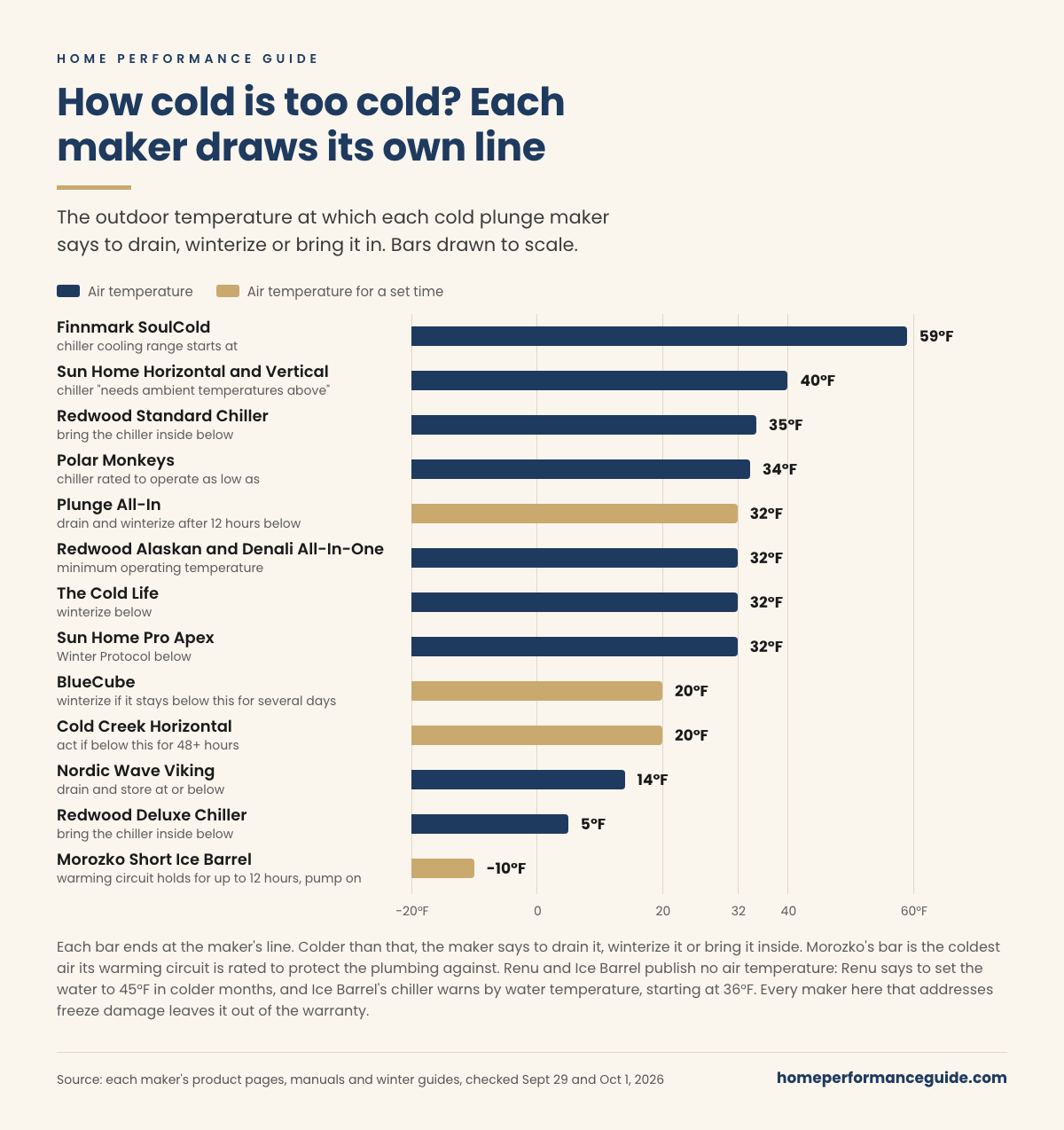
Whether you can keep a cold plunge outside in winter depends on its maker's winter line, and the makers set theirs far apart. Published lines run from 59°F down to Morozko's -10°F for up to 12 hours.
To plunge through freezing weather on a Sun Home model, ask about the Cold Plunge Pro Apex: its manual has a written winter method, "Option B." So does the Cold Plunge Pro's, updated in October 2026. Their product pages say the opposite, so get Sun Home's written answer before you order. As of October 1, 2026, it lists at $15,599 regular, with a sale running.
If your plunge winters indoors or in an insulated garage at 59°F or warmer, the Finnmark SoulCold cools and heats, $6,990 at SaunaKits as of that date. For winters well below freezing, start with BlueCube, Cold Creek, Nordic Wave and Morozko, which publish colder lines.
We read 12 makers' cold-weather rules between September 26 and October 1, 2026.
The short answer
- There are two winter plans, and the model picks yours. Some makers say their plunge can keep running outside through winter if it stays powered and the water keeps moving. Others say the chiller can't run in freezing air at all, so it is drained and winterized or brought inside.
- Match the line to your coldest month. Sun Home says the chiller on its inflatable plunges "needs ambient temperatures above 40°F to run." Plunge, Redwood Outdoors' all-in-one tubs and The Cold Life draw the line at 32°F. BlueCube and Cold Creek act at 20°F, Nordic Wave at 14°F and Redwood's Deluxe Chiller at 5°F.
- Freeze damage is almost always on you. Every maker in this guide that addresses freeze damage excludes it from the warranty.
- Running through winter means power and moving water. The makers that allow it want the plunge plugged in around the clock. BlueCube says a power cut in freezing weather "can cause plumbing damage in under an hour," so the outlet and a backup plan are part of the purchase.
- Read the manual as well as the product page. Sun Home, Polar Monkeys and Morozko each publish winter guidance that disagrees with another page of their own.
How cold is too cold for a cold plunge chiller?
Too cold is wherever your model's maker draws its line, by air, time or water temperature, because the chiller and the plumbing are the parts at risk. Sun Home's Cold Plunge Pro Apex manual puts it plainly: "Water that freezes inside the filtration lines, pump, or chiller expands and breaks them." The same manual notes that the tub itself is insulated, "but the lines in the bay are not."
An "indoor or outdoor" listing doesn't settle it. The makers' own manuals and winter pages tell a different story: no two draw the line in the same place, and they don't measure it the same way. Most give an air temperature. Some add a time limit, such as 12 hours or several days below the line, and Ice Barrel's chiller goes by the water temperature instead.
Hold your spot's coldest winter week against the second column, then read across for what to do.
On a phone, swipe the table sideways for every column.
| Maker and model | Winter line, as published | Measured by | What the maker says to do |
|---|---|---|---|
| Finnmark SoulCold | Ambient range "59~109F (Cooling) 59~95F (Heating)" | Air | Move the chiller "to an inside location or in a properly insulated area during freezing conditions" |
| Sun Home Horizontal and Vertical (inflatable) | The chiller "needs ambient temperatures above 40°F to run" | Air | "Never let water sit in the chiller through freezing weather." |
| Redwood Outdoors, Standard Chiller | Bring the chiller inside "anything below 35°F" | Air | Drain it and move it indoors; the tub can stay out with its hoses capped |
| Polar Monkeys | The chiller is "rated to operate in ambient temperatures as low as 34°F (1.1°C) but is not freeze-proof" | Air | Below freezing, store the chiller in a sheltered space; the tub can stay out "fully drained and covered" |
| Plunge All-In | "below 32°F / 0°C for 12 hours" | Air and time | "drain the Plunge, filter and chiller and fully winterize the Plunge" |
| Redwood Outdoors Alaskan and Denali All-In-One | "The minimum operating temperature for our All-In-One plunge tub systems is 32°F." | Air | Drain and winterize; "You should not use the unit at all while winterized." |
| The Cold Life | Winterize "below 32°F" | Air | Bring the chiller "into a climate controlled environment" when freezing temperatures are expected |
| Sun Home Cold Plunge Pro Apex, and the Cold Plunge Pro (manual updated October 2026) | "32 F to 113 F (0 C to 45 C) in operation; follow the Winter Protocol below 32 F" | Air | Shut it down, or keep plunging with the filtration closed off (details below) |
| Ice Barrel chiller | An alert below 33°F; at 32°F "the risk of a system freeze-over is imminent" | Water | At its first warning level (36°F), winterize and move it somewhere "consistently above freezing" |
| Renu Cold Stoic 2.0, 3.0 and Vero | No air temperature published; "set the temperature to 45°F" in colder months | Water set point | Keep it running 24/7; winterize in "prolonged freezing temperatures" |
| BlueCube | Winterize when temperatures "stay below 20°F (-6°C) for several days" | Air and time | Otherwise it "can run right through winter" if it stays powered |
| Cold Creek Horizontal | Act if temperatures "remain below 20°F for 48+ hours" | Air and time | Drain and bring the chiller indoors, or move the whole tub inside |
| Nordic Wave Viking | "If ambient temperatures reach or fall below 14°F" | Air | Drain it and store it "in a temperature-controlled environment" |
| Redwood Outdoors, Deluxe Chiller | "anything below 5°F (start acting when temps hit ~10°F)" | Air | Move the chiller inside |
| Morozko Short Ice Barrel | A warming circuit protects the plumbing "as low as -10F for up to 12 consecutive hours when the filter pump is on" | Air and time | Run the filter pump 24/7 through winter |
Three of these lines sit above freezing: 59°F, 40°F and 35°F. A chiller listed that way isn't meant to run outside on a cold night even when the water never freezes, so in a cold climate it's a three-season outdoor product or an indoor one.
The 32°F group looks consistent until you read the conditions. Plunge says 12 hours below 32°F. Redwood calls 32°F a minimum operating temperature. Sun Home's Apex and Cold Plunge Pro manuals offer a way to keep using the plunge below 32°F, and Redwood says not to use its all-in-one units at all once they're winterized.
So with Plunge, Redwood's all-in-ones and The Cold Life, plan to drain and winterize once your weather crosses their line.
Checkpoint: your coldest month. If it drops below 32°F and the plunge stays outside, your list is the colder lines: BlueCube, Cold Creek, Nordic Wave and Morozko, plus Renu's Cold Stoic 3.0 with its freeze-protection heater. Sun Home's Cold Plunge Pro Apex and Cold Plunge Pro join them once Sun Home confirms their winter method. If the plunge can winter indoors, Sun Home's Horizontal and Vertical stay in play, drained or in air above 40°F, and so does the Finnmark SoulCold in a room at 59°F or warmer.
Who pays if a cold plunge freezes?
You do, with almost every brand here. These are the warranty lines, word for word:
- Sun Home: "freeze damage is not covered by the warranty" (Apex manual). The inflatable manuals: "Damage caused by freezing conditions or improper water chemistry is not covered under the warranty."
- Plunge: "damage caused by freezing conditions or improper water chemistry are not covered under our warranty."
- Redwood Outdoors: "Damage caused by use in temperatures below 32°F is not covered by the warranty."
- The Cold Life: "Damage due to improper winterization of the product is not covered under our manufacturer's or extended warranties."
- Ice Barrel: "extreme freezing conditions may lead to failure, which is not covered under the product warranty."
- Renu: "Cracked components are not covered by the warranty due to freezing over. It is the customer's responsibility to prevent the unit from freezing over."
- BlueCube: "Failing to winterize properly voids the warranty for freeze-related damage."
- Cold Creek: "Freeze damage caused by improper winterization or loss of water circulation is not covered under warranty."
- Nordic Wave: the warranty excludes "freezing conditions" and "power outages," and "Freeze damage resulting from failure to follow these requirements is not covered under warranty."
- Finnmark: "The limited warranty is void if damage is caused by freezing conditions."
Two brands publish no freeze clause on the pages we read. Morozko's Short Ice Barrel page says it is "warrantied for outdoor use" and carries a 1-year warranty "covering any manufacturing defect." Polar Monkeys' FAQ tells you to drain the tub and shelter the chiller below freezing but doesn't mention the warranty.
Power cuts matter here too. Plunge's warranty terms list "Not fully draining the Plunge or properly storing the Plunge if there is planned or unplanned power loss to the unit for more than 1 hour" as a way to void coverage, and Nordic Wave excludes power outages outright.
What this means for you: a winter mistake comes out of your pocket, so choose the winter plan you'll keep before you choose the plunge. If you're often away in winter, BlueCube says to drain the unit entirely before you leave home for an extended period, so an indoor winter may suit you better.
How to keep a cold plunge from freezing in the winter
For the makers that allow winter use, the instructions come down to four habits.
Keep it plugged in and the water moving
Four makers give the same rule: keep the power on and the water moving, around the clock.
Renu: "Ensure your unit is plugged in and running 24/7. Continuous water flow helps prevent the water from freezing." BlueCube: "As long as the unit has power and water is circulating 24/7, moving water resists freezing." Morozko: "Run your filter pump 24/7 when your Morozko is installed outside during the winter months." Cold Creek: "Continuous water circulation is essential."
Sun Home's inflatable manuals add a daily check: "Monitor the plunge daily when the outside temperature is below 32°F to make sure water keeps flowing." If the water stops flowing, they say to turn the chiller off at once, because running it without flow "forms ice that can break the chiller."
Raise the set temperature
Set the water warmer in winter, at the number your maker names.
Renu: "During colder months, set the temperature to 45°F to help prevent freezing in colder weather." Sun Home's Apex winter option: "Set the temperature to 38 F or higher so the plunge does not enter Ice-Making Mode." Polar Monkeys' blog uses 39°F as its example for a 15°F night, though its own FAQ disagrees about running the chiller below freezing at all (see below).
Keep the lid on and the vents clear
Renu: "Clear Snow from Vents" and "Keep the lid on the unit when it's not in use." Sun Home's Apex manual: "Outdoors, keep the Insulated Lid on whenever the plunge is not in use." Sun Home's inflatable manuals say to keep the tub and chiller clear of "plants, trees, grasses, soil and snow deposits," and the same wording appears among the warranty's conditions.
Plan for a power cut
BlueCube's winterization guide is the most direct: "In freezing weather, a power cut can cause plumbing damage in under an hour." It calls a backup generator "the single best protection for a unit running through winter." With Plunge and Nordic Wave, an outage can also cost you warranty coverage (see above).
What this means for you: a plunge that winters outside needs power you can count on, so price the generator with the plunge. If you can't promise power all winter, buy for an indoor winter instead: the SoulCold in a room at 59°F or warmer, or Sun Home's inflatables in air above 40°F.
How to winterize a cold plunge
When it gets colder than your model's line, or you'll be away, the makers' winterizing steps follow the same pattern: get every drop of water out of anything that can't take ice.
- Unplug it and drain the tub completely. Every maker starts here.
- Take the filters out and store them indoors. BlueCube, in capital letters: "DO NOT LEAVE THE FILTER IN THE UNIT." A wet filter "will freeze and can damage the housing."
- Purge the lines. Sun Home's Apex manual says to use a shop vacuum at the filter openings or "compressed air at no more than 30 psi." BlueCube prefers a small transfer pump, which "evacuates the components more thoroughly than a shop vac." Renu and Nordic Wave suggest a wet/dry vac or "HVAC or vacuum system."
- Empty the pump and the chiller. BlueCube points out that its circulation pumps "do not have drain valves," so draining the tub doesn't empty them; it says to apply suction at the pump ports and then blow them out with compressed air. Redwood and The Cold Life both say to tip the standalone chiller so the water runs out.
- Leave it open. Sun Home and Renu say to leave the valves open, and Redwood says to leave the system open "so water has room to expand if any remains."
- Cover it. BlueCube: "Put the insulating cover on the tub." Sun Home's Apex manual says to set the lid "slightly ajar so air can circulate."
Two brands add their own rules. Plunge's winterizing uses antifreeze, and it names "WINTER PRUF® Concentrate Antifreeze 32OZ" as "the only antifreeze that is compatible with the Plunge system." Redwood says not to use its all-in-one units "at all while winterized."
For the Ice Barrel itself, Ice Barrel's winter page suggests stirring the water, running a submersible pump, breaking ice early or moving the barrel into a garage. Finnmark's manual says to remove standing water from the SoulCold's chiller before storing it for more than a month: "remove the hoses and the filter cap. Tilt the chiller to the side to properly drain all water."
So before the first freeze, have a shop vacuum or a small transfer pump on hand, and compressed air if your manual calls for it. Keep a dry shelf indoors for the filters and any standalone chiller.
Where makers' own winter numbers don't line up, and what to confirm before you order
These are the conflicts we found inside a single maker's own pages. Put each one to the maker in writing before you pay, and plan your winter around the figure it confirms.
Sun Home: the product pages against the Apex manual
Sun Home's product pages for the Pro, Apex and Titan say the plunge can go "Indoors or outdoors where airflow and drainage allow" but is "not running in sub-freezing outdoor temperatures," and that "The one rule: don't leave it sitting out through sub-freezing weather." The Apex owner's manual (version 2.1, September 2026) has an "Option B: Plunge through winter" that says: "You can keep the tub full and plunge through freezing weather if the filtration bay is protected."
Option B means closing both shut-off valves, removing the filters, purging the lines, setting 38°F or higher, leaving the Polar Jet off, and sanitizing by hand: "skim daily, and change the water every 2 weeks." We didn't find it in the Sun Home manuals we read for the Vertical and the Horizontal. Sun Home's Cold Plunge Pro manual, updated in October 2026 (version 4.0), now carries the same Option B.
Plan on the product page's rule until Sun Home answers in writing. If it won't confirm the winter method for an outdoor Apex or Pro, BlueCube, Cold Creek, Nordic Wave and Morozko publish colder winter lines.
Sun Home inflatables: 40°F or below 32°F?
The Horizontal and Vertical product pages say the chiller "needs ambient temperatures above 40°F to run." Both manuals tell you to monitor the plunge "daily when the outside temperature is below 32°F to make sure water keeps flowing," which assumes it is running in freezing air.
Plan on 40°F, the stricter line, until Sun Home says otherwise in writing.
Polar Monkeys: 34°F in the FAQ, 15°F on the blog
Polar Monkeys' FAQ says the chiller is "rated to operate in ambient temperatures as low as 34°F (1.1°C) but is not freeze-proof," and that below freezing you should "store the chiller in a sheltered space."
Its blog post on year-round outdoor use says: "When the outdoor temperature drops to 15°F ... You can set the digital thermostat to 39°F, and the unit will actually act as a mild heater." The same post answers the question in its title, "Can Polar Monkeys cold plunge tubs be used outdoors year-round?", with "The short answer is an absolute yes."
Plan on the FAQ's 34°F and a sheltered winter for the chiller until Polar Monkeys confirms the blog's answer in writing, or look to the colder lines in the picks below.
Morozko: 10F, -10F, and 38F or 40F
Morozko's winter post says flowing water keeps its plumbing liquid "at temperatures as low at 10F." Its Short Ice Barrel page says the warming circuit protects the filter, pump and piping "as low as -10F for up to 12 consecutive hours when the filter pump is on," and its technology page says "Outdoor durability in temperatures from -10F to +120F." The winter post's summary says the filter heater comes on when the air "drops below 38F," and the same post's body says "below 40F."
Plan on 10F, the stricter figure, until Morozko says which one applies; Morozko is in the below-freezing group in the picks.
BlueCube: a floor or a trigger?
The C1 product page says the chiller "operates down to 20°F ambient," which reads like a hard minimum. BlueCube's winterization guide treats 20°F as a duration trigger instead: the plunge "can run right through winter," and winterizing "becomes necessary during sustained cold spells where temperatures stay below 20°F (-6°C) for several days."
Plan on 20°F as a floor until BlueCube confirms otherwise in writing.
Renu Vero: the version decides it
Renu says freeze protection "is included when you choose the Hot + Cold option with the Vero, but it is not included with the Cold-only option, as the Cold-only model does not have a heating element," and the same page gives every Vero owner the same advice to keep it running outdoors 24/7. If you're buying the Cold-only Vero for an outdoor spot in a cold climate, ask Renu about it first. The Hot + Cold Vero is in the picks below.
The questions to send
Paste your maker's questions into an email before you pay, and keep the written answers with your order.
- Sun Home, Apex: Does Option B in the owner's manual (version 2.1) apply to an Apex installed outdoors, and does the same Option B in the Cold Plunge Pro's manual (version 4.0, updated in October 2026) apply to a Pro outdoors?
- Sun Home, Horizontal and Vertical: The product pages say the chiller needs air above 40°F, and the manuals describe a daily check below 32°F. Which applies outdoors?
- Polar Monkeys: Your FAQ rates the chiller to 34°F of air, and your blog sets it to 39°F on a 15°F night. Which applies to an outdoor install, and does the warranty cover freeze damage?
- Morozko, Short Ice Barrel: Is the plumbing protected to 10F or to -10F, does the filter heater come on below 38F or below 40F, and does the 1-year warranty cover freeze damage?
- BlueCube, C1: Is 20°F a floor for the chiller, or a trigger only after several days?
- Renu: What is the lowest air temperature you allow for an outdoor install, with or without the Hot + Cold option?
- Redwood Outdoors, Deluxe Chiller: You list 5°F for the Deluxe Chiller, and your warranty excludes "Damage caused by use in temperatures below 32°F." Does that line apply to the Deluxe Chiller outdoors?
Is your outdoor outlet ready for winter?
A plunge that stays outside through winter also keeps its plug outside, so the outlet has to meet your model's rules:
- Keep the power dry. Sun Home's inflatable manuals: "the chiller's power source must stay dry and covered, do not operate the unit in rain." Polar Monkeys' blog: "Use a weatherproof outdoor outlet cover to protect the connection from rain and snow."
- Test the GFCI. Sun Home's Apex manual: "Test the GFCI once a week using its TEST and RESET buttons; if it does not trip and reset, stop using the plunge and call an electrician."
- Extension cords: the makers disagree. Plunge: "Extension cords are prohibited." Sun Home's Apex manual: "Never use an extension cord, power strip, or plug adapter," and its Vertical manual says the same. Sun Home's Horizontal manual says: "If an extension cord is absolutely necessary, a 11-ampere cord should be used." Finnmark's SoulCold manual allows "a 14 AWG cord with a single plug end." Follow the manual for your model.
That last line can decide the model. If the only outlet in reach needs a cord, the Apex and the Vertical are out. The Horizontal's and the SoulCold's manuals allow one only on their stated terms, so an outlet closer to the spot is the cleaner fix.
Hand your electrician the manual's own lines. For the Apex, that's a dedicated 120V, 15 A GFCI circuit and no extension cord, plus a weatherproof cover and the distance from your panel to the spot.
Our cold plunge electrical requirements guide lists each maker's circuit, GFCI and plug requirements. If a sauna is going in the yard too, ask about both circuits on the same visit: our outdoor sauna picks list the power each maker publishes for seven backyard saunas.
Which cold plunge to get for your winter
Picture the first frost of the year, a clear morning with the deck rail gone white. The plunge sits at the end of the deck on its own GFCI circuit, the outlet under its weatherproof cover. You brush the frost off the insulated lid, raise it and step in.
Your coldest month decides which plunge gets you there:
- Your winters stay below freezing and the plunge stays out: BlueCube, Cold Creek, Nordic Wave or Morozko, which publish colder lines, or Renu's Cold Stoic 3.0. Hold your coldest week against each line in the table above.
- You want a Sun Home plunge that stays out through freezing weather: the Cold Plunge Pro Apex, whose manual has a written winter method; Sun Home's Cold Plunge Pro manual, updated in October 2026, now has the same one. See the Cold Plunge Pro Apex at Sun Home
- Your plunge can spend winter in a garage or basement, drained or running where the air stays above 40°F: Sun Home's Horizontal or Vertical. See the Horizontal at Sun Home
- You want cold and hot water in one cedar cabinet, in a room that stays at 59°F or warmer all winter: the Finnmark SoulCold. See the Finnmark SoulCold at SaunaKits
Sun Home Cold Plunge Pro Apex: to keep plunging through freezing weather
The Apex's manual has a written way to keep using the plunge through freezing weather, in its "Option B" section, and Sun Home's Cold Plunge Pro manual, updated in October 2026, now has the same section. Its product page says the opposite, so send Sun Home question 1 above before you plan on winter use. The manual lists an operating range of 32°F to 113°F of air, a minimum water temperature of 28°F, and a dedicated 120V, 15 A GFCI circuit. Book the electrician for that circuit before delivery.
As of October 1, 2026, the regular price is $15,599, and a sale was running. By our arithmetic, that's $11,500 more than the Horizontal's $4,099 regular price as of that date, so be sure an outdoor winter is your plan before you pay the difference.
- Best for: a deck where winter drops below 32°F and you'll keep plunging, once Sun Home confirms Option B.
- Skip it if: the only outlet in reach needs an extension cord, which the manual rules out.
- Main compromise: Option B closes off the filtration, so in winter you skim daily and change the water every 2 weeks.
If Sun Home says yes, order the Apex; if it won't, plan on the product page's rule or look to the colder lines below.
Check the Cold Plunge Pro Apex at Sun Home
Sun Home Horizontal and Vertical: three seasons outside, winter in the garage
Inflatable tubs with a chiller, at the lowest prices of the three picks here. As of October 1, 2026, the regular prices are $4,099 for the Horizontal and $3,899 for the Vertical, and both were on sale.
- Best for: a deck from spring to fall, then a garage or basement that stays above 40°F for the winter.
- Skip it if: the plunge has to stay outside through nights below 40°F.
- Main compromise: the Vertical's manual rules out an extension cord, and the Horizontal's allows an 11-ampere cord only if one is "absolutely necessary," so plan on an outlet within reach.
The product pages say the chiller "needs ambient temperatures above 40°F to run," while both manuals have you check it daily below 32°F, so plan on 40°F until Sun Home answers question 2.
See the Horizontal at Sun Home
Finnmark SoulCold: cold and hot water in one cedar cabinet
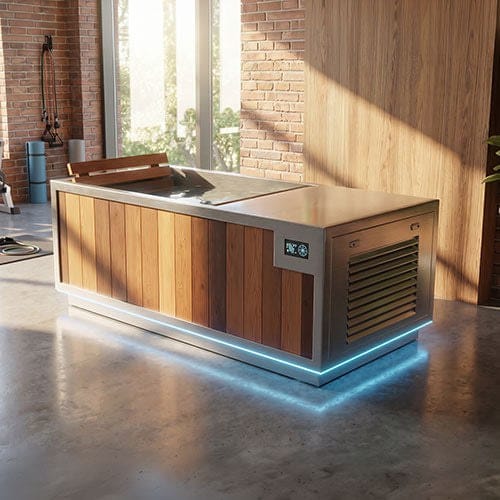
A stainless steel tub in a cedar cabinet with a chiller that cools and heats. Finnmark's manual lists its ambient range as "59~109F (Cooling) 59~95F (Heating)" and says the chiller "should be moved to an inside location or in a properly insulated area during freezing conditions." As of October 1, 2026, the price at SaunaKits is $6,990. Our Plunge alternatives guide covers its power and warranty documents.
- Best for: an indoor room or an insulated garage that stays at 59°F or warmer.
- Skip it if: it has to sit outside through freezing weather, when Finnmark's manual moves the chiller inside.
- Main compromise: its 59°F line is the warmest in the table above, so a cool spring or fall night outside already falls below its cooling range.
Finnmark SoulCold
A 1-person cold and hot plunge with a built-in chiller. Plan an indoor or garage spot for winter. $6,990 at SaunaKits when we checked on October 1, 2026.
Check the SoulCold at SaunaKitsWith a spot that stays at 59°F or warmer all winter, the SoulCold is ready to order. Check the Finnmark SoulCold at SaunaKits
BlueCube, Cold Creek, Nordic Wave, Morozko or Renu: to stay outside below freezing
BlueCube, Cold Creek, Nordic Wave and Morozko publish colder winter lines than the three picks above, from 20°F down to Morozko's -10F for up to 12 hours with the pump on. Renu's Cold Stoic 3.0 and Vero Hot + Cold come with freeze-protection heaters, though Renu publishes no air temperature.
Get Nordic Wave's Viking if your coldest week stays above 14°F and your power is steady: Nordic Wave rates it for year-round use down to 14°F. For nights toward -10F, look at Morozko's Short Ice Barrel; its winter post says 10F instead, so ask which applies with the Morozko question above.
Redwood's Deluxe Chiller lists 5°F, and the Redwood warranty line above excludes "Damage caused by use in temperatures below 32°F," so ask Redwood in writing whether that line covers the Deluxe Chiller (question 7) before you count on 5°F.
- Best for: a plunge that stays outside through winters below 32°F, on power around the clock.
- Skip it if: storms cut your power and a generator isn't in the plan; Nordic Wave's warranty excludes "power outages."
- Main compromise: BlueCube's and Morozko's own pages disagree on their numbers, and Renu gives no air line to check.
Send BlueCube, Morozko and Renu their questions above. Cold Creek and Nordic Wave each publish one line, so hold your coldest week against it, then order from the maker.
Before you order a cold plunge for outdoor winter use
- Find the chiller's minimum air temperature in the manual, as well as on the product page. Sun Home, Polar Monkeys, Morozko and BlueCube each say something different on different pages.
- Check whether the chiller heats or has a freeze-protection heater, and whether the version you're ordering includes it. Renu's Cold Stoic 3.0 has one, and the Vero has it only in the Hot + Cold version. Cold Creek's Horizontal chiller has a freeze-protection heater, which Cold Creek says "does not eliminate the risk of freezing during extreme or prolonged cold weather."
- Note what the line is measured in: air temperature alone, air temperature for a set time, or water temperature.
- Plan as if freeze damage is yours to pay for: every warranty line above says so, and Morozko and Polar Monkeys publish no freeze clause, so ask them in writing.
- Decide where the chiller or the tub goes when it has to come inside, and whether it fits there. Cold Creek gives its tub as "approximately 170 lbs dry with the chiller removed." If the plunge will spend winter indoors full of water, check the floor first; our cold plunge floor load guide has the weights.
- Plan the power: a dedicated GFCI circuit, a weatherproof cover, no extension cord unless your manual allows one, and a generator if your area loses power in storms.
- Send your maker its questions from the list above.
- Then order for your winter. If the plunge winters indoors at 59°F or warmer, the SoulCold fits that plan: See the Finnmark SoulCold at SaunaKits
- Or stay outside on a Sun Home plunge. The Apex is the one if Sun Home says yes to question 1: See the Cold Plunge Pro Apex at Sun Home
- Or stay outside with a colder line. If Sun Home says no, or your winters run well below freezing, order from BlueCube, Cold Creek, Nordic Wave, Morozko or Renu once that maker's line and answers fit your coldest week.
Running a chiller through winter, especially one that heats, also changes the electric bill. Our cold plunge running cost guide shows how to work it out from a chiller's wattage.
Common questions
Can you keep a cold plunge outside in winter?
Some models, yes, and some no. Makers that allow it, such as BlueCube, Renu, Cold Creek and Morozko, want the plunge powered with the water moving, and each sets its own cold limit. Nordic Wave rates its Viking for year-round use down to 14°F. Others say to drain and winterize at 32°F (Plunge, Redwood's all-in-one tubs, The Cold Life), and Sun Home's inflatable chillers need air above 40°F to run.
How do you keep a cold plunge from freezing?
The makers that allow winter use say to keep it plugged in with the water moving, keep the lid on, clear snow off the vents and plan for power cuts. Renu says to set 45°F in colder months, and Sun Home's Apex manual says 38°F or higher for its winter option. BlueCube says a power cut in freezing weather can cause plumbing damage in under an hour.
What temperature is too cold for a cold plunge chiller?
It depends on the maker. Published limits include 59°F of air for Finnmark's SoulCold cooling range, 40°F for Sun Home's inflatable chillers, 35°F for Redwood's Standard Chiller, 34°F for Polar Monkeys, 32°F for Plunge after 12 hours, 20°F for BlueCube over several days, 14°F for Nordic Wave and 5°F for Redwood's Deluxe Chiller.
Does a cold plunge warranty cover freeze damage?
Not with the brands that address it. Sun Home, Plunge, Redwood Outdoors, The Cold Life, Ice Barrel, Renu, BlueCube, Cold Creek, Nordic Wave and Finnmark all exclude freeze damage, and Nordic Wave also excludes power outages. Plunge's terms list leaving a unit undrained through a power loss of more than one hour as a way to void coverage.
Do you have to winterize a cold plunge?
If it stays outside where temperatures drop below your model's published line, the makers say yes. Winterizing means draining the tub, removing the filters, purging the lines, pump and chiller, and leaving the system open. Plunge also requires its own antifreeze, and Redwood says not to use its all-in-one units at all while winterized.
Your next step
Tonight, look at the place the plunge or its chiller will spend the winter: the route in, the floor under it, and whether there's an outlet on a dedicated circuit. Photograph that outlet and your panel for the electrician, and note your spot's coldest winter week, the number every line above is read against. The free Home Performance Room Planner lists the measurements to take first, whether the room is for a cold plunge or a sauna.
Get the free Home Performance Room Planner
We read the makers' own documents cited above, checked September 26 to October 1, 2026, and did not test these plunges. This is general information, not electrical, code or medical advice, so confirm your model's details with its maker, your local authority and a licensed electrician. Home Performance Guide earns a commission on some links here, at no extra cost to you (affiliate disclosure, editorial standards). We have also applied to Renu's and Polar Monkeys' affiliate programs; neither has a link here.
Get the Room Planner.
Thirteen measurements to take before you buy sauna or recovery equipment, with the manufacturer specs and code references behind each one. Free. Planning a golf simulator instead? There is a twelve-measurement golf planner too.
ABOUT
Verified buyer guides for home sauna, cold plunge and recovery equipment. Specs from the manufacturers, not from other blogs.