Can Your Floor Hold a Cold Plunge?
By Evan Reid, with research from the HPG Research Team · Updated Oct. 17, 2026
Deck plunges sit steps from the back door, with joists under them carrying every gallon. Settle the cold plunge floor load first: filled, the five tubs in our first table weigh 886 to 2,029 pounds, by the makers' figures and our arithmetic.
The math is one line: dry weight plus 8.34 pounds per gallon. On a concrete slab on grade, you're almost certainly fine. Over joists, divide that weight by the tub's own footprint; if it runs several times the code's 40 psf, get a structural engineer before you order.
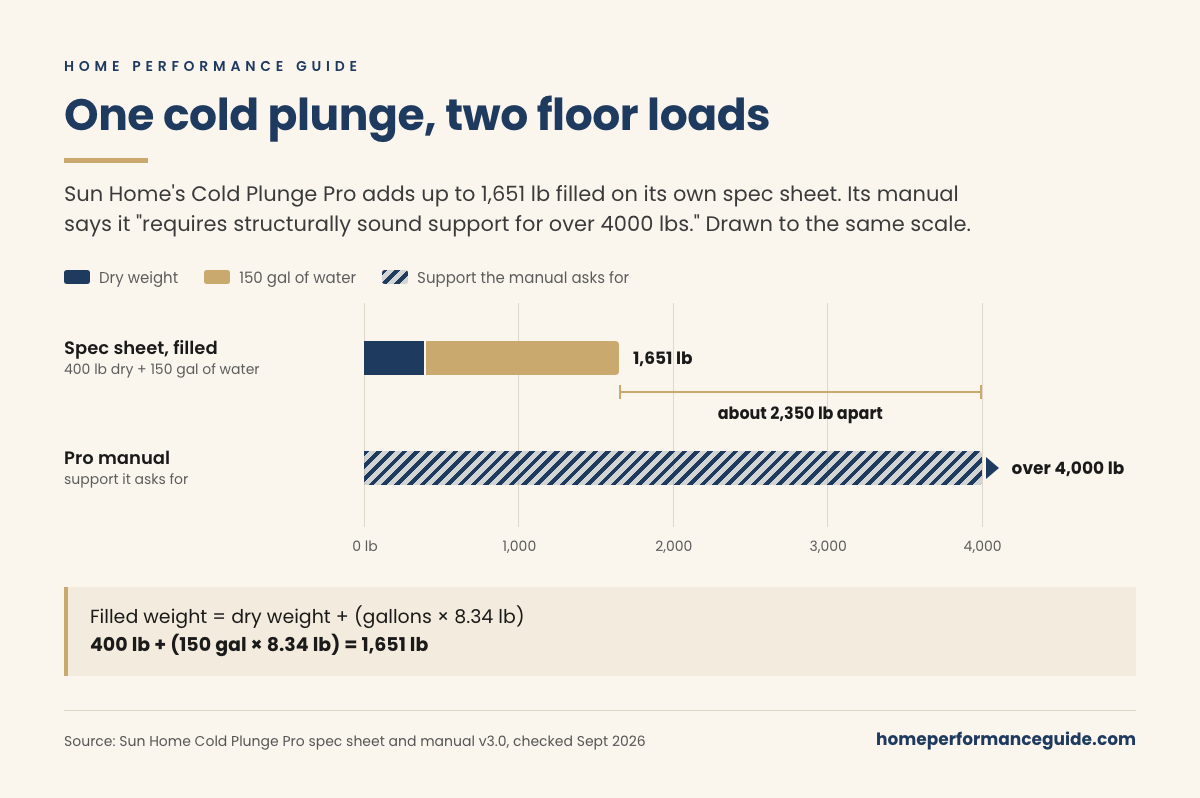
Then check each maker against itself. Sun Home's spec sheet puts the Cold Plunge Pro at 400 pounds dry and 150 gallons, 1,651 pounds filled by our arithmetic. Its manual, updated in October 2026, now agrees: "about 1,650 lb." Its older manual, still linked online, says "over 4000 lbs."
In September 2026, we read six makers' product pages, help centers and manuals against the code table for residential floors.
- Your spot sits on joists: start with a laydown shape. Renu's Aurelius spreads about 1,065 pounds over 24.7 square feet, 43 psf by our arithmetic, the lowest in the per-square-foot table below, though still above the code's 40. See the Aurelius at Renu Therapy
- You want a Sun Home plunge on a deck or upper floor: the Apex. Sun Home publishes "over 2,500 lb" of support with a bather, above the 2,029 pounds of tub and water we work out from its spec sheet, so your engineer gets one number to work from once Sun Home confirms it in writing. See the lineup at Sun Home Saunas
- You want a round barrel on a deck or upper floor: book the engineer first. The Polar Monkeys Barrel puts 197 psf on its 6.3 square feet by our arithmetic, the most concentrated load here.
- Your spot is a concrete slab on grade: the floor is unlikely to be the problem, so clearances and power decide. If the Sun Home Cold Plunge Pro is on your list, a slab is the easiest spot for it; settle its two sets of clearance figures with Sun Home first.
What will your cold plunge weigh once it's filled?
Dry weight + (gallons × 8.34) = filled weight
That's the whole formula, and it's the part you control. Run it on the maker's own published dry weight and capacity, and you have a number you can defend.
Find the tub you're considering in the first column, then compare the maker's filled figure with the arithmetic in the last column.
| Model | Dry weight | Capacity | Filled, per the manufacturer | Filled, by arithmetic |
|---|---|---|---|---|
| Plunge All-In | 238 lb | 105 gal | 1,150 lb | 1,114 lb |
| Sun Home Cold Plunge Pro | 400 lb | 150 gal | "About 1,650 lb" (manual updated October 2026; the older manual asked for "over 4000 lbs" of support) | 1,651 lb |
| Sun Home Apex | 528 lb | 180 gal | "over 2,500 lb" of support, with bather | 2,029 lb |
| Polar Monkeys Barrel | 156 lb | 130 gal | 1,240 lb | 1,240 lb |
| Ice Barrel 500 | 104 lb | 94 gal | 886 lb | 888 lb |
Filled-by-arithmetic figures are calculated from each manufacturer's own published dry weight and capacity at 8.34 lb per gallon. They are not manufacturer claims.
Ice Barrel and Polar Monkeys agree with themselves almost exactly. Plunge is 36 pounds off, too little to change a floor decision. Sun Home's older Pro manual asked for more than twice what its own published numbers add up to, a gap of about 2,350 pounds. Sun Home's manual, updated in October 2026, closes it: "about 1,650 lb (400 lb dry plus 150 gal of water)," within a pound of the arithmetic.
The Apex's figures now agree. When we first checked, its help page asked buyers to confirm 4,000 pounds of support; as of September 26, 2026, Sun Home publishes "over 2,500 lb, including the filled plunge and bather," and 2,029 pounds of plunge and water sits under it.
What this means for you: with Sun Home's manual updated in October 2026, the maker's figures now line up with the arithmetic for all five tubs. Hand an engineer the larger of the two, which for the Apex is Sun Home's "over 2,500 lb" with a bather. For the Pro, plan around 1,651 pounds plus a bather, and ask Sun Home to confirm the updated manual governs your order, since the older one is still linked on its help center.
What does a published weight actually include?
Find out what each published number covers before you compare two tubs. It matters more than the arithmetic.
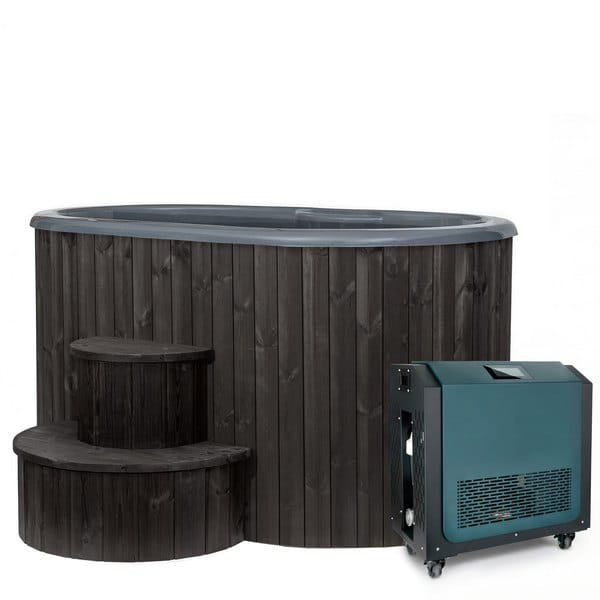
A cold plunge is often two objects. Some models are a single sealed unit. Others are a tub plus a separate chiller module that sits beside it on its own feet. Renu says so explicitly about its Vero: the tub and chiller are separate modules, and the chiller weighs 132 pounds on its own.
A published filled weight may include a chiller that does not stand on the tub's footprint. Renu's Vero is listed at roughly 1,080 pounds filled. Work backwards: 153 pounds for tub and lid, plus 132 for the chiller, plus 95 gallons of water, is 1,077.
The published weight includes the chiller module. Put that figure over the tank's 42 by 33 inch footprint and you have loaded 132 pounds onto a spot where it does not sit.
And a published footprint may include a chiller that the weight does not. Polar Monkeys lists the Barrel at 1,240 pounds and gives a total footprint of 71 by 34.25 inches. But 1,240 is exactly 156 pounds plus 130 gallons, so it is tub and water only.
That footprint is labeled as the total system envelope. The barrel itself is 34 inches in diameter, which is about 6.3 square feet.
So one maker's weight is too inclusive for its footprint, and another's footprint is too inclusive for its weight, in opposite directions. Neither is labeled.
The rule that follows: before dividing weight by area, confirm both describe the same object. If the tub and chiller are separate, work out the tub's own weight over the tub's own footprint, then treat the chiller as its own smaller load nearby. If the plunge on your list has a separate chiller, ask the maker for the tub-only weight before you order.
Cold plunge floor load per square foot: which shapes concentrate it?
Floors are rated in pounds per square foot, so what counts is the weight spread over the tub's own footprint.
Each row puts tub and water only over the tub's own footprint, with and without a 200 pound person, so find your tub and read across to the psf.
| Model | Tub + water | Tub footprint | psf | psf with a bather |
|---|---|---|---|---|
| Polar Monkeys Barrel | 1,240 lb | 6.3 sq ft | 197 | 229 |
| Renu Vero | 945 lb | 9.6 sq ft | 98 | 119 |
| Sun Home Cold Plunge Pro | 1,651 lb | 18.3 sq ft | 90 | 101 |
| Plunge All-In | 1,114 lb | 16.8 sq ft | 66 | 78 |
| Renu Aurelius | ~1,065 lb | 24.7 sq ft | 43 | 51 |
Every psf figure here is by our arithmetic. The Aurelius figure uses Renu's published filled weight, which may include its chiller as the Vero's does, in which case its true tub-only load is lower still.
The round barrel is the outlier by a distance. It is one of the lightest tubs here empty, at 156 pounds dry. Yet it concentrates nearly three times the load of a Plunge All-In, because a 34 inch circle is a very small piece of floor.
Footprint matters more than weight. The Aurelius is a laydown model weighing about the same as the Vero and produces less than half the load, because it spreads over two and a half times the area. The compact upright and the round barrel are the shapes to watch.
So if the plunge is headed for joists, put the lowest-psf tubs at the top of your list: the Aurelius at 43 psf and the Plunge All-In at 66, by our arithmetic. A compact upright or a round barrel is an engineer question from the start.
What load is your floor designed to carry?
Residential floors are designed to the live load figures in the International Residential Code, section R301.5, so find the room your tub would sit in.
| Space | Live load |
|---|---|
| Rooms other than sleeping rooms | 40 psf |
| Sleeping rooms | 30 psf |
| Exterior balconies and decks | 40 psf |
One caveat, stated plainly. The ICC publishes the code text behind a paywall, so we verified these against state adoptions and secondary sources rather than ICC's own document. The habitable-room and sleeping-room figures were consistent everywhere we checked. The deck figure is the one to watch: some jurisdictions amend it upward, Washington State to 60 psf.
Code figures follow the edition and amendments your area adopted, so confirm what applies where you live.
Set that against the table and every unit here exceeds the figure for the room it would sit in. With a bather, the barrel in a bedroom is more than seven times the 30 psf value.
The same test works for a hard shell hyperbaric chamber headed for a bedroom: our hyperbaric chamber room guide runs nine chambers through it, and two hard shells load a floor at more than three times that 30 psf figure before anyone sits inside, by our arithmetic.
If the plunge is going on a deck, ask your building department for its deck figure before you compare anything. Then read the next section before you rule a tub out.
Does going over 40 psf mean your floor fails?
Not by itself. Table R301.5 values are uniformly distributed live loads. The assumption is weight spread evenly across the whole floor, which is how joist span tables are built.
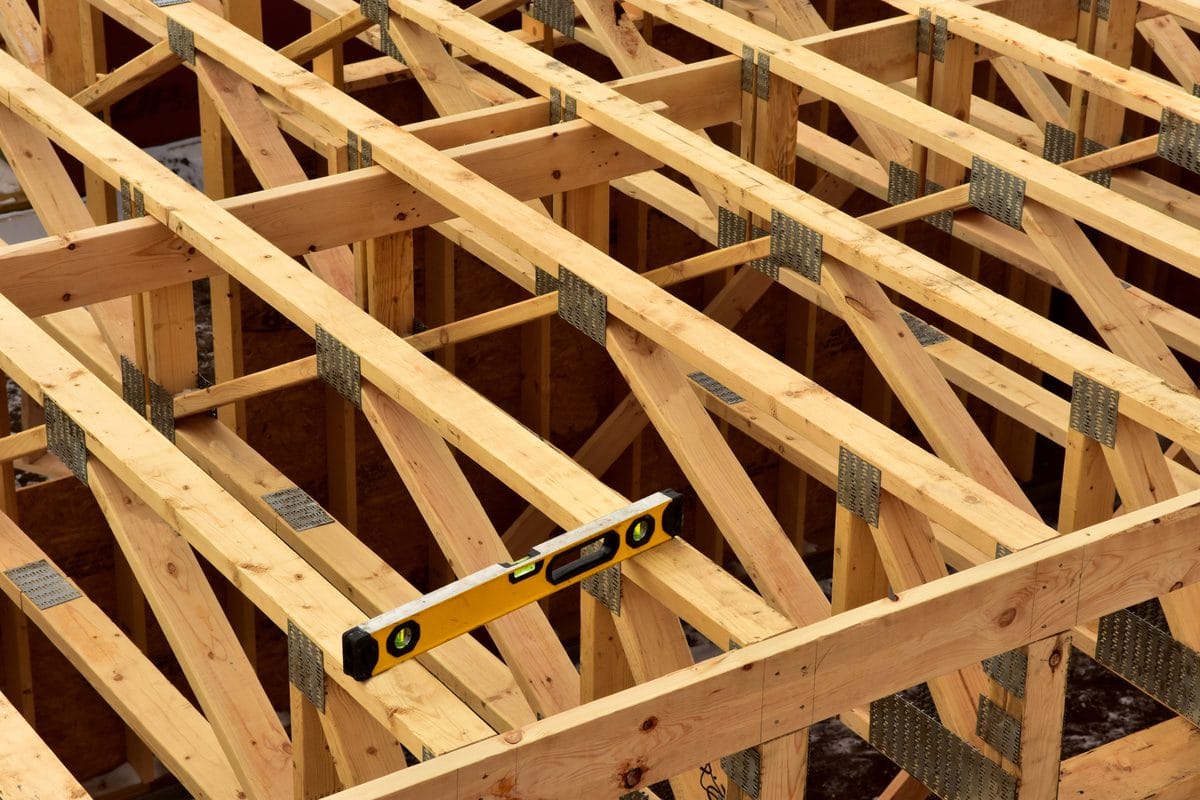
A cold plunge is the opposite: a concentrated, permanent load on ten to twenty-five square feet, bearing on perhaps four to six joists.
So comparing your psf to 40 is a screening test, and the framing gives the verdict. What actually decides it:
- Joist size, species, grade and spacing
- The span, meaning the distance between supports
- Whether the tub sits near a bearing wall or out at mid-span
- Whether it runs across the joists or parallel to them
A tub set perpendicular across six joists near a bearing wall behaves completely differently from the same tub mid-span over two. Code live loads also carry safety factors and sit alongside separate dead load capacity, so going over 40 psf in one spot doesn't mean the floor fails.
What the number is good for is knowing whether to ask. On a slab-on-grade ground floor you're almost certainly fine, because the load goes straight into the ground. Over a crawlspace, a basement, an upper floor or a deck, you have joists, and if your figure is several times the code value, that's a question for a structural engineer before you order.
Bring the engineer three things: the filled weight, the footprint, and exactly where in the room it would sit.
Checkpoint: what's under the spot. If it's a slab on grade, every tub here can stay on your list, and clearances, power and drainage decide the rest. If it's joists, run the psf screen: Renu's Aurelius and Plunge's All-In start closest to the code figure, and any tub several times over it goes to a structural engineer before you order. Settle this before you compare features.
Which fill level should you plan the floor for?
Use the fill level you will actually use, and use the manufacturer's own filled weight where they publish one. Where they do not, do the arithmetic at the top of the range, because that is the worst case your floor has to survive.
One more trap is easy to miss: Renu publishes capacity as a range, 95 to 125 gallons depending on fill level for the Siberian Pro, 91 to 104 for the Cold Stoic 3.0.
Pick a number off the top of that range and the arithmetic disagrees with the manufacturer's published filled weight, and it looks like the manufacturer got it wrong. Pick the bottom and it looks like they were conservative. Neither means Renu got it wrong. A range read as a single point does that.
For a Siberian Pro, plan on 125 gallons; for a Cold Stoic 3.0, 104.
Desert Plunge has the same shape of thing from the other direction. It publishes 105 gallons filled to the top, a suggested fill level of roughly 65 to 70 gallons, and a weight with water of 800 to 950 pounds. Those describe different fill states, and the page does not say which weight goes with which.
For a Desert Plunge, don't stop at 950. Ask Desert Plunge for the dry weight, add 105 gallons at 8.34 pounds each, and plan on whichever is higher, that or 950, until Desert Plunge says which weight goes with which fill.
Renu's Vero is listed at about 1,080 and about 895 pounds: which do you plan for?
Plan for the higher one until Renu says what each figure includes. Renu publishes the Vero's filled weight as approximately 1,080 pounds on one page and approximately 895 on another.
That is a 185 pound spread on the same product from the same company. The chiller alone is 132 pounds, less than the gap, so the two pages may count different parts. Neither page says.
The same tub can have more than one correct weight, depending on what's on the scale. Before you size a floor, find out which one you're holding. Ask Renu in writing which parts each number includes; the question is in the list below.
What to confirm in writing before you order
Four more published contradictions touch the order: three on Sun Home's own Pro pages and one between Plunge and a dealer. None rules a tub out. Each comes with the number to plan around, and the list after them holds the questions to send before you pay.
Sun Home's clearance instructions disagree with each other. The Cold Plunge Pro product page specifies 12 inches of airflow at the sides and 36 at the front. Its own installation page specifies at least 27 inches on the large vent side and at least 15 on the small one. If you are planning an alcove, those two documents give different answers about whether it fits.
Until Sun Home says which page governs, plan to the larger figures from both pages: at least 27 inches on the large vent side, 15 on the small vent side and 36 in front. Ask Sun Home which faces the vents are on.
Sun Home's cold weather limits disagree too. The product page lists a minimum water temperature of 28°F. The installation page says not to operate the chiller below 32°F outside. For a deck plunge in a cold climate, plan to stop running the chiller when the outside air drops below 32°F, the installation page's line, until Sun Home answers.
If your plunge will stay on the deck all winter, our guide to keeping a cold plunge outside in winter lines up the cold-weather rules 12 makers publish and who pays if something freezes.
And this one is off by a factor of ten. Sun Home's Cold Plunge Pro information page says, twice:
Install at least 15 meters (5 FEET) away from all metal surfaces.
Fifteen meters is 49 feet. It is almost certainly meant to read 1.5 meters, which is 4.9 feet and matches the parenthetical. Taken literally, no house could meet it. Plan on the 5 feet in the parenthetical, and ask Sun Home to correct the page.
A dealer disagrees with the manufacturer. Plunge's own site lists the All-In at 238 pounds dry with 105 gallons. Rogue Fitness, an authorized dealer, lists the same unit at 270 pounds empty with roughly 100 gallons. Use the manufacturer's figure.
Email these before you order: the first five go to Sun Home, the next two to Renu and the last to Desert Plunge.
- Your Cold Plunge Pro manual, updated in October 2026, says the filled Pro weighs about 1,650 lb, while the older manual still linked on your help center asks for support for over 4000 lbs. Which one governs an order placed today?
- The Pro's product page asks for 12 inches at the sides and 36 at the front; its installation page asks for at least 27 inches on the large vent side and 15 on the small one. Which clearances apply, and which faces of the unit are the vent sides?
- The Pro's product page lists a 28°F minimum water temperature, and its installation page says not to run the chiller below 32°F outside. Which limit applies to an outdoor install?
- The Pro's information page says to install at least 15 meters (5 feet) from metal surfaces. Is the intended distance 1.5 meters?
- What is the Apex's own footprint, tub only, so a structural engineer can work out its load per square foot? Can you also confirm in writing that "over 2,500 lb" is its current support figure?
- One Vero page lists about 1,080 pounds filled and another about 895. Which parts does each figure include?
- Does the Aurelius's published filled weight include a chiller, and what does it weigh filled with tub and water only?
- Your page lists 800 to 950 pounds with water. Which weight goes with the 105 gallon fill, which with the suggested 65 to 70, and what does the tub weigh dry?
The first four questions decide the Pro. Its pick block below says what to do if Sun Home won't answer.
What do the brands' own floor-load articles leave out?
The code section and their own weights. We read the two manufacturer articles currently ranking for cold plunge deck and floor load questions. Both reference the International Residential Code. Neither gives a section number, a table, or an edition.
One links to the code publisher's homepage.
More striking: neither article mentions its own products' weights. One brand's article about cold plunges on decks works through load figures in the abstract. It never states that its own Cold Plunge Pro is about 1,651 pounds filled, or that the Pro's older manual asked for support for over 4,000 pounds. Sun Home's manual, updated in October 2026, now prints the filled weight itself: "about 1,650 lb."
Every tub figure we work from comes from the makers' own pages. So when a brand's article says a deck can take a plunge, check it against that brand's own weight and support figures before you order.
Which cold plunge to get for your floor
Picture an early fall morning on the deck, with low sun across the boards and a towel over the rail. The plunge sits where your engineer cleared it, set across the joists near the bearing wall. You lift the lid and step into the cold water.
Sun Home Saunas makes the Cold Plunge Pro and the Apex discussed above, and its own documents supplied several of the findings here. None of that rules either one out. Read Sun Home's installation page with its product page before you order; the picks below give you the numbers to plan around on each floor.
Sun Home Cold Plunge Pro: if it's on your list and your spot is a slab
On a slab, the floor question is all but settled, so the Pro comes down to its clearances. Sun Home's spec sheet gives 400 pounds dry and 150 gallons, 1,651 pounds filled by our arithmetic. If the Pro is your choice, a slab spot that clears the larger figures in Best for below is where it makes sense.
- Best for: a slab-on-grade spot with room for the larger figures from both Sun Home pages, 27 inches on the large vent side, 15 on the small vent side and 36 in front, once Sun Home says which faces the vents are on.
- Skip it if: the spot sits on joists your engineer hasn't cleared for about 1,650 pounds plus a bather, the filled weight in Sun Home's manual, updated in October 2026.
- Main compromise: Sun Home's own Pro documents disagree with each other in four places, from the older manual's support figure to the 15 meter error.
Confirm before you order: Sun Home's manual, updated in October 2026, says the filled Pro weighs "about 1,650 lb," in line with the 1,651 its spec sheet adds up to. The older manual asking for "over 4000 lbs" is still linked on its help center, and its product and installation pages give different side clearances. Send Sun Home the first four questions in the list above, and plan to the larger figures until it answers.
If Sun Home won't confirm the Pro's figures in writing, the Apex's published support figure at least fits its spec sheet: "over 2,500 lb" against the 2,029 pounds of tub and water we work out. The Ice Barrel, Polar Monkeys and Plunge figures also line up with the arithmetic. Once Sun Home answers, the Pro is ready to order for a slab spot.
Check the lineup at Sun Home Saunas
Renu Aurelius: the laydown shape for a framed floor
Of the five tubs in the per-square-foot table above, the Aurelius is our pick for a framed floor. It's a laydown tub, so you lie back along its length instead of sitting upright. It spreads about 1,065 pounds over 24.7 square feet, 43 psf by our arithmetic (51 with a 200 pound bather), the closest of the five to the code table's 40 psf. If Renu's figure includes its chiller, as the Vero's does, the tub's own load is lower still.
- Best for: a deck, an upper floor or any spot on joists, where you want the lowest psf on the screen.
- Skip it if: the spot can't take its 24.7 square foot footprint.
- Main compromise: Renu's Aurelius filled weight may include its chiller, and Renu lists its Vero two ways, about 1,080 and about 895 pounds.
Ask Renu in writing whether that filled weight includes a chiller (the Aurelius question in the list above). If you'd rather start from a maker whose figures agree, the Plunge All-In comes next at 66 psf, and Plunge's own filled figure is only 36 pounds off the arithmetic. With Renu's tub-only figure in hand, and your engineer's answer if your floor needs one, the Aurelius is the framed-floor tub to order.
Check the Aurelius at Renu Therapy
Sun Home Apex: one support figure an engineer can use
The Apex is the Sun Home tub whose current figures agree. Sun Home publishes "over 2,500 lb, including the filled plunge and bather," and 528 pounds dry plus 180 gallons comes to 2,029 pounds filled by our arithmetic, so you can hand an engineer one support figure that fits the spec sheet.
- Best for: a slab, or a framed floor an engineer has cleared for 2,500 pounds.
- Skip it if: your engineer needs a psf figure before you shop. The Apex isn't in the per-square-foot table above, so ask Sun Home for its tub-only footprint first (the fifth question in the list above).
- Main compromise: the most weight in this guide, and its support figure has changed: Sun Home's help page asked buyers to confirm 4,000 pounds when we first checked, so get the 2,500 confirmed in writing before an engineer clears a framed floor for it.
If you want a Sun Home plunge over joists, the Apex is the one to get once your engineer clears it for 2,500 pounds.
See Sun Home Saunas' current lineup
Before you order
Ten steps, in this order, turn the published numbers into an answer you can order on.
- Find the dry weight and capacity on the manufacturer's own page, not a retailer's. Note whether capacity is a range.
- Check whether the chiller is separate. If it is, find its weight, and work the tub on its own.
- Multiply gallons by 8.34 and add the dry weight. Use the top of the range if there is one.
- Add 200 pounds per person who will be in it.
- Measure the tub's own footprint in square feet, not the total system envelope.
- Divide weight by footprint. Compare to 40 psf, or 30 for a bedroom. Treat the result as a flag that tells you whether to ask.
- Slab-on-grade ground floor: move on to clearances, power and drainage.
- Anything with joists under it, and a figure well over the code value: get a structural engineer before you order.
- Send the questions on your tub from the list above, and plan to the larger figure until the maker answers.
- Order with the answers in hand. Once the maker has answered, and the engineer if your floor needed one, order the tub that passed. For Sun Home's Pro or Apex, see the lineup at Sun Home Saunas. For the Aurelius, order from Renu once its tub-only weight is in hand.
Floor load is half the installation question. The other half is power. Our guide to cold plunge electrical requirements lays out what each manufacturer publishes, including two brands whose own documents disagree about the circuit.
Your next step
Tonight, find out what's under the spot. On a slab, tape out the tub's footprint with its clearances; over joists, note their size, spacing and direction, and how far the spot sits from a bearing wall. Then work through the planner's thirteen measurements, from electrical capacity and drainage to door widths, before you shop.
Get the free Home Performance Room Planner
Running cost belongs on your list as well. How much a cold plunge costs to run covers the chiller's draw, water and filters, using the wattages the makers publish.
We read the makers' own documents and the code sources cited above, checked September 2026, and did not test these plunges. This is general information, not structural engineering, code or medical advice. Confirm the details for your model with the maker, and for your floor with a structural engineer and your building department. Home Performance Guide earns a commission on some links here, at no extra cost to you (affiliate disclosure, editorial standards).
Get the Room Planner.
Thirteen measurements to take before you buy sauna or recovery equipment, with the manufacturer specs and code references behind each one. Free. Planning a golf simulator instead? There is a twelve-measurement golf planner too.
ABOUT
Verified buyer guides for home sauna, cold plunge and recovery equipment. Specs from the manufacturers, not from other blogs.