Hyperbaric Chamber Room Requirements: Floor Space, Ceiling and Doors
By Evan Reid, with research from the HPG Research Team · Updated Oct. 23, 2026
Room by room, you size up the house for a chamber of your own, from the spare bedroom to the basement. The winner passes all four hyperbaric chamber room requirements: floor space, ceiling height, floor load and your narrowest door.
Floor space decides first, and the chamber is the small part of it. For a 90 by 33 inch chamber like Summit to Sea's Dive, clear about 11.5 by 7.75 feet, by our arithmetic: 3 feet where you climb in and 2 feet everywhere else. Tape it out tonight.
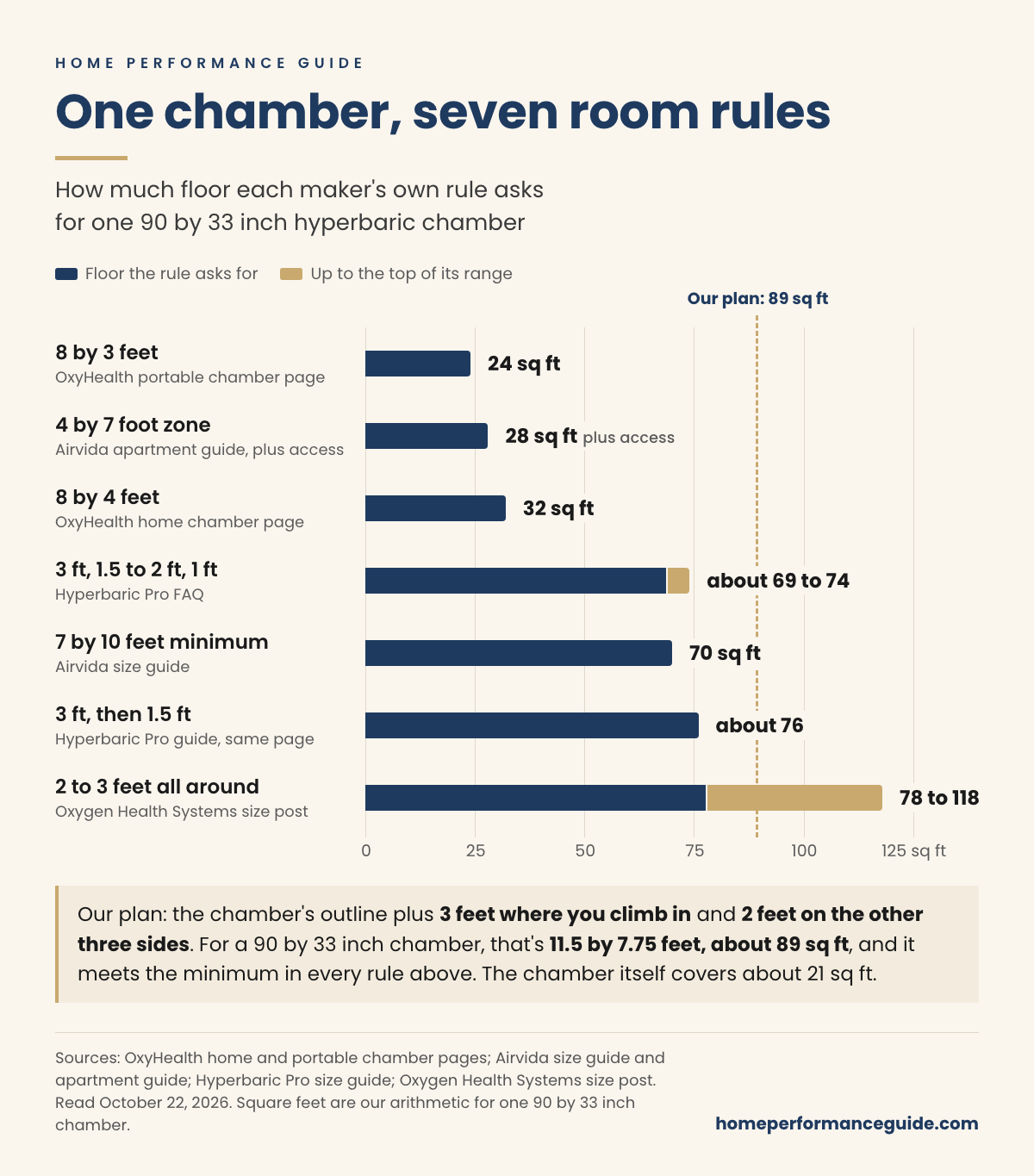
The makers' own room rules don't agree. For that one chamber, they run from 24 to about 118 square feet, by our arithmetic, and three makers contradict their own figures. The layout above meets the minimum in every rule we read.
On October 22, 2026, we read what eight chamber makers publish on size, weight, power, delivery and returns, plus the pages of four Summit to Sea sellers.
Quick picks
Choose by the room you have, then check the ceiling and the floor.
- Best for a spare bedroom: Summit to Sea Dive. Why: 33 inches across and 90 inches long, with two compressors, and Summit to Sea's homepage says it works on "a standard 120V 15 AMP outlet." Compromise: Summit to Sea publishes no room size, clearance or noise figure, and one seller's listing also gives 30 inches across. Buy from a seller on its distributor list: returns run through the reseller.
- Best for a basement with a 7 foot ceiling: any lying chamber, or the Oxygen Health Systems (OHS) Vertical Mini to sit up. Why: OHS lists it at 65 inches tall, which leaves 19 inches under 7 feet, by our arithmetic. As of October 22, 2026, the regular price is $10,900. Compromise: an 18 inch wide door.
- Best for a garage: Summit to Sea Grand Dive. Why: Summit to Sea says it weighs about 50 pounds and stores in its carry case, so it can come indoors whenever the garage leaves the maker's 40 to 80 degree storage range. Compromise: setting it back up after each pack-away, which Recovery Room Direct puts at 15 to 20 minutes.
- Best for an apartment or an upper floor: OxyNova 5. Why: 22 inches across, the narrowest chamber we read, at 24 pounds. Compromise: a hose OxyNova gives as both 9 feet and 2.5 meters, so plan the compressor within 8 feet, by our arithmetic.
- Best for a big room with an 8 foot ceiling: Summit to Sea Grand Dive Vertical. Why: 60 inches across and 7 feet tall, with room for a chair inside. Compromise: two sellers list it smaller, and Summit to Sea's homepage and manual disagree on how many compressors it ships with.
Skip a hard sitting shell upstairs until a structural engineer has the numbers. By our arithmetic, Airvida's Elite and OxyRevo's Space60 load about 94 to 107 pounds per square foot before anyone sits in them, against 30 for a bedroom.
See the Vertical Mini at Oxygen Health Systems
Based on the makers' own documents. Prices as of October 22, 2026.
Below: the floor first, then the ceiling for the two tall uprights, the floor load for hard shells, and the doors on the way in. Or skip to our picks by room.
Hyperbaric chamber room requirements: whose rule sets the floor space?
No maker publishes a complete room spec, so the floor space you plan depends on whose page you read. Only three makers give a room size at all, and each one contradicts itself.
OxyHealth's home chamber page says its 90 inch Vitaeris 320 "needs approximately 8 feet of length and 4 feet of width." Its portable chamber page says "approximately 8 feet by 3 feet when inflated," and both pages carry a September 17, 2026 update date. That second line covers the Quamvis 320 too, which OxyHealth lists at 100 inches long.
Airvida's size guide, posted July 13, 2026, asks for "a minimum 7×10 ft clear space" for a soft chamber. Its apartment guide, three days later, says "as little as 4 by 7 feet," and elsewhere in the same post, "about 7-8 feet long and 4-5 feet wide." Hyperbaric Pro, the catalog site of Oxygen Health Systems, gives two different clearance rules on one page.
Find the source you've seen in the first column, then read across: the last column is the room it asks for, worked out for the same 90 by 33 inch chamber.
On a phone, swipe the table to see every column.
| Whose rule | What it says | Room for a 90 by 33 inch chamber, by our arithmetic |
|---|---|---|
| OxyHealth portable page (maker) | 8 by 3 feet, for its 90 inch Vitaeris 320 | 24 sq ft |
| OxyHealth home page (maker) | 8 by 4 feet, for the same chamber | 32 sq ft |
| Airvida apartment guide (maker) | a 4 by 7 foot zone plus 2 feet of access | 28 sq ft plus access, and 7 feet is shorter than the chamber |
| Peak Primal (Summit to Sea distributor) | add 24 inches to the length and at least 18 to the diameter | 9.5 by 4.25 feet, about 40 sq ft |
| Airvida size guide (maker) | 7 by 10 feet minimum | 70 sq ft |
| Hyperbaric Pro FAQ (Oxygen Health Systems catalog) | 3 feet on the access side, 1.5 to 2 opposite, 1 at each end | about 69 to 74 sq ft |
| Hyperbaric Pro guide, same page | 3 feet on the access side, 1.5 on every other side | about 76 sq ft |
| Oxygen Health Systems size post (maker) | at least 2 to 3 feet on all sides | about 78 to 118 sq ft |
| Recovery Room Direct (Summit to Sea distributor) | 2 to 3 feet at each end | 11.5 to 13.5 feet long |
The chamber itself covers about 21 of those square feet, by our arithmetic. The rest is clearance, and clearance is where the rules split.
So plan to a layout that meets the minimum in every rule above. Take the chamber's outline at full pressure, then add 3 feet on the side or end you climb in from and 2 feet on the other three. For the Dive, that's 11.5 by 7.75 feet, about 89 square feet, by our arithmetic. It falls short only of the upper ends of the Oxygen Health Systems and Recovery Room Direct ranges.
Keep the 3 feet on the zipper side. Four of Summit to Sea's eight manuals say "Always have someone outside the chamber to assist you," so the room needs standing space for a second person by the zipper and the compressors.
The zipper also decides which wall the chamber can sit against. Summit to Sea's Shallow Dive, Dive and Grand Dive have "Double sided full length zippers," so either long side can go to the wall, and Newtowne offers "Top or Side zipper placement" on its A4-27. No maker publishes how much room a zipper side needs, which is why the 3 feet goes there.
How big is a hyperbaric chamber? Sizes and the room each one needs
The soft lying chambers we read list lengths from 78 to 108 inches, and 90 inches is the most common. Widths run from 22 to 60 inches across. Uprights trade floor for height, and Hyperbaric Pro puts verticals at "roughly 4 by 4 feet."
Find the type you want, then read the last column: it's the floor to clear under the 3 foot and 2 foot layout above, by our arithmetic.
On a phone, swipe the table to see every column.
| Chamber | Type | Size the maker lists | Weight the maker lists | Room to clear, by our arithmetic |
|---|---|---|---|---|
| OxyNova 5 | soft, lying | 22 in across, 87 in long | 24 lb | 11 ft 3 in by 6 ft 10 in, about 77 sq ft |
| Summit to Sea Shallow Dive | soft, lying | 26 in across, 84 in long | not published | 11 ft by 7 ft 2 in, about 79 sq ft |
| Summit to Sea Dive | soft, lying | 33 in across, 90 in long | not published | 11 ft 6 in by 7 ft 9 in, about 89 sq ft |
| OxyHealth Quamvis 320 | soft, lying | 32 in across, 100 in long | not published | 12 ft 4 in by 7 ft 8 in, about 95 sq ft |
| Summit to Sea Grand Dive | soft, lying | 40 in across, 90 in long | about 50 lb | 11 ft 6 in by 8 ft 4 in, about 96 sq ft |
| Summit to Sea Dive Vertical | soft, upright | 40 in across, 85 in tall | not published | 8 ft 4 in by 7 ft 4 in, about 61 sq ft |
| OHS Vertical Mini | soft, upright | 55 by 35 in, 65 in tall | 29 lb chamber, 134 lb system | 8 ft 7 in by 7 ft 11 in, about 68 sq ft |
| Summit to Sea Grand Dive Vertical | soft, upright | 60 in across, 7 ft tall | not published | 10 ft by 9 ft, 90 sq ft |
For the Vertical Mini, we put the 3 feet on a long side, since Oxygen Health Systems doesn't say which face the door is on.
Check the length against your height, too. Hyperbaric Pro's guide says to plan "at least 8 inches of clearance beyond your height," so a 6 foot 2 inch buyer needs about 82 inches, by our arithmetic. For anyone over six feet, the same guide says to "confirm interior length of at least 88 inches." The table gives the lengths the makers list, which may not be the inside length, so a tall buyer should ask for the inside length before ordering the 84 inch Shallow Dive or the 87 inch OxyNova 5.
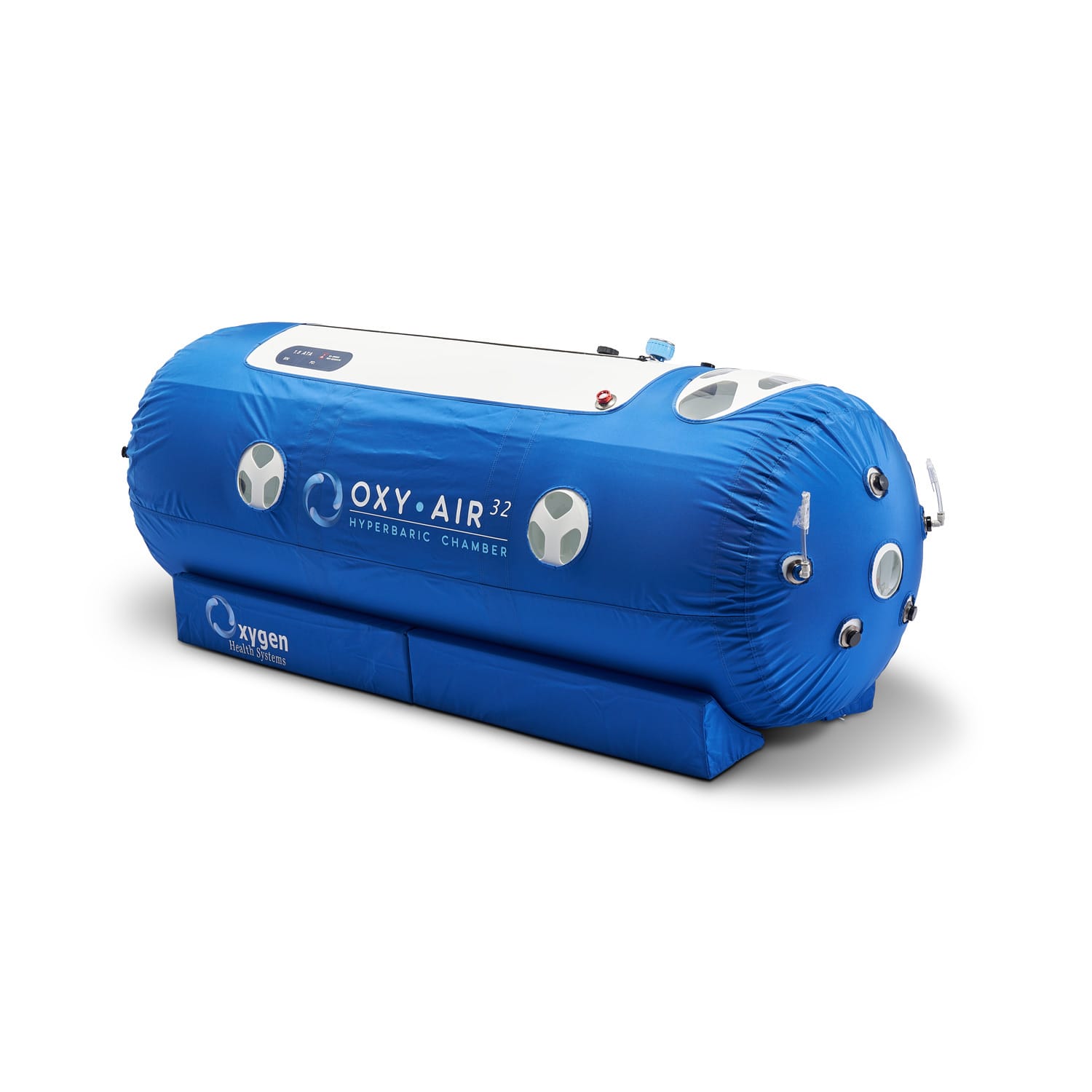
A narrower chamber saves less floor than you might expect. The OxyNova 5 is 11 inches narrower than the Dive, and its room is only about 12 square feet smaller, by our arithmetic. An upright saves more: the Dive Vertical's room is about 28 square feet smaller than the Dive's, by our arithmetic.
Checkpoint: the floor. If you can clear 11.5 by 7.75 feet, every 90 inch soft lying chamber up to 33 inches across is on your list, the Summit to Sea Dive included. In a smaller room, your shortlist is the OxyNova 5, Summit to Sea's Shallow Dive or an upright that clears your ceiling. Settle the floor before you compare anything else.
Will a vertical chamber clear your ceiling?
Under an 8 foot ceiling, every chamber we read fits, on the heights the makers list. Under a 7 foot basement ceiling, two don't: Summit to Sea's Dive Vertical, listed at 85 inches tall, and its Grand Dive Vertical, listed at 7 feet.
Find your ceiling in the column headings, then read down: a row at zero or below doesn't fit.
On a phone, swipe the table to see every column.
| Chamber | Height the maker lists | Room left under an 8 ft ceiling, by our arithmetic | Room left under a 7 ft ceiling, by our arithmetic |
|---|---|---|---|
| Summit to Sea Dive Vertical | 85 in | 11 in | 1 in short, does not fit |
| Summit to Sea Grand Dive Vertical | 7 ft (84 in) | 12 in | 0 in, does not fit in practice |
| Airvida Chair Pro | 77 in | 19 in | 7 in |
| OHS MC4000U walk-in | 66 in | 30 in | 18 in |
| OHS Vertical Mini | 65 in | 31 in | 19 in |
| OHS Vertical Ultra | 62 in (its intro says 6 ft) | 34 in (24 in at 6 ft) | 22 in (12 in at 6 ft) |
| Airvida Elite (hard shell) | 61 in | 35 in | 23 in |
| Newtowne Tent | 58 in, frame 60.5 in | 35.5 in under the frame | 23.5 in under the frame |
| Newtowne Shoe | 42 in | 54 in | 42 in |
Two 8 foot rules ask for more than any of these models needs. Hyperbaric Pro's size guide says "Vertical sitting and walk in chambers need ceiling height of 8 feet at minimum, and 9 feet for some taller models," while its own catalog lists the 65 inch Vertical Mini. Recovery Room Direct, a Summit to Sea distributor, writes "Summit to Sea asks for at least 8 feet of ceiling clearance for the Dive Vertical." Summit to Sea's homepage and the manual text we could extract carry no such line.
Airvida's hard-shell rules don't agree with each other. Its size guide gives "Ceiling height: 8 ft minimum" for a hard shell, while its apartment guide says hard shells "need 6+ feet of ceiling clearance." By our arithmetic, the 61 inch Elite clears a 7 foot ceiling, so before an Airvida hard shell goes into a 7 foot basement, ask Airvida in writing which rule applies.
What this means for you: under a true 8 foot ceiling, the Dive Vertical leaves 11 inches, and Hyperbaric Pro's "6 inches of clearance for top venting" still leaves 5, by our arithmetic. Under 7 feet, skip both Summit to Sea uprights and sit up in a chamber under 6 feet tall instead, such as the OHS Vertical Mini.
Measure to the lowest thing overhead, not the ceiling. Airvida's size guide is the only maker text we read that mentions what hangs there: "no ceiling fans overhead." Summit to Sea's text we read doesn't say whether the Dive Vertical's 85 inches includes its floor system, so ask.
Don't plan the Grand Dive Vertical to the 6.5 feet two of its sellers list. Summit to Sea says 7 feet, and the Grand Dive Vertical pick below sets out what to confirm. The Dive Vertical needs the same care: Game Room Empire's listing gives its height as both 80 and 85 inches, and at 80 it would seem to clear a 7 foot ceiling. Plan to Summit to Sea's 85.
Can your floor carry a hard shell hyperbaric chamber?
A soft chamber loads a floor lightly. A hard shell can load it at more than three times a bedroom's design figure, by our arithmetic.
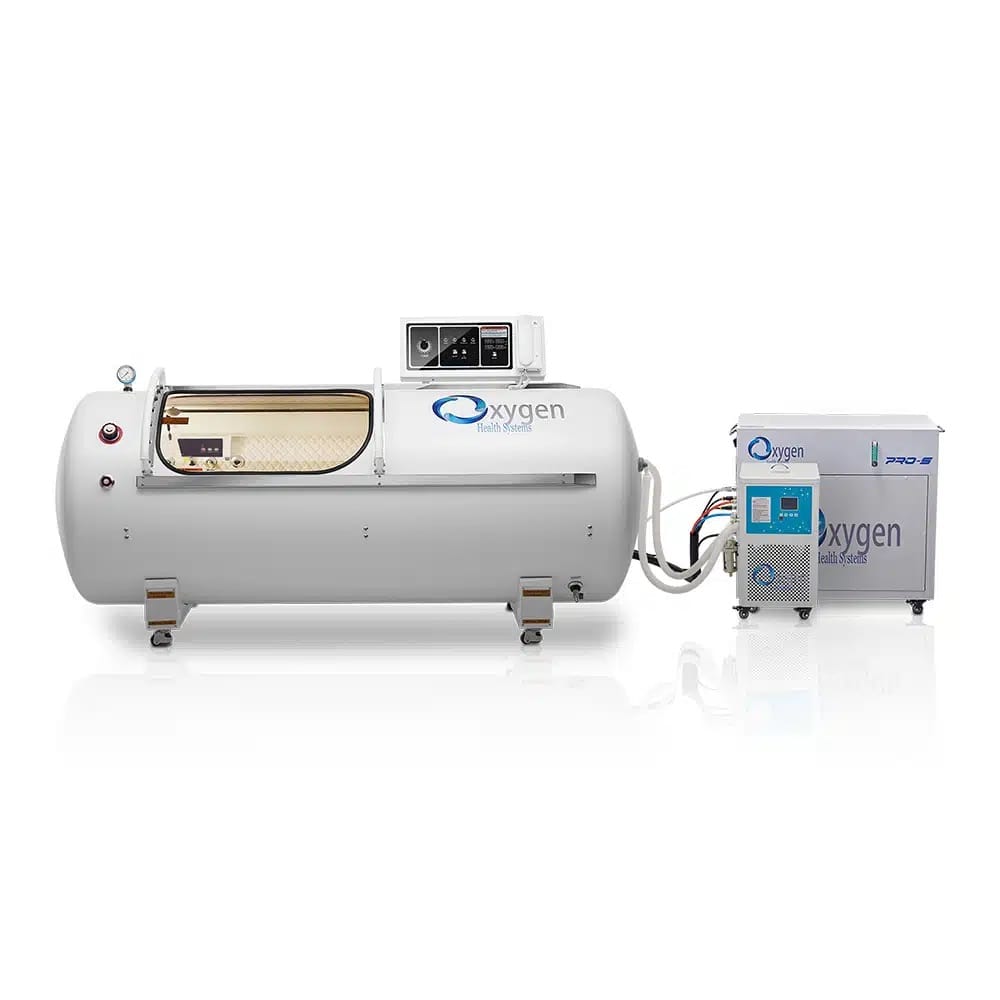
Most soft chambers weigh 24 to 95 pounds on their listings, and Airvida's Chair Pro is 199 pounds with its "metal base and frame." Spread over their footprints, that's about 2 to 7 pounds per square foot (psf), by our arithmetic.
Hard shells are another matter. Our cold plunge floor load guide screens floors against the International Residential Code's live loads in section R301.5: 30 psf for sleeping rooms and 40 psf for other rooms. That guide checked both figures against state adoptions and secondary sources rather than ICC's own text.
Find the chamber, then set its psf columns against 30 for a bedroom or 40 for another room: a higher number means a structural engineer should check the floor before you order.
On a phone, swipe the table to see every column.
| Chamber | Weight the maker lists | Footprint | psf empty, by our arithmetic | psf with a 250 lb person, by our arithmetic |
|---|---|---|---|---|
| Airvida Elite (hard, sitting) | about 2,000 lb, recliner included | 79 by 34 in | 107.2 | 120.6 |
| OxyRevo Space60 (hard, sitting) | 1,760 lb | 79 by 34 in | 94.4 | 107.8 |
| OxyHealth Fortius 420 (hard, lying, marketed as clinical) | 1,250 lb | 91 by 45 in | 44.0 | 52.7 |
| Airvida Ultra 36 (hard, lying) | 772 lb, the upper figure | 89 by 36 in | 34.7 | 45.9 |
| OxyRevo Quest30 (hard, lying) | 507 lb | 89 by 30 in | 27.3 | 40.8 |
| Macy-Pan HP2202-75 (hard, lying) | 150 kg (331 lb) | 87 by 30 in | 18.2 | 32.0 |
| Oxygen Health Systems 30 in (hard, lying) | 306 lb | 88 by 30 in | 16.7 | 30.3 |
| Airvida Chair Pro (soft) | 199 lb | 66 by 66 in | 6.6 | 14.8 |
| Summit to Sea Grand Dive (soft) | about 50 lb | 90 by 40 in | 2.0 | 12.0 |
The 250 pound person is our assumption, not a maker figure.
Two details change how you read it. OxyRevo's hard shells stand on "4 x Solid Wheels," so the weight lands on four points, while the code figures assume an even spread. The operating unit sits apart, too: Airvida's Elite unit is 242 pounds on a 32 by 16 inch base, about 68 psf on its own, by our arithmetic.
The makers' size guides don't match their own heavy listings, so screen your floor with the model's own listed weight. Airvida's guide gives hard shells as "300-1,200+ lbs," while its own Elite is listed at "~900 kg / 2000 lbs (including recliner chair)." Hyperbaric Pro says 40 inch hard shells reach "200 to 300 pounds" in one step of its guide, and "400 to 600 pounds" for 36 to 40 inch shells a few sections later.
Hyperbaric Pro's line that "Standard residential flooring supports 40 pounds per square foot" matches the code figure for rooms other than bedrooms, so in a bedroom, screen against 30.
Airvida's Elite and OxyRevo's Space60 list the same 200 by 86 by 153 centimeters, with different weights: about 2,000 pounds with a recliner for the Elite, 1,760 for the Space60. Plan to the heavier figure until the seller tells you in writing what its number includes.
The short version: for a soft chamber, the floor isn't the deciding number. For any hard shell, send the maker's weight, footprint and wheel layout to a structural engineer before you order, wherever it's going. The lightest per square foot we read is the 30 inch hard shell from Oxygen Health Systems, at 16.7 psf empty and about 30 with that 250 pound person inside, by our arithmetic.
Will it fit through your doors and up the stairs?
For a soft chamber, the route comes down to the box. For a hard shell, the narrowest door decides, and the makers disagree about a 32 inch door.
Summit to Sea doesn't publish its shipping carton sizes. Its support page sizes the boxes customers use for returns: 30 by 24 by 12 inches for the Shallow Dive and 48 by 24 by 12 for the Dive, Dive Vertical and Grand Dive. The Grand Dive Pro and Pro Plus take a 36 by 30 by 16 inch box.
Recovery Room Direct says the Shallow Dive "is the only chamber in the range narrow enough to pass a typical 28 or 30 inch interior doorway without being repacked." If a door on your route is 30 inches or narrower, ask the seller for the carton size before you order.
For hard shells, Airvida's size guide says "A 34-inch diameter chamber does not fit through a standard 32-inch interior doorway." Yet the Elite's catalog lists it at 79 by 34 by 61 inches. The same catalog offers setup for pre-assembled hard shells delivered to a ground or first floor, with 32 to 38 inches of door clearance required, without saying which figure applies to the Elite. Oxygen Health Systems says its 34 inch steel chamber "is sure to fit through most doorways."
Confirm before you order: plan to Airvida's rule, that a 34 inch shell won't pass a 32 inch door, and measure every door and turn on the route. Ask the seller in writing for the shell's outside width as it ships, and whether delivery includes bringing it into the room.
By our arithmetic, the 30 inch shells, such as Airvida's Ultra 30, OxyRevo's Quest30 and Macy-Pan's HP2202-75, are narrower than a 32 inch door. That holds only if the listed diameter is the outside one, and only OxyHealth publishes both: its Fortius 420 is 42 inches inside and 45 inches wide outside.
Stairs are the next limit. Hyperbaric Pro says "Hard shell chambers above 200 pounds rarely make it up residential stairs without professional movers." Airvida's catalogs add a crane charge when a chamber has to go above ground level with no service elevator, an amount that "will vary depending on your city and the size of the chamber."
OxyHealth sells a split chamber, the Fortius 420 EXP, that it says "Fits standard doorways," but it doesn't publish the size of a section. If a hard shell has to go upstairs, get the movers' or crane quote in writing before you order, plus the section size if it's the EXP.
No hard-shell maker publishes how far its door swings or how much room it needs in front. The only figures are guidance: Airvida's guide asks for "36-inch clearance on all sides," 4 feet on the door end and at least 8 by 12 feet of floor for a hard shell. Plan to those until the maker gives you its own number.
Where do the compressors, hoses and concentrator go?
Beside the chamber, within reach of the hose, and only two makers say how far that is. OxyHealth lists a 10 foot hose with its soft chambers. OxyNova lists a "9 ft (2.5 m) hose," and 2.5 meters is about 8.2 feet, by our arithmetic, so plan the compressor within 8 feet.
Summit to Sea's FAQ describes "Two compressors with separate hoses" but gives no hose length, and its eight manuals list no compressor size in the text we could extract. Oxygen Health Systems lists its soft-chamber compressor at 15 by 9.5 by 10.2 inches. Hard shells bring a bigger box: Airvida's operating unit is 32 by 16 by 36 inches, and Macy-Pan's all-in-one machine is 30 by 18 by 26.
Give whichever box you get room to breathe. Hyperbaric Pro's guide asks for "12 to 18 inches of wall clearance for air intake" behind a compressor and says to avoid closets "where heat builds up."
A concentrator is a second box, and sellers disagree on whether a Summit to Sea chamber needs one. Da Vinci Medical's Summit to Sea pages say "O2 Generator required. Must be a 10LPM @ 20 PSI to work with this chamber." Summit to Sea's manuals say "Do not inflate the chamber with only pure oxygen; use the compressor provided." Recovery Room Direct, on Summit to Sea's distributor list, says "No oxygen concentrator is included, none is required."
Confirm before you order: plan the room around Summit to Sea's own kit, compressors only, and ask Summit to Sea in writing whether its chamber needs a concentrator. Da Vinci's listings offer a "Da Vinci 10LPM Oxygen Generator" option, with no published size or weight. As of October 22, 2026, the regular price is $1,997 more than the chamber alone. If Da Vinci won't square its line with the manual in writing, buy any Summit to Sea pick from a seller on Summit to Sea's distributor list.
If a concentrator does join the setup, give it its own spot. The DeVilbiss 1025DS that Game Room Empire offers as an option is 42 pounds and 24.5 by 13.5 by 12 inches, per Drive. Drive's manual says to keep it "a minimum of 12 inches (30.5 cm) away from any wall" and "DO NOT operate the unit in a closed or confined space, such as a closet."
A concentrator also takes an outlet of its own, which is why OxyHealth plans "two outlets near your chamber location," although no OxyHealth kit lists a concentrator.
Will your room's temperature, flooring and noise work?
No chamber maker we read publishes an operating temperature range. OxyHealth asks for "a clean, dry, well-ventilated room," and the closest thing to a number is Summit to Sea's storage line: keep the chamber "in a dry area between 40 and 80 degrees."
Guidance fills the gap. Hyperbaric Pro's guide flags rooms below 65°F for the concentrator, and rooms above 78°F because they "can trigger automatic shutoff." For a garage, Recovery Room Direct says "We would ask about an uninsulated garage or attic in a hot climate before you order," and Airvida's guide says hard shells need "climate control."
So in a garage that runs hot or cold, choose a soft chamber you can pack away, and store it indoors whenever the garage leaves Summit to Sea's 40 to 80 degree range.
The makers disagree on carpet. Airvida's size guide prefers a "Flat, hard surface" and says to "avoid thick carpet," while Oxygen Health Systems says "Carpets are fine; just avoid uneven flooring." Drive's concentrator manual asks for "a hard surface, avoid thick rugs or carpeting." Plan to the stricter line: a flat, hard floor under the chamber and the concentrator.
Summit to Sea's manuals add "ENSURE the chamber is on a stable platform or on the floor," and the Grand Dive Vertical comes with its own "Floor system" and "Carpet," per its manual.
Published sound levels include Macy-Pan's "≤ 45 db," OxyRevo's "≤50 dB," Airvida's "<50 Db," the "< 55 db" Oxygen Health Systems gives for its compressor, and OxyNova's "LESS THAN 60 DB (A)." None says how far from the machine it measured, so the figures can't be compared. Summit to Sea, OxyHealth and Newtowne give no decibel figure at all. If the chamber will share a wall with a bedroom or a neighbor, ask for the sound level in dB and the distance it was measured at.
Can your outlet run it?
For a Summit to Sea chamber, the maker's answer is a standard outlet. As of October 22, 2026, Summit to Sea's homepage says every model "Works on a standard 120V 15 AMP outlet," including the Grand Dive Pro Plus with its four compressors.
Peak Primal, a Summit to Sea distributor, writes that "Dual-compressor units in particular benefit from a dedicated 20-amp circuit." Summit to Sea publishes no wattage, so ask it for one and give that number to your electrician with everything else on the circuit. Its Grand Dive manual adds: "Don't use an outlet controlled by a light switch."
Other makers publish bigger numbers. Oxygen Health Systems lists its soft systems at 1,460 watts lying and 1,560 watts upright, about 13 amps at 120 volts for the upright, by our arithmetic. One of its 34 inch hard shells, the 34 inch 1.5 ATA model, carries "Two 20 Amp circuits required" in its title, and Airvida lists its Elite at "120 V / 240 V (30 Amp)." Hyperbaric Pro's guide says most home chambers "pull 200 to 300 watts," against its own catalog's 1,460 and 1,560.
What this means for you: a Summit to Sea chamber goes on a 15 amp outlet that isn't on a light switch, and a hard shell needs an electrician before you order. Our guide to hyperbaric chamber electrical requirements sets out each maker's circuit figures.
Which hyperbaric chamber to get for your room
Picture the spare bedroom on a weeknight after dinner, with the lamp on. The Dive lies along the long wall, inside the 11.5 by 7.75 feet you taped out, its zipper facing the open floor. Its two compressors sit on the hard floor by the outlet, each with its own hose to the chamber. You pull the zipper open along its full length.
Summit to Sea Dive: for a spare bedroom
Get the Dive if your spare room clears 11.5 by 7.75 feet, by our arithmetic. Summit to Sea lists it at 33 inches across and 90 inches long, with two compressors and "Double sided full length zippers," so either long side can go to the wall. Its homepage says it "Works on a standard 120V 15 AMP outlet," and its warranty covers "parts and labor" for "two years from delivery date." As of October 22, 2026, the regular price is $9,995.
- Best for: a spare bedroom with at least 11.5 by 7.75 feet of clear floor, such as the 10 by 12 foot room Peak Primal uses as its example.
- Skip it if: your clear floor is less than 7 feet 9 inches wide; the OxyNova 5 needs 6 feet 10 inches, and the Shallow Dive 7 feet 2 inches, by our arithmetic.
- Main compromise: Summit to Sea publishes no room size, clearance, hose length, weight or noise figure for the Dive in the documents we read, so you plan on other makers' rules.
Game Room Empire's Dive listing opens with "a 30 inch diameter and 90 inch length" and gives 33 inches lower down. Plan to Summit to Sea's 33 inches, and ask your seller which figure its listing means. Buy from a seller on Summit to Sea's distributor list, since its 15-day return runs through the reseller. Game Room Empire and Da Vinci Medical, which both list the Dive, weren't on that list when we checked on October 22, 2026.
OHS Vertical Mini: for a basement with a 7 foot ceiling
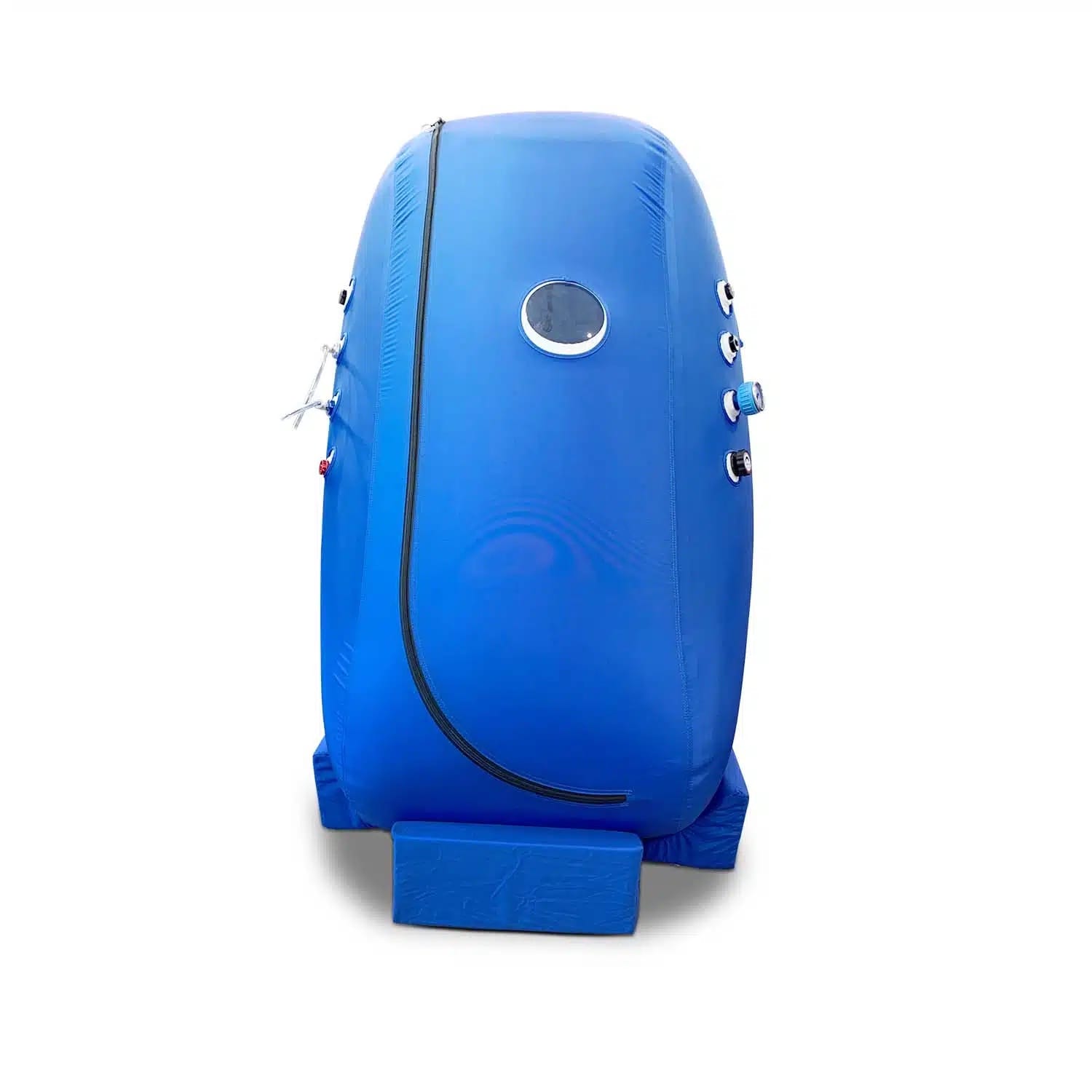
Any lying chamber fits under a 7 foot ceiling. If you want to sit up, start with the Vertical Mini: Oxygen Health Systems lists it at 65 inches tall, which leaves 19 inches under 7 feet, by our arithmetic. As of October 22, 2026, the regular price is $10,900. The whole system weighs 134 pounds on OHS's listing.
- Best for: a basement or any room under 7 feet where you want to sit up, with about 8 feet 7 inches by 7 feet 11 inches of clear floor, by our arithmetic.
- Skip it if: the circuit you'd use already carries other loads, since OHS lists the system at 1,560 watts.
- Main compromise: a door OHS lists as "18″ Wide x 40″ Tall."
The listing gives three sizes. Its intro says "29 inch wide by 55 inch deep and a height of 5′ 4″," one spec block gives 55 by 29 by 65 inches inflated, and a second gives 55 by 35 by 65. Plan to 35 inches wide and 65 tall, the larger figures, and ask OHS which one is the chamber at full pressure.
See the Vertical Mini at Oxygen Health Systems
Summit to Sea Grand Dive: for a garage
In a garage, temperature is the first question, and no chamber maker we read publishes an operating range. Get the Grand Dive if your garage leaves Summit to Sea's 40 to 80 degree storage range for part of the year.
Summit to Sea says it "Weighs approximately 50 pounds," and its manuals say to store it in its carry case, so it can come inside between uses. It's 40 inches across and 90 inches long, on two compressors. As of October 22, 2026, the regular price is $13,995.
- Best for: a garage with about 11 feet 6 inches by 8 feet 4 inches of clear floor by our arithmetic, and an outlet off any light switch, as the Grand Dive manual asks.
- Skip it if: you want to leave a chamber set up year-round in a garage that runs below 40 or above 80 degrees.
- Main compromise: setting it back up after each pack-away. Recovery Room Direct says "setup runs about 15 to 20 minutes from deflated."
Game Room Empire's Grand Dive listing gives a "90 inch height." Summit to Sea lists 90 inches as its length, lying down, so plan your floor to that.
Compare the Summit to Sea chambers
OxyNova 5: for an apartment or upper floor
Our pick for the tightest apartment is the OxyNova 5. At 22 inches across and 87 inches long, it's the narrowest chamber we read, and OxyNova lists it at 24 pounds. OxyNova says "Anyone can install and disassemble," with no special tools, and backs it with a "Lifetime Warranty, for both personal and commercial use." OxyNova prints no price: its store listing says "Login to see price."
Upstairs, plan on a soft chamber. Airvida sets up pre-assembled hard shells on a ground or first floor and charges extra for a crane above ground level when there's no service elevator. And don't plan to the "4 by 7 feet" in Airvida's apartment guide: 7 feet is shorter than this chamber.
- Best for: an apartment or upper-floor room with about 11 feet 3 inches by 6 feet 10 inches of clear floor, by our arithmetic.
- Skip it if: you want to sit up; it's a lying chamber.
- Main compromise: its hose, which OxyNova gives as both 9 feet and 2.5 meters, so the compressor sits within 8 feet, by our arithmetic. Its "LESS THAN 60 DB (A)" comes with no distance.
If you'd rather buy Summit to Sea, its narrow model is the Shallow Dive, at 26 inches across and 84 long. Recovery Room Direct, a Summit to Sea distributor, says it passes a 28 or 30 inch door without being repacked.
Summit to Sea Grand Dive Vertical: for a big room with an 8 foot ceiling
If you have the floor and an 8 foot ceiling, start with the Grand Dive Vertical. Summit to Sea lists it at 60 inches across and 7 feet tall, and its manual's included items name a frame, a floor system and carpet. There's room for a chair inside: the manual says to place it on its side and slide it "through the middle of the zipper at the widest opening." As of October 22, 2026, the regular price is $17,995.
- Best for: a room with at least 10 by 10 feet of clear floor and a ceiling of 8 feet or more. Recovery Room Direct gives 10 by 10 as this model's minimum and recommends 12 by 12.
- Skip it if: your ceiling is 7 feet or lower.
- Main compromise: Summit to Sea's own documents disagree on how many compressors come with it.
Our 3 foot and 2 foot layout gives 10 by 9 feet, by our arithmetic, so the distributor's 10 by 10 is the stricter number to tape out.
Confirm before you order: Game Room Empire lists the Grand Dive Vertical at "6.5 feet tall" with a 54 inch base, and Da Vinci Medical describes a 6 1/2 foot tall interior with a 54 inch base. Summit to Sea says 7 feet tall and 60 inches across, and that 54 inch figure now turns up as a Google search suggestion. On compressors, Summit to Sea's homepage says three, its manual's "WHAT IS INCLUDED" list says "2 Compressors," and Recovery Room Direct says four.
Plan to 7 feet, 60 inches and floor space by the outlet for three compressors, and ask Summit to Sea in writing for the height, the base and the compressor count. With that answer in hand, the Grand Dive Vertical is ready to order. Until then, hold the order.
Check the Summit to Sea manuals
What it costs to get the chamber into the room
Game Room Empire and Da Vinci Medical list Summit to Sea's seven models at the same prices as Summit to Sea's own table. As of October 22, 2026, the regular price is $7,995 to $21,995. That table is dated June 2025 and was still posted on October 22, 2026. As of October 22, 2026, the shipping price it lists is $275 to $700 within the 48 contiguous states.
Delivery can stop short of the room. Game Room Empire's free shipping option is "curbside," so line up the help to carry the box in. Recovery Room Direct says its Summit to Sea orders "ship LTL, free to the contiguous 48, and the carrier requires a delivery appointment," with "3 to 5 weeks from order to delivery" typical.
Build the paperwork into the date, too. Summit to Sea's FAQ says "All of our chambers require a prescription," and Recovery Room Direct says its lead time starts once that is cleared, not at checkout.
Having the chamber placed for you can cost extra. Airvida's catalogs offer professional install for its soft chambers, with a checklist that covers "Proper placement to walls, ventilation, window exposure." As of October 22, 2026, the regular price is $1,999.
Airvida's Elite page says the chamber comes "delivered, installed, and ready," yet its store also sells a separate Elite delivery, setup and training listing. As of October 22, 2026, the regular price of that listing is $3,999. Ask which applies before you order the Elite. For the Elite itself, as of October 22, 2026, the regular price is $49,999, and a sale was running.
OxyHealth's Fortius 420 travels by "dedicated medical freight," and OxyHealth says installation "typically takes 4-8 hours." For the full price picture, chamber by chamber, see what a home hyperbaric chamber costs.
What to confirm with the maker and the seller before you order
First, check who's selling. Game Room Empire and Da Vinci Medical both list all seven Summit to Sea models, and neither appeared on Summit to Sea's distributor list when we checked on October 22, 2026. That matters for returns, because Summit to Sea's 15-day return runs through "the Summit to Sea reseller you purchased your product from."
The return terms disagree. Summit to Sea calls its policy an "unconditional return policy": within 15 days of delivery, the reseller refunds the chamber "minus original shipping charges," and you pay to ship it back. Da Vinci Medical's policy says "we're not able to accept standard returns," and exchanges "may be subject to a restocking fee of up to 25%." Game Room Empire's product pages repeat Summit to Sea's 15 days, while its sitewide policy gives a "30-day window from the ship date" with restocking fees and return shipping.
Plan as if you can't send it back until the seller confirms Summit to Sea's 15 days in writing. That puts the room check before the order.
Other makers are narrower. Airvida takes returns within 30 days only with "no signs of any setup," so you can't inflate one to test the fit, and it charges a 10% restocking fee. As of October 22, 2026, Oxygen Health Systems' soft chamber listings add a 25% restocking fee and a $250 handling fee to a return within 15 days. On the Vertical Mini at its $10,900 regular price as of October 22, 2026, that's $2,975 before shipping, by our arithmetic.
The warranty differs by seller, too. Summit to Sea warrants its chambers for "two years from delivery date," and "The warranty covers parts and labor." Da Vinci lists a "2-Year Warranty on Parts," so ask whether labor is covered when you buy there.
Send these questions to the maker or the seller before you order, and keep the answers:
- Are you an authorized Summit to Sea reseller, and does Summit to Sea's 15-day return apply to my order?
- How much clearance does this chamber need, on which sides, and how long is each compressor hose?
- What are the Grand Dive Vertical's height and base diameter at full pressure, and how many compressors ship with it?
- Does the Dive Vertical's 85 inch height include its floor system?
- Does this chamber need an oxygen concentrator, and if so, what are its size and weight?
- How many watts does the full system draw, and does it need its own circuit?
- What is the sound level in dB, and at what distance was it measured?
- For a hard shell: What is the outside width as it ships, what does the full system weigh, what ceiling height do you require, and is delivery into the room included or extra?
- What are this chamber's width and length at full pressure, and its carton size as it ships?
- Does the warranty cover labor as well as parts?
If a seller won't answer in writing, buy from one on Summit to Sea's distributor list, and plan to the maker's own numbers.
Buying for a business? A gym, spa or clinic isn't a home, and the fire rules change. Minnesota's State Fire Marshal says mild hyperbaric chambers and the places that house them "must comply with the applicable provisions of NFPA 99, Chapter 14," the hyperbaric chapter of the health care fire code. Idaho's State Fire Marshal asks for the same, including rules "related to fire suppression, fire alarms, and emergency planning." In Des Moines, the fire department stopped a soft chamber at one business and "required that it be removed from the building" (its 2024 appeal memo).
Idaho's bulletin says it "does not apply" to private one and two-family homes, which is who this guide is for. If the chamber is going into a business, call your local fire marshal before you buy and ask which rules they enforce.
Before you order
- Tape out the chamber's outline at full pressure, plus 3 feet on the side you climb in from and 2 feet on the others. For the Dive, that's 11.5 by 7.75 feet, by our arithmetic.
- Measure from the floor to the lowest thing overhead. Under 7 feet, skip both Summit to Sea uprights; to sit up there, the Vertical Mini fits: See the Vertical Mini at Oxygen Health Systems
- For a hard shell, send the maker's weight, footprint and wheel layout to a structural engineer, and measure every door and turn on the route.
- Mark the compressor spot within reach of the hose, and leave 12 inches around a concentrator, out of any closet.
- Check the outlet: not on a light switch, and checked by an electrician for any hard shell. Our electrical guide lists each maker's circuit figures.
- Send the questions above in writing, and keep the answers with your order.
- Then order the chamber your room passed. For a spare bedroom, that's the Dive: See the Summit to Sea lineup
Common questions
How big is a hyperbaric chamber?
The soft lying chambers we read list 78 to 108 inches long, most often 90, and 22 to 60 inches across. Sitting and upright soft chambers run from 41 to 85 inches tall in the makers' spec blocks. Hard sitting shells such as Airvida's Elite and OxyRevo's Space60 are 79 by 34 inches and 60 to 61 inches tall.
How much room do you need for a hyperbaric chamber?
For a 90 by 33 inch chamber, the published room rules run from 24 to about 118 square feet, by our arithmetic. Plan to the chamber's outline plus 3 feet on the entry side and 2 feet on the others: 11.5 by 7.75 feet, about 89 square feet, by our arithmetic. That layout meets the minimum in every room rule we read.
What ceiling height does a hyperbaric chamber need?
On the heights the makers list, every chamber we read fits under an 8 foot ceiling. Under 7 feet, Summit to Sea's Dive Vertical, at 85 inches, and its Grand Dive Vertical, at 7 feet, don't fit, by our arithmetic. Measure to the lowest thing overhead, ceiling fans included.
Can a hard shell hyperbaric chamber go upstairs?
Only after a structural engineer has seen the numbers. By our arithmetic, the hard shells we read load a floor at about 17 to 107 pounds per square foot empty, against the 30 psf the code gives for a sleeping room. That 30 psf comes from state adoptions and secondary sources rather than ICC's own text. Airvida sets up pre-assembled hard shells on a ground or first floor and charges extra for a crane above ground level when there's no service elevator.
Does a hyperbaric chamber need a dedicated circuit?
For a soft chamber, Summit to Sea and OxyHealth point to a standard outlet. As of October 22, 2026, Summit to Sea's homepage says every model "Works on a standard 120V 15 AMP outlet," and OxyHealth says "No special wiring, dedicated circuits, or electrician visits are required." Hard shells ask for more: Oxygen Health Systems lists "Two 20 Amp circuits required" for its 34 inch 1.5 ATA hard shell, and Airvida lists "120 V / 240 V (30 Amp)" for its Elite.
How much does a hyperbaric chamber weigh?
Most soft chambers we read list 24 to 95 pounds, and Airvida's Chair Pro is 199 pounds with its metal base and frame. A full soft system weighs more: Oxygen Health Systems lists its Vertical Mini system at 134 pounds. Hard shells run from 306 pounds for Oxygen Health Systems' 30 inch to about 2,000 pounds for Airvida's Elite, recliner included.
How loud is a hyperbaric chamber?
Published figures include Macy-Pan's "≤ 45 db" and OxyNova's "LESS THAN 60 DB (A)," and none of the makers says how far from the machine it measured. Summit to Sea, OxyHealth and Newtowne give no decibel figure. In a condo, or next to a bedroom, ask the seller for the sound level and the distance it was measured at before you order.
Your next step
Tonight, tape out the chamber and its clearances where it would go, and measure from the floor to the lowest thing overhead. Then measure the narrowest door between the front door and that room, and photograph the outlet you'd use.
The free Home Performance Room Planner is written for sauna and cold plunge rooms, but its room and electrical measurements apply to a chamber too.
Get the free Home Performance Room Planner
Once the room checks out, our hyperbaric chamber guides cover the circuit and the cost in more detail.
We read the makers' own documents cited above, checked October 22, 2026, and did not test these chambers. This is general information, not medical, electrical or code advice, so confirm the details with the maker and a structural engineer. Home Performance Guide earns a commission on our Oxygen Health Systems links, at no extra cost to you. The other makers' links on this page earn us nothing (affiliate disclosure, editorial standards).
Get the Room Planner.
Thirteen measurements to take before you buy sauna or recovery equipment, with the manufacturer specs and code references behind each one. Free. Planning a golf simulator instead? There is a twelve-measurement golf planner too.
ABOUT
Verified buyer guides for home sauna, cold plunge and recovery equipment. Specs from the manufacturers, not from other blogs.